Court of Miracles outcasts
The Hunchback of Notre DameThe Court of Miracles outcasts are a community of vagabonds who turn their shared marginality into collective action. Under Clopin Trouillefou, they organize to reclaim Esmeralda from the threat of execution, arguing that the protection of a condemned woman and the sacredness of Notre-Dame Cathedral stand or fall together. Their assault is both a rescue attempt and a challenge to the competing authorities that govern medieval Paris.
Identity and Setting
Part of the Court of Miracles occupied an old city wall, where a ruined tower had been converted into a gathering place. The tower’s cellar served as a tavern, while its upper stories were used for other purposes; it remained active at night even when much of the surrounding outcast quarter had gone quiet. The setting gives the group a recognizable center, but the narrative presents it as a crowded, improvised refuge rather than a formal civic institution.
The band includes men, women, and children, and is associated with the names Argot, Egypt, and Galilee. Its members are described as outcasts, thieves, and vagabonds, but the scene of assembly also shows their capacity to act together. When Clopin calls for ranks, the crowd forms into a column. The narrative emphasizes how quickly a scattered multitude can become an organized force.
Authority and Sanctuary
The outcasts live within a city divided among overlapping authorities. In fifteenth-century Paris, the City, the Town, and the University each had distinct privileges and governing institutions; the bishop, the provost of the merchants, and the Rector held authority in their respective districts, while the royal Provost of Paris ruled over the whole. Disputes over jurisdiction could shape where a person was tried and punished, and local privileges had sometimes been secured through revolt and mutiny.
Church sanctuary offered another form of jurisdiction. A fugitive who entered an asylum was protected, but safety depended on remaining within its bounds: outside the sanctuary, the ordinary penalties again threatened. Although a parliamentary decree could sometimes override asylum, armed seizure was treated as a serious violation. This precarious protection is central to the outcasts’ appeal. They say Esmeralda has taken refuge in Notre-Dame Cathedral and accuse the authorities of allowing the Parliament to seize her there.
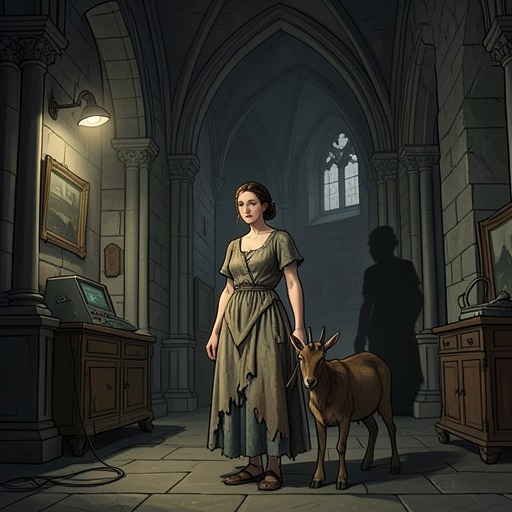
Esmeralda’s immediate danger gives that dispute its urgency. She has been sentenced to death on charges that include sorcery and crimes against Phoebus de Châteaupers; her sentence also condemns her goat, Djali. The outcasts call her their sister and describe her conviction as false. Their argument does not rest only on whether the sentence is just: they contend that the church owes her asylum and safety, and that the sanctuary’s protection must mean something in practice.
Organization and Collective Action
At midnight, Clopin’s call sends the outcasts out of the tavern in a mass, carrying weapons and old iron implements. In the darkness, he orders them to form ranks, and the crowd appears as a column. The narrative later stresses that his orders are carried out with silence and precision. Their discipline is therefore not incidental to the attack: it allows a large, loosely described population to act under a leader and pursue a common objective.
Clopin speaks from the church square to Louis de Beaumont, bishop of Paris. He presents the conflict as an exchange of obligations: if the church is sacred, so is the woman who has sought shelter there. He demands that the bishop return Esmeralda to the outcasts, warning that otherwise they will take possession of her again and pillage the church. As a sign of their claim, Clopin plants their banner between the paving stones. The threat is direct, but its stated grounds are the protection of a member of their community and the defense of sanctuary.
Assault on Notre-Dame Cathedral
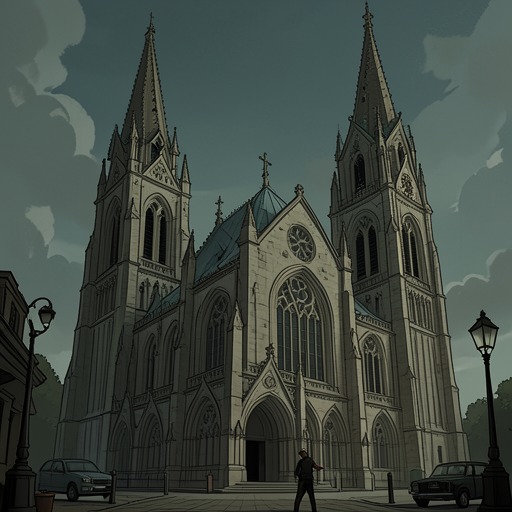
The standoff becomes an assault after the death of a scholar in the struggle. That loss intensifies the crowd’s anger, as does its humiliation at having been held back for so long by Quasimodo. The outcasts find ladders, knot ropes, and climb by the projecting stonework; some use the carvings, while others pull themselves upward by clinging to one another. They approach the church from several sides, turning the façade into the focus of a mass attack.
Quasimodo cannot hear Clopin’s address, and the assault places him in the position of defending Notre-Dame Cathedral while fearing for Esmeralda. As the attackers advance, he is shown overwhelmed by the scale of the force. The episode’s contrast is stark: the outcasts’ coordinated ranks and shared purpose meet the solitary resistance of the hunchback. Their action is powerful, but the crowd’s anger also makes the rescue bid more destructive and less controlled.
Local Conflict and Narrative Significance
Elsewhere, the outcasts are identified as vassals of the bailiff, yet they have long complained about him and refuse to recognize him as either judge or officer responsible for the highways. This detail places their rebellion within everyday disputes over jurisdiction as well as the exceptional crisis surrounding Esmeralda. They are subject to local authority, but contest the right of its officer to judge or regulate them.
When Louis XI hears that they are the bailiff’s vassals and reject his authority, he responds with a satisfaction he tries to conceal. The account does not make that reaction an alliance between the king and the outcasts; instead, it reveals how their challenge to a local official can please a monarch who stands above that official. The group’s position is thus neither simply outside the law nor securely protected by it. Their episode brings communal loyalty, church sanctuary, local jurisdiction, and royal power into direct collision, while showing how a community treated as marginal can briefly act with collective force.