Djali's alphabet
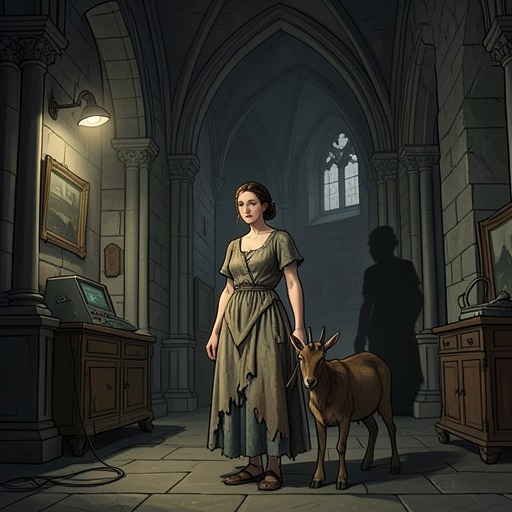
The Hunchback of Notre DameDjali's alphabet is a portable set of small boxwood letter blocks carried in a bag around the Goat’s neck. Its decisive appearance comes when the Goat arranges the letters to spell Phoebus’s name before the household at Fleur-de-Lys’s home. What might have remained a trained performance becomes an involuntary-looking disclosure: the letters make Esmeralda’s association with Phoebus legible to Fleur-de-Lys and everyone who gathers around them.
Form and Handling
The alphabet consists of separate letters, each inscribed on a tiny block of boxwood. They are kept together in a bag fastened to the Goat’s neck, so the object is both a carried accessory and a collection that can be brought out and rearranged. The scene makes its physical components precise: the bag is detached, its contents are emptied onto rush matting, and individual blocks become available for the Goat to move.
Bérangère has coaxed the Goat into a corner with a marchpane cake, and the two have become friends while the others remain unaware. The child then opens the bag and spreads the blocks on the floor. The alphabet thus enters the scene through a small act of curiosity, not through a planned demonstration before the company. Its ordinary, manipulable form matters: the word will be made from pieces everyone can see, one block moved after another.
The Goat’s Performance
Once the blocks are spread out, the Goat draws certain letters toward itself with its golden hoof and pushes them into an order. The movement is described as sure and unhesitating, as though the animal has been trained to form this particular word. The alphabet supplies the visible means of the feat, while the Goat’s practiced handling supplies its apparent wonder; the account presents the event as a marvel without explaining how the training was accomplished.
Bérangère notices the result first and calls Fleur-de-Lys to look. The blocks have formed PHOEBUS. The child’s exclamation turns a quiet discovery in the corner into a spectacle, and the assembled adults and young women hasten to see what the Goat has done. The alphabet is not merely displayed: its rearrangement produces a word that can be read immediately by the witnesses.
The Name and Its Effect
The word is the captain Phoebus’s name. Fleur-de-Lys runs toward the letters and trembles before asking whether the Goat wrote them. Bérangère confirms that it did. The confirmation fixes the scene’s meaning for the people present: the arrangement is not an unintelligible trick but a legible name, and the captain himself is among those gathered to witness it.
Esmeralda sees the blocks and turns red, then pale; she trembles before Phoebus as though she were a culprit. Phoebus, by contrast, regards her with satisfaction and amazement. Fleur-de-Lys calls attention to Esmeralda’s marvellous memory, interpreting the act as evidence that she knows the captain’s name. The alphabet has made that knowledge public without Esmeralda having to announce it herself.
Exposure and Narrative Significance
For Fleur-de-Lys, the spelling confirms what she calls the secret. Her response shifts quickly from startled recognition to anguish: she bursts into sobs, hides her face, and faints. She first calls Esmeralda a magician, then hears the more painful conclusion that Esmeralda is her rival. The alphabet therefore changes the emotional meaning of the gathering. A child’s discovery and a Goat’s performance expose a conflict that had not been openly stated in the room.
The blocks do not explain the relationship or prove more than the scene shows: they spell Phoebus’s name, and Esmeralda’s bodily reaction and Fleur-de-Lys’s interpretation give that spelling its force. Its effect comes from the contrast between the small, playful apparatus and the distressing consequence of its public message. After Fleur-de-Lys faints, her mother cries out for her daughter and orders Esmeralda away. The alphabet’s brief arrangement has thus redirected the household’s attention from amusement to accusation and separation.