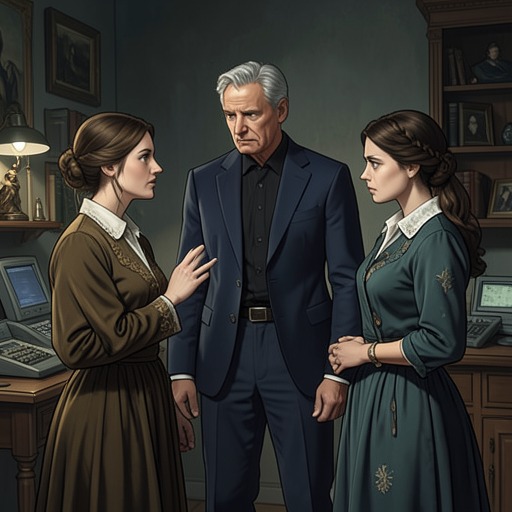
Esmeralda’s infatuation with Phoebus
The Hunchback of Notre DameEsmeralda’s infatuation with Phoebus turns a public summons into a revealing encounter: she abandons her dance at his call, endures the disdain of the high-born women around him, and can scarcely bring herself to leave. Her feelings are vivid in her gestures and gaze, while Phoebus treats their connection as a passing amusement. The contrast makes her devotion both tender and painfully unequal.
The Call and Her Recognition
When Phoebus calls from a balcony, Esmeralda is not beating her tambourine. She turns toward the voice, fixes her brilliant eyes on him, and stops. At his repeated summons and beckoning, she makes her way through the astonished spectators to the house, holding her tambourine under her arm. The narrator compares her slow, tottering approach to that of a bird yielding to a serpent’s fascination. The image gives her movement an involuntary, vulnerable quality: she seems drawn forward even as the comparison makes the attraction ominous.
A moment later, Esmeralda appears at the chamber threshold, blushing, confused, and breathless, with her eyes lowered. Phoebus frames the reunion as a question about whether she recognizes him. She interrupts with a smile and says, “Oh! yes.” Fleur-de-Lys remarks that she has a good memory. Esmeralda’s prompt recognition, and the sweetness with which it is conveyed, establish that Phoebus matters to her far more than she matters to him. Her attention answers his self-regarding performance before he has offered any tenderness in return.
Phoebus recalls that she escaped “the other evening” and asks whether he frightened her. Esmeralda answers, “Oh! no.” The narrator emphasizes the intonation: following her “Oh! yes,” it contains something ineffable that wounds Fleur-de-Lys. The two brief replies thus carry more emotional weight than their literal meaning. Esmeralda communicates an attachment that the other woman perceives, while Phoebus treats the exchange as playful conversation.
Devotion in a Hostile Room
Phoebus describes the earlier attempt to carry Esmeralda off and ridicules Quasimodo, calling him one-eyed and hunchbacked and mocking the names associated with the church bellringer. Esmeralda says she does not know why he wanted her. The passage places her earlier danger inside Phoebus’s banter, not as a subject he seriously investigates. His attention shifts quickly to his own mockery, while Esmeralda remains fixed on him; the disparity clarifies how little mutual understanding underlies her feelings.
The young women then subject the dancer to laughter, sarcasm, condescension, and malicious scrutiny of her spangled, tinsel-decorated clothing. The narration likens their treatment to golden pins thrust into a beautiful slave’s breast and to grayhounds circling a fawn. Esmeralda registers the insults: shame flushes her, anger flashes in her eyes and cheeks, and she makes a familiar grimace. Yet she remains motionless and looks at Phoebus with sadness, sweetness, and resignation. The account explicitly joins happiness and tenderness to that gaze, suggesting that her attention to him persists not because the room is kind, but despite its cruelty. Her endurance also seems shaped by the fear of being expelled.
Phoebus laughs and takes her part with a mixture of impertinence and pity. He tells her to let the others talk and calls her charming despite her allegedly extravagant appearance. His defense offers momentary relief, but it also keeps him in control of the encounter: he can dismiss the women’s insults as readily as he has made light of the danger she faced. Esmeralda’s response is not described as a verbal argument; instead, after Colombe de Gaillefontaine speaks and Phoebus replies carelessly, she raises her lowered eyes, now beaming with joy and pride, and looks at him again. The change in her expression registers how powerfully a slight word from him affects her, even when he gives it without evident deliberation.
The Reluctant Departure
The encounter ends without a promise or a declaration between them. The older dame angrily asks what Esmeralda and her goat are doing there if neither can dance for the company. Esmeralda walks toward the door without answering, but her pace slows as she approaches it. The narration presents an irresistible magnetic force holding her back. She turns tear-wet eyes toward Phoebus and stops. The image transforms the earlier movement toward him into its reverse: even when leaving, she cannot easily break the pull of his presence.
Phoebus calls her back and asks her name. Still looking at him, she answers, “La Esmeralda.” The young women burst into wild laughter at the name, and Diane calls it a terrible one for a young lady. Esmeralda’s final words therefore expose her to another round of ridicule, but the scene locates their emotional significance in the unbroken gaze with which she speaks them. Her attachment is established through a chain of observable responses—stopping at his voice, recognizing him, enduring humiliation while watching him, brightening at his careless reply, and halting on her way out. The scene gives no equivalent evidence of Phoebus’s devotion; its decisive contrast is between the intensity of Esmeralda’s response and the casualness with which he summons, teases, and dismisses her.