Fate and destiny
The Hunchback of Notre DameFate and destiny are presented as forces that seem to overtake human intention, but not as a simple excuse that erases responsibility. Claude Frollo describes events as having passed beyond his command, while the course of those events remains bound to his own decisions. After Esmeralda’s condemnation, his reflections make that tension central: the catastrophe appears to him both fated and self-made, an inescapable outcome of choices he does not regret.
Fate and the Prosecution
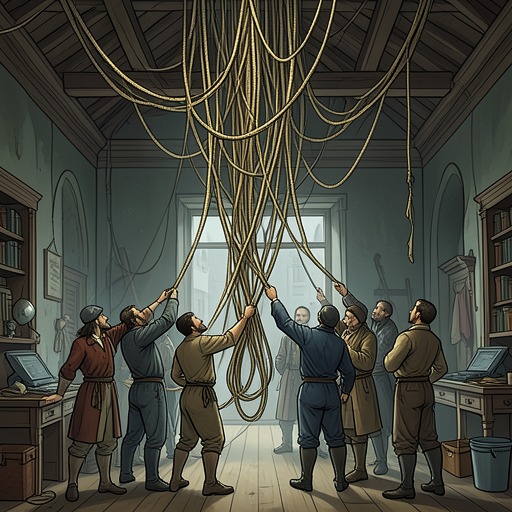
Claude Frollo recalls believing that a trial would place Esmeralda in his power. He denounced her, imagining that he could decide whether to pursue or abandon the prosecution. Even as he recounts this, he presents his design as a structure he had built and then watched become uncontrollable: he thought himself powerful, but fate, in his account, proved stronger. His language of machinery gives the conflict a stark shape. The danger was not an abstract force arriving from nowhere; it was a process he had set in motion, which then carried Esmeralda toward a result he could no longer reverse.
His recollection also distinguishes intention from consequence. He says that he hesitated and might have renounced his plan, but describes the evil thought as pressing toward action. That claim makes fatality feel psychologically persuasive without making his conduct inevitable in any objective sense. He had imagined himself able to stop the prosecution, and his later account of fate grows out of the gap between that confidence and what followed. Destiny names his experience of losing control; the narrative still keeps his initiating acts in view.
A Life Recast as an Intersection
After fleeing the Grève, Claude Frollo looks back on the intertwined paths of his and Esmeralda’s lives. He imagines fate bringing their two destinies to a point of intersection and dashing them together without mercy. The image turns their story into a collision, but his reflection does not detach that collision from the people involved. He sees Esmeralda as someone he has destroyed, even as he thinks of her as the person who destroyed him. His account therefore joins reciprocal ruin to an unequal distribution of power and consequence: she faces execution, while he understands himself as spiritually damned.
The retrospective passage widens into a series of counterfactuals. Claude Frollo imagines that a peaceful life with Esmeralda might have been possible if she had not been a gypsy, if he had not been a priest, and if Phoebus had not existed or she had loved him. These conditions are imagined alternatives, not events that occurred. Their accumulation shows how he tries to locate the catastrophe in the circumstances that separated him from the life he desires. Yet the imagined happiness cannot undo the choices he actually made, and his longing sharpens rather than resolves his sense of fatality.
Fate as Self-Examination and Accusation
In the countryside, Claude Frollo examines the beliefs and commitments that had ordered his life. He meditates on the apparent vanity of vows, chastity, science, religion, and virtue, and on the uselessness of God. The passage records the conclusions of a mind in crisis, not a general ruling that these commitments are meaningless. His attention turns inward: he recognizes his hatred and malevolence as corrupted love, and sees his vocation as having intensified the conflict between passion and religious identity. Fate thus becomes entangled with self-judgment. He can describe himself as caught in a terrible design, yet he also identifies his own passion and choices as part of its making.
That self-knowledge does not lead to repentance. Claude Frollo says that he does not regret what he has done and would do it again, even while admitting that he suffers. This refusal matters to the novel’s treatment of destiny: his anguish is not presented as proof that he has changed course or withdrawn his earlier actions. He experiences the consequences as relentless, but continues to affirm the will that helped produce them. Fate may describe the force of the outcome; it does not turn his lack of remorse into innocence.
The Narrowing of the Future
As his thoughts circle around Esmeralda’s likely execution, Claude Frollo imagines that the chain he saw earlier may be closing around her. He sets her first appearance, lively and dancing, against the condemned figure he imagines approaching the gallows. This contrast makes time itself feel like an irreversible passage from one state to another. The woman who once seemed full of movement and possibility is now joined, in his mind, to the instrument of her death; the future has narrowed to the outcome he fears and helped bring about.
His surroundings continue their ordinary activity while his inner life becomes increasingly disordered. He sees small creatures, moving clouds, the spire of Saint-Victor, and a mill turning in the distance. Their continuing, organized life contrasts with his sense that everything within him has collapsed. By sunset, he can hold only two distinct images in his mind: Esmeralda and the gallows. Their imagined growth into a radiant figure and a vast, horrifying structure gives his perception the force of a private, distorted vision—not evidence that fate has taken supernatural form.
Meaning and Limits of Fatality
The passage ultimately presents destiny less as a settled doctrine than as the way Claude Frollo interprets the consequences of his own history. He describes the prosecution as a machine he built, the lovers’ lives as paths forced into collision, and Esmeralda’s fate as an outcome that now seems impossible to prevent. At the same time, his own recollections preserve the points at which intention, hesitation, and choice mattered. His claim that fate overtook him coexists with his admission that he helped create the conditions of the disaster.
That contradiction gives the motif its tragic weight. Claude Frollo neither escapes the consequences nor accepts responsibility in a way that would lead to repentance. He keeps his desire fixed even as his imagined future contracts to Esmeralda and the gallows. Fate, in these scenes, is therefore both the name he gives to overwhelming consequence and the pattern through which the novel exposes how a person’s chosen actions can come to feel like an unavoidable destiny.