Feast of Fools of 1482
The Hunchback of Notre DameThe Feast of Fools of 1482 joined a religious solemnity to a crowded public festival in Paris on January 6. It opens the novel not with a celebrated political event but with a city in motion: bells ring across its three urban divisions, people converge on competing spectacles, and a planned performance is overtaken by the audience’s appetite for something else.
Date and Setting
The event took place on January 6, 1482, when Epiphany and the Feast of Fools were observed together. The narrator gives the date an emphatically ordinary historical standing: the bells had set Paris in a ferment, but the day itself was not one history had preserved as remarkable. Its importance in the novel comes instead from the crowd and the public performances that draw it together.
The bells sounded throughout the three distinct parts of Paris: the City on the island, the University on the left bank, and the Town on the right. These were not merely neighborhoods with different characters. Each had its own privileges and governing authority, while the royal provost of Paris stood above the separate jurisdictions. The opening peal thus reaches across a city divided in law and administration, summoning its inhabitants into shared public space.
The festivities were announced the previous evening at the crossroads by the provost’s men, dressed in short violet coats marked with large white crosses. On the feast day, citizens closed their houses and shops and chose among three advertised attractions: a bonfire on Place de Grève, a maypole at the Chapel of Braque, or a mystery play in the Grand Hall of the Palais de Justice. The crowd favored the bonfire and the indoor play; the maypole, with its sparse flowers, was left exposed to the January sky.
The Crowd and the Grand Hall
The Grand Hall drew particular interest because the Flemish ambassadors, who had arrived two days earlier, were expected both at the mystery play and at the election of the Pope of the Fools. Their diplomatic mission concerned the marriage alliance between Marguerite of Flanders and the Dauphin, giving the performance an audience that included visitors from beyond Paris as well as the local crowd.
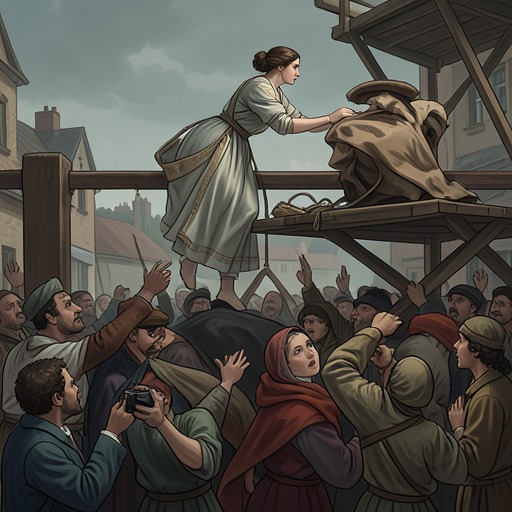
The press of spectators made entry difficult. Outside the palace, the gathering spread into the square like a rising sea, fed by people pouring from several streets. The grand staircase carried streams of people up and down, dividing at its landing before flowing along both sides. Cries and laughter swelled with the movement; when officials or their horses tried to force order, the crowd’s current briefly recoiled and churned. The festival’s audience was itself a spectacle, but also a force difficult for civic authority to manage.
The Play and the Proposed Election
The mystery play was Pierre Gringoire’s work. After an interval of commotion, the audience waited quietly when Gringoire revealed himself as its author and promised that the performance would begin at once. That pause displays the precariousness of his authority: the crowd could be loud and unruly, yet the promise of an imminent beginning temporarily held its attention.
The performance did not keep that attention for long. Jacques Coppenole, a hosier, objected that the actors’ quarrel consisted of words rather than blows and that the play was not entertaining. He contrasted it with the Feast of Fools as he knew it in Ghent, where participants took turns making grimaces through an opening and the ugliest face won the election by acclamation. He proposed this contest as a livelier way to choose a Pope of the Fools, and the audience welcomed the idea. Gringoire, whose play had briefly commanded the hall, could only watch the crowd’s enthusiasm turn elsewhere.
Place in the Narrative
The feast establishes public attention as something unstable and contested. The mystery play, the election, the bonfire, and the maypole compete for spectators; within the hall, Coppenole’s proposed face-making contest displaces Gringoire’s authored performance. The novel’s opening therefore makes the festival more than a calendar occasion: it stages the distance between a creator’s intended work and the crowd’s shifting appetite.
The day also brings together religious observance, civic organization, diplomatic ceremony, and popular amusement without erasing their differences. The ambassadors’ presence lends the hall an international and political dimension, while the separate authorities and crowded streets reveal the divided structure of Paris. The Feast of Fools begins the story through a collective gathering whose energy no single performance—or official arrangement—can fully control.