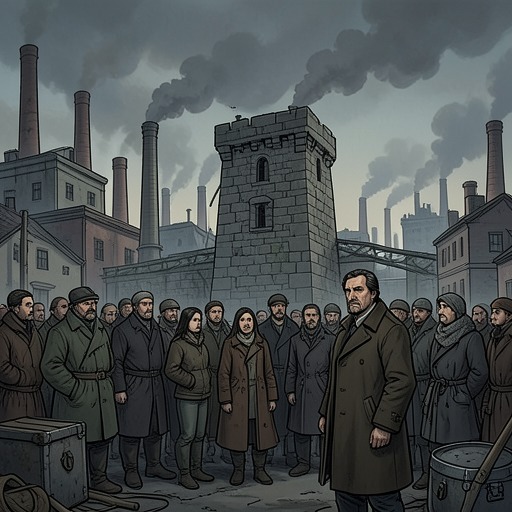
Feudal fragmentation and royal centralization
The Hunchback of Notre DameFeudal fragmentation and royal centralization is the political and legal tension that shapes the novel’s account of medieval Paris: authority is divided among numerous lords and institutions, while Louis XI presses toward a kingdom governed by a single sovereign power. The conflict appears not as an abstract constitutional debate but in the city’s streets, privileges, sanctuaries, and rival claims to judge and punish. Paris is at once a shared urban body and a patchwork of jurisdictions that repeatedly frustrates any simple exercise of royal control.
A City Divided by Jurisdiction
In the fifteenth-century arrangement described in the novel, Paris consists of three distinct divisions: the City on the island, the Town on the right bank of the Seine, and the University Quarter of Paris on the left bank. Each has its own character and institutions. Churches concentrate in the City, palaces in the Town, and colleges in the University Quarter of Paris. Their legal authorities are divided as well: the island belongs to the bishop, the right bank to the provost of the merchants, and the left bank to the Rector, while the provost of Paris stands above them as a royal rather than municipal official. These arrangements place ecclesiastical, civic, academic, and royal power beside one another without merging them.
The account makes that division concrete through the city’s uneven geography. Paris began on the island, bounded by the Seine, then expanded across the river and beyond successive walls as the growing mass of houses overwhelmed its earlier limits. Yet three separately governed districts still form one connected city. Long streets run through all three, crossing the river by bridges and carrying people between them; viewed from the towers of Notre-Dame Cathedral, the whole appears as one crowded expanse, even as its constituent parts retain distinct authorities. Urban connection does not erase legal division: the same streets that bind Paris together pass through territories in which different institutions claim power.
The resulting jurisdictional tangle reaches well beyond the three principal divisions. During the confrontation around Notre-Dame Cathedral, the narrative explains that Paris contains 141 lords claiming a manor and 25 claiming both a manor and the right to administer justice. The bishop’s jurisdiction alone extends over 500 streets, while the Prior of Notre-Dame des Champs claims four. Each authority asserts control over roads, so that the city has many competing systems of regulation rather than one effective police power. The scale of these overlapping claims helps explain why an act of public violence against a residence or church could occur without a single, dependable authority intervening at once.
Privilege, Courts, and Contested Punishment
The novel’s examples show that jurisdiction determines not only who rules a neighborhood but where an accused person is tried and punished. Offences committed by scholars in the University Quarter of Paris are tried in courts on the island and punished at Montfauçon, unless the Rector intervenes. The University’s privilege of jurisdiction is not presented as a gift of orderly royal administration: privileges of this kind, the narrator observes, had often been wrested from kings through revolts and mutinies. Royal power yields ground under pressure, and the concession itself becomes another layer in the city’s legal patchwork.
A dispute over the bailiff’s authority makes this patchwork visible at street level. The people of the Cour des Miracles are described as the bailiff’s vassals, yet they complain of him and refuse to recognize him as either judge or voyer, the official responsible for highways. His claimed jurisdiction covers a specified collection of streets and localities, thirteen residences, the Cour des Miracles, the Maladerie, and the road running from there to the Porte Sainte-Jacques. Within those bounds he claims authority over roads and justice at every level, as well as the position of a full lord. The people’s resistance is therefore directed at a particular set of powers: control of movement, legal judgment, and lordship are bundled together in the bailiff’s claim, but the people dispute that claim’s legitimacy.
Sanctuary introduces another jurisdictional boundary. Churches, royal palaces, and princely residences may serve as places of asylum, where a fugitive who has entered is protected from ordinary punishment. That protection is conditional: leaving the sanctuary returns the fugitive to the reach of the law, while a solemn decree of Parliament can, on rare occasions, override asylum and deliver the condemned person to execution. The narrator emphasizes both the refuge’s real force and its limits. It can shelter someone for years, yet it may also function as a prison, since safety depends on remaining within its bounds. The story’s sentence against Esmeralda likewise records the court directing that her punishment take place when it pleases the king, showing royal authority entering the wording and timing of a judicial penalty without making the wider system appear unified.
Louis XI and the Limits of Centralization
Louis XI is associated with an effort to break the network of seigneuries by imposing rules across the city. In 1465, orders require inhabitants to place candles in their windows at nightfall, keep their dogs shut up, close streets with iron chains in the evening, and refrain from carrying weapons at night. The measures reach into household routine, street access, and public safety: they are attempts to make rules apply beyond the jurisdiction of any one lord. But their practical authority soon decays. Residents allow the candles to go out and the dogs to roam; chains are extended only during a siege; and the weapon prohibition produces little more than a change in the name of a street. The failure is not that the crown issues no commands, but that it cannot consistently make a city of competing powers obey them.
The king’s response to the bailiff’s extensive claims gives the drive toward centralization its clearest formulation. He objects to local lords possessing tollgates, courts, and executioners among his people, and longs for a France with only one king, one lord, one judge, and one headsman. Yet the scene also marks a limit on what can be openly said: after urging the people on against the false lords, he breaks off, checks himself, and warns that he would burn his hat if it knew what was in his head. The passage presents centralization as a desire voiced in anger and immediately restrained, not as a completed political settlement. The narrator places Louis XI’s effort within a longer historical dismantling of feudal power, later continued by Richelieu and Louis XIV and ultimately completed, in the narrator’s account, for the people’s benefit.
Political Meaning in the Story
The concept links the novel’s cityscape to its conflicts over justice and refuge. Paris’s three divisions can be seen from above as parts of one whole, but their authorities remain divided among bishop, Rector, merchant provost, royal provost, lords, and church institutions. A person’s exposure to punishment or access to protection depends on which boundary has been crossed and which authority asserts jurisdiction. Sanctuary offers a genuine alternative to ordinary justice, but its safety can be lost at the edge of its enclosure; academic privilege can redirect a case, but depends on a Rector willing to assert it; royal orders can seek uniformity, but fall into disuse when local practice resists them.
The result is more than a backdrop for the action. Fragmented authority makes Paris vulnerable to disorder while also limiting the crown’s ability to respond uniformly. The planned assault on Notre-Dame Cathedral takes place in a city where numerous powers overlap and where no single police authority reliably governs every street. Against that disorder, Louis XI’s wish for one supreme judge and lord promises coherence but also concentrates the powers of judgment and punishment. The novel holds the two conditions in tension: feudal division multiplies conflict and uncertainty, while centralization offers a remedy whose reach and consequences remain unsettled.