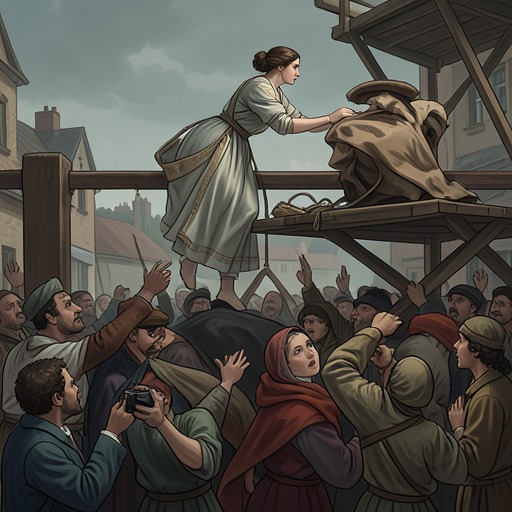
Jacques Charmolue
The Hunchback of Notre DameJacques Charmolue, the king’s procurator in the Ecclesiastical Court, serves as both a prosecutor in cases of alleged sorcery and a disciple of Claude Frollo in alchemical study. His scenes bring together the novel’s interest in medieval learning and its criticism of legal power: Charmolue can contemplate the symbolic meanings of Notre-Dame Cathedral’s carvings while also helping conduct proceedings that treat accusation, coercion, and punishment as instruments for establishing guilt.
Identity and Position
Charmolue enters as a man in black, gray and wrinkled, with a grave expression that Jehan, watching from concealment, first takes as belonging to a physician or magistrate. His face seems to carry a sweetness that the narrator characterizes as affected and treacherous. The description establishes an appearance of solemn authority, though Jehan’s skeptical view also punctures the dignity of the newcomer.
His title identifies him as the king’s procurator in the Ecclesiastical Court, also called the officiality. He is one of the officials involved in judging Esmeralda, rather than a detached observer of the trial. At the same time, his position belongs to a larger landscape of divided authority. Medieval Paris is described as three jurisdictions—the City, the University, and the Town—with separate authorities and privileges. The account notes, for example, that offenses by scholars on the left bank could be tried on the island and punished on the right bank, subject to the University’s privileges. This fragmentation gives the ecclesiastical proceedings against Esmeralda a particular institutional setting: legal authority is distributed among competing bodies rather than gathered into one uncomplicated system.
The novel’s account of sanctuary further clarifies that setting. Churches could protect those who reached asylum, but safety depended on remaining within the refuge; outside it, the machinery of punishment waited. Such protection did not erase the surrounding jurisdictions or their capacity to pursue a condemned person. Charmolue’s office represents one of the legal powers operating within this contested world, where church authority, royal officials, civic officers, and established privileges intersect.
Disciple of Claude Frollo
Charmolue approaches Claude Frollo deferentially. Frollo does not rise to receive him, instead directing him to a stool; their forms of address mark the difference between a teacher and a disciple. Charmolue waits through Frollo’s silences and answers with respect, a relationship that combines professional consultation with intellectual dependence.
Their conversation first turns to Charmolue’s search for the philosopher’s stone. He reports that the effort has yielded ashes rather than gold, and Frollo impatiently clarifies that he is asking about a prosecution, not alchemy. The exchange shows that Charmolue’s scholarly and legal pursuits occupy the same relationship with his mentor, even when Frollo insists on separating them.
The two also discuss the carved figures on Notre-Dame Cathedral. A royal procurator asks whether a portal depicts the opening of a work of physics and whether one of seven nude figures at the cathedral’s feet represents Mercury. Frollo attributes the interpretation to the Italian doctor Augustin Nypho and offers to explain it with the text before them. Later, Charmolue studies a carving of Job with Frollo, who connects the figure to the philosopher’s stone and to the trials required for its perfection. Charmolue’s attention to sculpture is therefore not incidental: he and Frollo read the cathedral as a repository of learned and alchemical meanings, and Charmolue follows his teacher’s interpretations with evident deference.
Prosecutions and Methods
Frollo asks Charmolue about the trial of Marc Cenaine, a butler of the Court of Accounts accused of magic. Charmolue reports that the accused has not confessed despite the court’s use of torture. He describes the man as unyielding and says that the authorities are sparing no effort to obtain what they call the truth. The account makes Charmolue a reporter of coercive procedure as well as a participant in the system that authorizes it; it does not establish that he personally administers the abuse in this case.
Charmolue also asks Frollo when he should apprehend Esmeralda. He identifies her as the dancer who comes to the church square despite an official prohibition, and presents her goat’s unusual abilities as evidence of demonic influence and grounds for prosecution. In his description, the goat can read, write, and perform mathematics. The charge expands from the dancer to her animal companion, reflecting a judicial culture willing to put an animal on trial for sorcery. The broader narrative notes earlier precedents for such cases, including the prosecution of a sow at Corbeil; the legal process does not treat an animal accused of witchcraft as an impossibility.
At the examination, Charmolue addresses Esmeralda with a sweet smile and asks whether she still denies the charges. She maintains her denial. When the court applies the screw-jack, Charmolue tells the official operating it to proceed, then asks whether she will confess. Under that pressure, Esmeralda gives the confession the court demands. The sequence makes clear that the confession is produced by coercion, not offered as an unpressured account. Charmolue’s conduct places him within the machinery of the examination, even though another official operates the device.
Judgment and the Cathedral Carvings
Charmolue presents the prosecution’s case in an elaborate Latin oration, delivered with emphatic gestures and extensive classical references, especially to Plautus. The narrative describes his performance but declines to reproduce the speech. Its form contrasts the apparent learning of the argument with the means by which the confession was obtained: rhetorical display supplies a polished public rationale for proceedings already shaped by force.
The judges vote without stating their reasons, and the sentence is read to Esmeralda. It orders public penance before the grand portal of Notre-Dame Cathedral and a subsequent execution at the Place de Grève. Her goat is also condemned, and the sentence imposes a monetary payment to the officiality. The decision bundles together accusations of sorcery, magic, debauchery, and the murder of Phoebus de Châteaupers, treating Esmeralda’s forced confession as the basis for a sweeping judgment. Charmolue is identified as the king’s procurator among the ecclesiastical officials involved in this process.
During the public penance, Charmolue becomes absorbed in a bas-relief on the cathedral’s portal. The scene associates the carving with two interpretations: the sacrifice of Abraham, or an alchemical operation in which the figures signify the sun, fire, and the artisan. A police sergeant has to draw Charmolue’s attention back to the condemned woman, after which he signals the executioners’ assistants to bind her again. His study of the relief interrupts the immediate business of carrying out the sentence. The episode sharply juxtaposes the learned gaze fixed on stone with the person awaiting punishment before it.
Narrative Role
Charmolue is drawn through a recurring contrast between interpretive learning and judicial practice. He searches for the philosopher’s stone, studies the symbolic program of Notre-Dame Cathedral with Claude Frollo, and gives his courtroom speech the apparatus of classical rhetoric. Yet his legal work concerns prosecutions in which alleged supernatural signs are treated as evidence, and his conduct at Esmeralda’s examination helps convert coercion into confession and then into a formal sentence.
The character also connects the novel’s ecclesiastical tribunal to a wider system of competing powers. The book describes church asylum as protection that can become confinement, and Parisian justice as divided among overlapping jurisdictions and privileges. Charmolue’s role does not resolve these tensions; it makes them visible in practice. He is at once a subordinate scholar seeking Frollo’s guidance and an officer of the court whose proceedings carry the authority to condemn. His distraction before the cathedral relief, while Esmeralda waits to be taken away, condenses the uneasy relation between the monument’s intellectual meanings and the human consequences of the institutions around it.