Montfaucon Gallows
The Hunchback of Notre DameMontfaucon Gallows was a large and conspicuous execution complex outside Paris, where the machinery of public punishment culminated in a cellar that received the remains of the executed. The site joins the novel’s account of medieval Parisian justice to its closing revelation: nearly two years after Esmeralda’s execution, two skeletons were discovered there, one still embracing the other. The clues to their identities make the place both a historical landmark of punishment and the setting of the story’s final confirmation of Quasimodo’s fate.
Setting and Structure
Montfaucon Gallows stood between the faubourgs of the Temple and Saint Martin, roughly a hundred and sixty toises beyond the walls of Paris and within sight of the surrounding district. It occupied the crest of a low limestone rise. The central structure was a raised, oblong mass of masonry, fifteen feet high, thirty feet wide, and forty feet long, with a gate, an outer railing, and a platform. Sixteen massive pillars of roughly hewn stone rose from that platform in a colonnade along three sides. Heavy beams joined their tops, and chains hung from them. The account describes the structure as resembling a Celtic cromlech, while the chains and the subsidiary gallows identify its practical purpose as a place of execution.
A stone cross and two smaller gallows stood on the plain beside the central structure. Their subordinate scale made the main monument the focus of the complex. Its elevated position meant it could be seen for several leagues, so the site was not hidden from the city’s wider landscape. The gallows had been built in 1328; by the end of the fifteenth century, it was already in disrepair. The beams were worm-eaten, the chains rusted, mould covered the pillars, and cracks ran through the masonry. Grass had grown across the platform. Its deterioration did not erase its authority: even in ruin, the structure remained a landmark associated with punishment.
Parisian Justice and Public Punishment
The gallows belongs to a city in which jurisdiction was divided among distinct authorities. Paris comprised the City on the island, the Town on the right bank, and the University on the left. The island belonged to the bishop, the right bank to the provost of the merchants, and the left bank to the Rector; the provost of Paris, a royal rather than municipal officer, exercised authority across the divisions. This arrangement meant that the place where an offence was tried and the place where punishment was carried out could differ. Offences committed by scholars on the left bank were tried on the island and could be punished at Montfaucon, unless the Rector intervened under the privileges of the University of Paris.
The novel places the gallows within a broader landscape of punishment and refuge. Asylum was available in royal residences and churches, among other places, but it was conditional: a fugitive who crossed beyond the sanctuary could again be seized by the forces of penal justice. The narrative presents gallows and other punishments as surrounding places of refuge, exposing the tension between protection and the continuing threat of execution. In 1467, Louis XI made all Paris a refuge, but that exceptional measure does not dissolve the underlying conflict among jurisdictions. The complaints of people from the Court of Miracles against the bailiff, whom they considered their lord but rejected as judge and officer of the highways, offer another instance of this contested authority. Montfaucon’s function belongs to this system, but the text does not identify it as the destination for every condemned person.
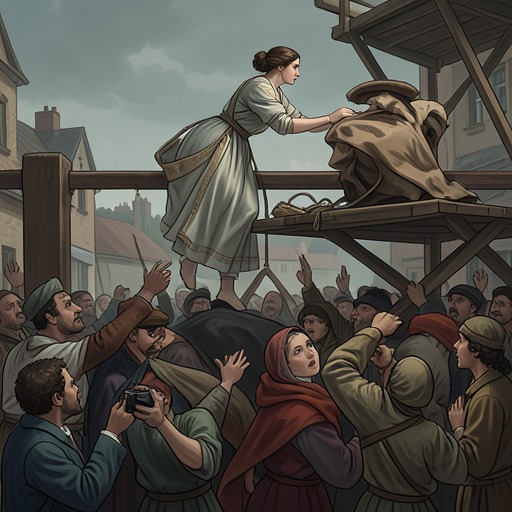
That distinction matters in Esmeralda’s case. After the judges assent to the verdict, the sentence announces that she and her goat are to be taken to Place de Grève and executed there. Montfaucon is not named as the place of her execution. Instead, it enters the story after her death: according to custom, night workers remove her body from the gallows and carry it to the cellar beneath Montfaucon. The novel thus separates the public act of sentencing and execution from the later disposal of the dead.
The Cellar and the Ending
The masonry beneath the gallows contains a large cellar, closed by an iron grating. It serves as a repository not only for remains taken down from the chains at Montfaucon but also for the bodies of people executed at Paris’s other permanent gallows. In the novel’s description, this underground chamber gathers together the consequences of punishment carried out across the city. Its contents include people of very different standing, from Enguerrand de Marigni, described as a just man and the first victim, to Admiral de Coligni, likewise described as just and the last. The cellar therefore holds more than the remains of criminals: the narrative stresses that innocent people and powerful figures have also contributed their bones to it.
About eighteen months or two years after the events that end the main story, a search is made in the cellar for Olivier Le Daim. He had been hanged two days earlier, and Charles VIII of France had granted permission for him to be buried at Saint Laurent instead. During the search, workers find two skeletons among the remains. One is identified as a woman by the few strips of a once-white garment still attached to it. Around her neck are beads and a small silk bag ornamented with green glass; the bag is open and empty. These surviving objects provide a material link to Esmeralda, rather than a name or a formal record.
The second skeleton is still locked in an embrace with the first. Its crooked spine, head set on the shoulder blades, and shorter leg identify the man as Quasimodo. The account notes that the skeleton shows no fracture at the nape of the neck, so the man had not been hanged. The evidence instead indicates that he came to the cellar and died there beside Esmeralda. When someone tries to separate the two skeletons, Quasimodo’s falls to dust. The discovery resolves the mystery of his disappearance from Notre-Dame without a witnessed account of his final journey.
Narrative Significance
Montfaucon Gallows links the legal divisions of Paris to the story’s final, private act of fidelity. Above ground, it represents a system in which verdicts, privileges, and places of punishment intersect without belonging to a single authority. Beneath it, the cellar collects the dead from multiple execution sites and levels of society. The closing discovery narrows that vast repository to two figures: Esmeralda, identifiable by remnants of clothing and her small bag, and Quasimodo, recognized by the shape of his body and the embrace that he has not relinquished. The dilapidated gallows and its crowded cellar make the ending inseparable from the city’s history of punishment, while the joined skeletons disclose the last consequence of Quasimodo’s disappearance.