Notre-Dame Cathedral
The Hunchback of Notre DameNotre-Dame Cathedral is the novel’s principal setting and more than a backdrop: it shelters Quasimodo, orders his world, and becomes the place where refuge and danger repeatedly converge. Its towers, bells, hidden chambers, and thresholds connect private lives to the crowded spaces outside, while the cathedral’s physical vulnerability gives the story a larger frame of memory and loss. The opening account begins with an inscription found in a tower and ends by imagining that the church itself may disappear; the novel’s central action then makes the building both home and contested ground.
Setting and condition
The book presents Notre-Dame Cathedral as a majestic and sublime building, yet one already marked by change. Its opening description laments the many degradations and mutilations inflicted by time and people, without regard for the figures credited with laying its first and last stones, Charlemagne and Philip Augustus. The monument thus appears both enduring and damaged: its presence commands attention, but its condition warns that age alone does not guarantee preservation.
That tension is built into the novel’s frame. The author recalls finding a word engraved by hand in an obscure nook of one of the towers. The Greek capitals were deeply cut into the stone and seemed to bear signs of medieval lettering; their grave, fatal meaning made a powerful impression. By the time the account is told, the writer has disappeared, the word has been erased, and even the church is imagined as liable to vanish. The book is founded on this surviving memory of something no longer materially present. Notre-Dame is therefore a setting in the action and a record whose marks can be lost.
The church also organizes the reader’s view of the city. The narrative pauses to restore, for the reader, features Notre-Dame possessed in the fifteenth century but no longer possesses in the author’s present, and identifies the view of Paris from the towers as the principal omitted beauty. From this height, the cathedral is not merely within the city: it is a vantage point from which the city can be apprehended as a whole. The towers join the church’s local spaces to the wider urban landscape.
Rooms, thresholds, and routines
The cathedral’s interior is made legible through specific uses. Sixteen years before the main period of the story, an abandoned infant was placed after mass on a wooden bed in the vestibule, opposite an image of Saint Christopher. The bed was set aside for foundlings, whom anyone could take in, and a copper basin stood before it for alms. The church’s threshold thus served not only worship but public charity. It is there that Claude Frollo encountered the child who would become Quasimodo.
Claude Frollo’s return to the church on Quasimodo Day brings the foundling space into his personal history. After mass at the Altar of the Lazy, he noticed the women gathered around the bed. The cathedral’s ordinary religious schedule and the practice of exposing foundlings meet in this scene: a familiar route through the church carries him into a lasting responsibility. Later, his clerical position and connection to Notre-Dame help make the building the setting in which Quasimodo grows up and becomes its bellringer.
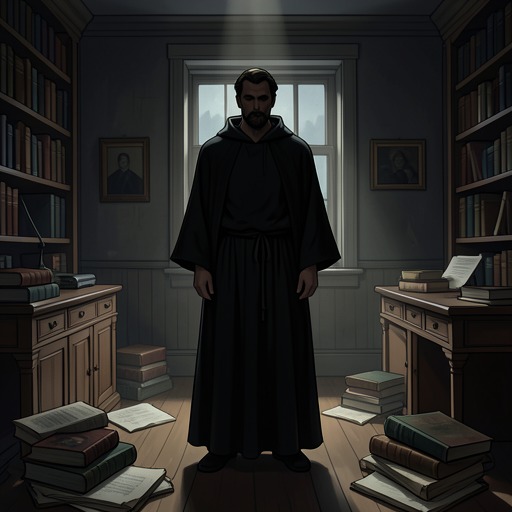
The church’s vertical layout repeatedly shapes what characters can see and do. Claude Frollo keeps a private cell in a tower, reached by a twisting staircase and secured with a small, complicated key. He goes there each day before sunset and sometimes remains through the night. Its single window faces the rear of the church, while the cell’s position separates his private retreat from the public spaces below. Yet sounds from the Parvis of Notre-Dame can draw him out: when he hears a tambourine and castanets, he leaves the door and climbs to the top of the tower to look toward the square.
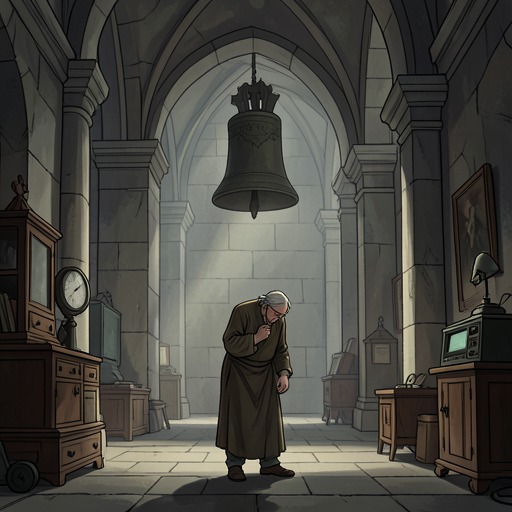
The bell chamber offers another elevated viewpoint. On a day when Quasimodo has returned to the bells, he sees Esmeralda performing below with a small goat and a gathering crowd. He turns away from the bells and watches her from behind the projecting slate roof. The bells stop together, disappointing those listening from the Pont au Change. In this episode, the tower connects the cathedral’s routine work to a spectacle in the square; Quasimodo’s attention interrupts that work, and his distant observation becomes visible to Claude Frollo as a change in the bellringer’s expression.
Quasimodo’s home and refuge
For Quasimodo, Notre-Dame is not simply where he works. His unknown birth and physical deformity have separated him from the wider world, and the church that received him becomes, as he grows, his egg, nest, house, country, and universe. This progression makes the building an intimate geography: its walls provide the boundaries within which his life has taken shape. The bellringer is joined to the cathedral by habit, dependence, and isolation.
The building’s bells and enclosed spaces also define his relations with other people. Quasimodo becomes the bellringer through Claude Frollo, his adoptive father. The ringing eventually leaves him deaf, and a private sign language develops between the two. Claude Frollo is the only person with whom Quasimodo maintains communication; the bellringer’s sympathy is concentrated on him and the cathedral. When the crowd identifies him as Notre-Dame’s hunchbacked, one-eyed, bandy-legged bellringer, it names him through both his body and his occupation. The cathedral gives him a place, but does not dissolve his estrangement from the people beyond it.
When Quasimodo later shelters Esmeralda, a small cell beneath the flying buttresses becomes her refuge. Its location on the roof of the side aisle places her within the cathedral but apart from its more public spaces. Quasimodo tells her she may remain there during the day and move about the church at night, but warns her not to leave: outside, she would be killed, and he would die. His words make the church’s protective boundary explicit. The refuge is real, but it depends on the limits that separate sanctuary from the threatened city.
Sanctuary and contested ground
Notre-Dame’s power as a place of refuge is staged at its central portal. During Esmeralda’s arrival, the escort halts before the entrance and the crowd falls silent. The great doors open onto a dark, nearly empty nave, sparsely lit by candles at the principal altar; in the distant apse, a large silver cross stands against black drapery. The bright square and shadowed church face one another across the open doorway. When the cry of sanctuary rises, the threshold becomes a decisive boundary between public pursuit and ecclesiastical shelter.
The cathedral’s enclosed spaces do not, however, guarantee safety. After the siege, the canons have fled to the bishop’s palace, leaving the cloister courtyard deserted. A route through the towers, across the shadowed church, and out by the red door leads to the courtyard and then to the Terrain, a walled tongue of land belonging to Notre-Dame’s chapter at the eastern end of the island behind the church. These connected spaces offer a way out of the building, but their emptiness also exposes how readily its usual occupants and protections can be displaced by crisis.
The assault on Notre-Dame turns the church into contested ground. The outcasts’ attack is met by resistance from Quasimodo, who has defended the refuge and its approaches. When the attackers are routed, he runs back to the cell, intent on kneeling before the woman he believes he has saved for the second time. But torches and armed men soon spread over the church’s towers, galleries, and flying buttresses as the royal searchers look for Esmeralda. The same architecture that served Quasimodo as a defensive landscape becomes visible and penetrable to armed pursuit.
The towers and the ending
The final movement returns to the towers, where height gives Quasimodo a view of events he cannot prevent. After discovering that Esmeralda has been abducted while he was defending her, he searches the church’s hiding places and unknowingly guides Tristan l’Hermite and the king’s archers through secret doors and concealed spaces. When he finally understands that she is gone, he returns to the cell where she had lived under his protection. The church, recently filled with tumult, is deserted again. His movement back through familiar spaces turns the place of refuge into the setting of his loss.
At daybreak, Quasimodo sees Claude Frollo walking along the highest part of the cathedral. From the tower, he also sees a ladder beside the permanent gallows at Grève Square and recognizes Esmeralda among those being led to execution. Claude Frollo watches from the balustrade as the execution proceeds. Quasimodo then pushes the archdeacon over the edge. The cathedral’s height, earlier a vantage point for watching the city and Esmeralda, becomes the site of Claude Frollo’s death and Quasimodo’s final break with the man to whom he had been devoted.
Quasimodo looks from Esmeralda’s body at the gallows to Claude Frollo below the tower, and his words encompass everything he has loved. The ending concentrates the cathedral’s governing contrasts: shelter and exposure, attachment and abandonment, the height of the towers and the irreversible consequences unfolding beneath them. Notre-Dame remains the world in which Quasimodo has lived, but it cannot save Esmeralda or preserve the bond that once defined his life.
Narrative significance
Notre-Dame Cathedral binds together the novel’s settings and its central relationships. Its vestibule brings Claude Frollo to the foundling; its bells make Quasimodo both servant of the building and a figure recognized by the crowd; its tower cells hold private retreat and threatened shelter; its portal marks the moment when sanctuary is claimed; and its heights frame the last reversals. These places are not interchangeable scenery. Their routes, doors, and elevations give the events their shape, determining who can watch, hide, enter, or escape.
The cathedral’s role in the story also echoes the opening meditation on material memory. A word cut into stone has been erased, and the building that once carried it is described as vulnerable to disappearance. Within the plot, Notre-Dame preserves Quasimodo by giving him a home, yet its shelter is breached and its towers witness deaths rather than preventing them. The novel places human lives and architectural survival under the same pressure of time and change: the church remains monumental, but neither its walls nor the memories attached to them are beyond loss.