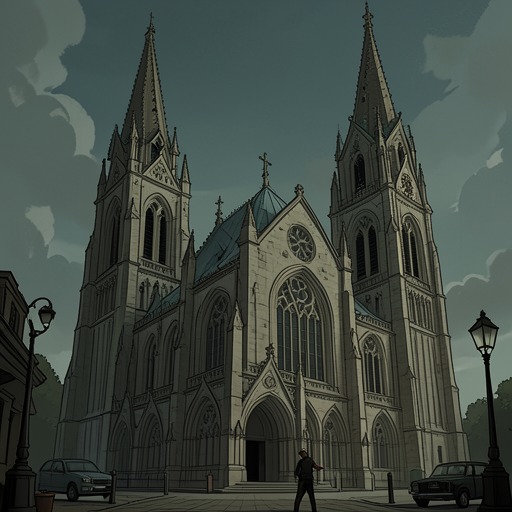
Notre-Dame as Quasimodo’s World
The Hunchback of Notre Dame“Notre-Dame as Quasimodo’s World” describes more than Quasimodo’s residence in Notre-Dame Cathedral: the church becomes the entire horizon of his life, a structure with which he seems physically and spiritually fused. The image moves from refuge to identity and, finally, to a living presence that the cathedral appears to lose.
From Refuge to World
Quasimodo’s isolation begins in what the narrative calls the double fatality of his unknown birth and natural deformity. Shut off from the wider world from infancy, he grows accustomed to seeing nothing beyond the religious walls that shelter him. The cathedral successively becomes “the egg, the nest, the house, the country, the universe”—a progression that makes his dependence on it feel both intimate and absolute.
The sequence enlarges the meaning of home. Notre-Dame is first a place of enclosure and nurture, then the setting of ordinary life, and ultimately the whole world available to him. His attachment is not simply a choice between the church and other homes: the passage presents the surrounding human world as one from which he has been separated.
A Body Shaped by Architecture
The bond is rendered through physical likeness. As a child, Quasimodo drags himself beneath the vaults, his human face and bestial limbs appearing to belong to the strange forms cast by the Romanesque capitals. As he grows, his daily life in the cathedral—living and sleeping there, and hardly ever leaving—seems to impress its shape upon him. Its projecting and recessed angles answer his own, until he appears not merely as an inhabitant but as its natural tenant.
The shell image gives this resemblance a vivid form: “The rough and wrinkled cathedral was his shell.” Like a creature sheltered by its outer covering, Quasimodo is enclosed by the building; yet the comparison also reverses the usual relation between a person and a home. The cathedral is not merely around him. His body and movements seem fitted to its structure, while its towers and carved surfaces become familiar terrain. He climbs the towers without vertigo or amazement, scaling the exterior by its uneven carved projections and leaping among the building’s heights and abysses.
The Cathedral Made Alive
Quasimodo’s connection to the building is expressed through action as well as resemblance. When he first seizes the tower ropes and sets a bell ringing, Claude Frollo sees the gesture as like a child beginning to speak. The bells give Quasimodo a voice within the space that has become his world, and his movements through the structure make him seem present in many places at once: high on a tower, among the church’s shadowed corners, at a bell rope, or along the balustrade.
The people’s superstition turns that pervasive presence into a story of animation. They imagine that his mysterious influence stirs the statues and makes the stones palpitate; the church seems to wait upon his will before raising its voice. At Christmas Eve, as the great bell summons worshippers to midnight mass, the façade and portal seem almost to watch or consume the crowd. The narrator’s final formulation is emphatic: Egypt might have taken Quasimodo for the temple’s god, while the Middle Ages believed him its demon; “he was in fact its soul.” The expression gathers the preceding images into one claim: the building’s apparent life is inseparable from the person who inhabits and animates it.
Absence and Meaning
The metaphor also shapes the account of Notre-Dame after Quasimodo is no longer there. For those who know that he existed, the cathedral is described as deserted, inanimate, and dead: its vast body remains, but its spirit has departed. The image of a skull retaining eye sockets but no sight recasts the building as a surviving form emptied of the life that once made it seem responsive.
This ending completes the progression from shelter to shared identity. Quasimodo’s presence makes the cathedral seem alive; his absence makes its continued physical existence feel insufficient. Notre-Dame is his world because it has received and contained him, but the metaphor finally suggests a reciprocal dependence: the cathedral, too, is imagined as less than fully itself without him.