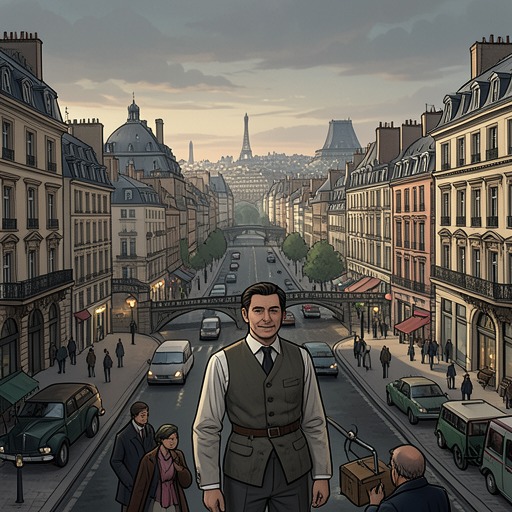
Palais des Tournelles
The Hunchback of Notre DameThe Palais des Tournelles is a sprawling and visually intricate palace whose forest of spires marks the landscape of Paris. In the narrative, it is also a destination for royal business: Louis XI invites Claude Frollo to meet him there, and later accounts associate the palace with their repeated conferences and Frollo’s growing influence.
Setting and Architecture
Seen beyond the House of Angoulême, the Palais des Tournelles rises as a dense thicket of architectural forms. Its spires, tiny bell towers, chimneys, weather vanes, winding staircases, lanterns, pavilions, and spindle-shaped turrets vary in shape, height, and aspect. The effect is likened to a gigantic stone chessboard, an image that makes the palace seem both intricately ordered and almost fantastical. Daylight threads through the crowded structures, heightening the impression of an aerial, openwork mass rather than a single uniform building.
The palace stands beside a more forbidding part of the urban landscape. To its right, the Bastille appears as a dark complex of enormous towers, encircled by a moat and equipped with a raised drawbridge, lowered portcullis, and projecting cannons; the Porte Sainte-Antoine lies at the foot of the fortress. This contrast places the Palais des Tournelles’ elaborate skyline close to a conspicuous emblem of military power.
A Royal Meeting Place
At the cloister curfew, Louis XI—whose identity Claude Frollo has just recognized—invites Frollo to come the next day to the Palais des Tournelles and ask for the Abbé de Sainte-Martin, of Tours. The request gives the palace a practical role in the plot: it is where a private encounter with the king is to take place, and where Frollo is directed to seek him under an ecclesiastical title.
Political Significance
The narrative reports that, after this encounter, Claude Frollo frequently conferred with Louis XI when the king came to Paris. It further asserts that Frollo’s influence came to overshadow that of Olivier Le Daim and Jacques Coictier, the latter of whom openly reproached the king for the change. The palace is thus associated not only with royal presence but with a shift in access and influence around the monarch.