Paquette la Chantefleurie
The Hunchback of Notre DamePaquette la Chantefleurie, later known as Sister Gudule, is introduced through two contrasting lives: the poor, lively girl remembered by Mahiette and the secluded mother whose world has narrowed to a child’s tiny shoe. Her story links youthful hardship to enduring grief, and private mourning to the public spectacle of a condemned young woman at Grève Square. The contrast between what Paquette believes about the Egyptians and what she sees at the pillory gives her reappearance its tragic force.
Identity and Early Life
Mahiette recalls Paquette as eighteen years old when she herself was eighteen, placing the remembered youth eighteen years before the conversation. Paquette was the daughter of Guybertant, a minstrel of the barges at Reims. Her father had performed before King Charles VII during the king’s coronation journey on the river Vesle, in a boat that also carried the Maid of Orleans. Guybertant died while Paquette was still a child, leaving her with her mother and little security.
Her mother was the sister of a Parisian master brazier and coppersmith, but the family’s respectable connections did not prevent poverty. She taught Paquette embroidery and toy-making, skills that brought in very little. The two women lived on the riverfront in the Rue de Folle-Peine at Reims, and the income from their work could amount to only six farthings a week. Mahiette contrasts this precarious livelihood with the twelve Parisian sous Guybertant had earned from a single coronation song.
Paquette’s names register changes in how others saw her. In her youth, she was widely called la Chantefleurie, a name Mahiette glosses as blossoming song, because she was pretty, cheerful, and fond of laughing. During a bitterly cold winter, her flushed appearance prompted the names Paquette and Pàquerette. Mahiette connects that winter, and Paquette’s beauty, with her ruin. She recalls that at fourteen Paquette was already beyond the point at which, in her view, she might have followed the settled course of life enjoyed by Mahiette: husband, children, and a secure household. A gold cross worn at church made Paquette’s changed circumstances visible to the people who knew her.
From Paquette to Sister Gudule
Years later, the recluse is known to those around her as Sister Gudule. When Mahiette hears this name, she identifies the woman as Paquette la Chantefleurie. The recognition reunites the recluse’s present identity with the remembered young woman, though the reclusive life she now leads is marked not by the sociable cheerfulness in Mahiette’s account but by isolation and consuming grief.
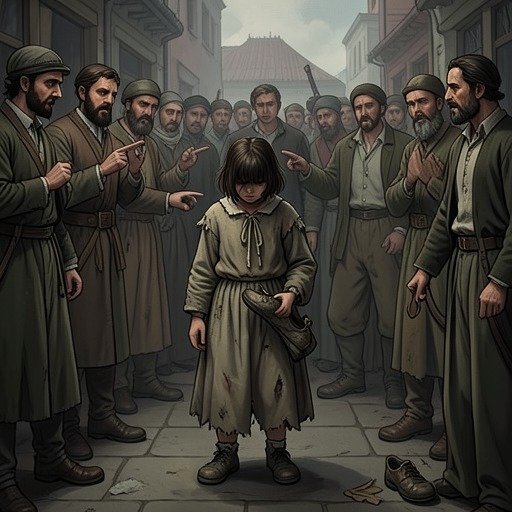
The tiny pink satin shoe, embroidered with gold and silver designs, is the center of that life. At the Tour Roland Hermitage, Paquette kneels before it and has done so for fifteen years. Her thought, the narration says, is shut up in the object: it has become her universe. The shoe is at once the surviving trace of her child and the focus of the prayers, complaints, sobs, and imprecations associated with her loss. Its delicacy makes the extremity of her despair more striking; the object that preserves tenderness also keeps grief present.
Grief and the Shoe
Paquette’s mourning is portrayed as enduring rather than gradually softened by time. She throws herself upon the shoe, and the grief returns with the force of the first day. The narration makes this persistence explicit: for a mother who has lost a child, every day can remain the first day. The worn state of mourning clothes does not indicate a corresponding fading of sorrow; outward time passes while her inner life remains fixed on the loss.
Children passing near her cell usually drive her into its darkest corner, as if she cannot bear their presence or sound. On this morning, however, their cries draw her to the air-hole. A child’s remark that a gypsy is to be hanged turns her attention from the shoe to the gallows being prepared at Grève Square. She sees the ladder against the permanent gibbet and the hangman’s assistant adjusting its rain-rusted chains. The shift is consequential: the condemned woman becomes, for Paquette, the object toward which years of grief and resentment have been directed.
Hatred and the Condemned Woman
Beside the cell, Paquette recognizes the archdeacon of Josas, who appears to be reading the public breviary while repeatedly looking toward the gallows. She asks who is to be hanged. After he confirms that the condemned person is probably a gypsy, Paquette responds with laughter and explains that she believes the Egyptians stole and devoured her daughter. Her hatred is not abstract prejudice in her own account; she experiences it as the consequence of a loss that has left her feeling that her heart was taken with her child.
She singles out a young woman whom she has cursed whenever the woman passes her cell. Paquette says that the young woman is of the age her daughter would have been and that seeing her stirs her blood. The archdeacon tells her that this particular young woman is the one about to die. Paquette answers with visible joy, interpreting the impending execution as the fulfillment of her curse. The exchange exposes the gulf between her account of justice and the suffering that the execution will inflict: her private grief has attached itself to a public punishment.
Narrative Significance
Paquette’s scenes bring together the shoe, the hermitage, and the gallows as connected images of loss. The shoe holds her attention within the memory of a vanished child; the air-hole opens that sealed world onto the public square, where a living young woman faces execution. The narration first places Paquette’s reclusion beside the preparation of the gallows, then makes the children’s announcement draw her outward. Her response grows from grief into hatred and finally into apparent triumph, so that the scene reveals how sorrow can harden into a desire for another person’s death.
The revelation that Sister Gudule is Paquette also changes the meaning of the recluse’s earlier curse against the daughter of Egypt. Mahiette’s recognition supplies the identity behind the name, while the later encounter shows how that identity has been shaped by fifteen years of mourning. Paquette’s decisive significance lies in this collision between an intimate object and a public event: the little shoe preserves her lost child in memory, while the gallows turns her belief about the Egyptians into a present and consequential judgment.