Paris as a stone-written chronicle
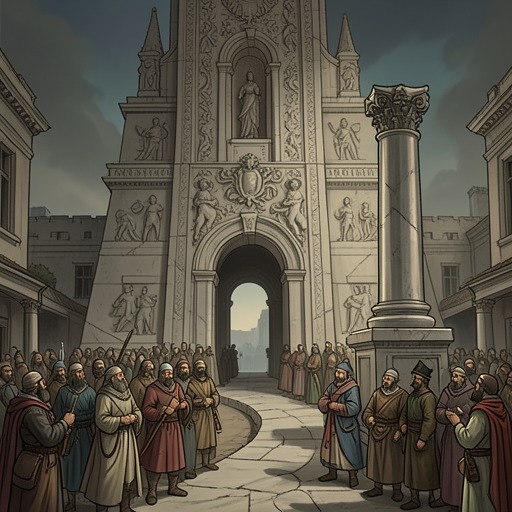
The Hunchback of Notre DameParis as a stone-written chronicle is the idea that a city’s buildings, streets, and boundaries preserve its history in material form. In the novel, Paris is not merely the setting for events: its changing architecture records the growth of the city, the succession of artistic eras, and the values of the societies that built and altered it. The panoramic view from Notre-Dame Cathedral makes that record visible, while later reflections on demolition and preservation show how readily it can be erased.
A city read from above
The account begins by inviting the reader to see Paris from the towers of Notre-Dame Cathedral in 1482. From that height, the first impression is a dense confusion of roofs, chimneys, streets, bridges, squares, spires, and bell towers. The city’s buildings differ in scale and form: carved gables and pointed roofs stand alongside eleventh-century stone structures, fifteenth-century slate towers, bare round keeps, and ornate square church towers. The scene is a visual archive whose smallest houses, with painted fronts and projecting stories, belong to the same artistic world as the great royal buildings.
The panorama gradually resolves into three connected parts: the City on its island, the University on the left bank, and the Town on the right. From above, each looks like a tangled web of streets, but the three districts form one urban body. The Seine binds and traverses them, carrying people between their separate quarters. Two long routes cross all three parts and serve as the city’s principal arteries; their names change from district to district, but their continuity makes the urban whole legible beneath its local distinctions.
The City began on the island in the Seine, where the river served first as moat and boundary. As the settlement outgrew its island, it crossed the water and spread beyond successive defenses. Philip Augustus enclosed Paris with a new circuit of high, solid towers, but the houses crowded against and eventually passed beyond that wall. The city’s expansion thus remains visible as a succession of boundaries, each overtaken by the growth it was meant to contain. In the fifteenth-century view, the river, bridges, gates, walls, and crowded buildings together record that long outward movement.
Urban form as history
The city’s shape also carries the imprint of practical and political organization. The City had five bridges, many burdened with houses; the University and the Town each had six gates. At night, the gates were shut and great iron chains barred the river at both ends of the city. Walls and waterways divided and protected the districts, while the principal streets and bridges joined them. Paris’s history is therefore inscribed not only in celebrated monuments but also in the infrastructure that directed movement and marked limits.
From Notre-Dame Cathedral, the three districts form distinct masses: the island at the center, the dense University to the left, and the more varied Town to the right, interspersed with gardens and monuments. The Seine cuts across the composition, with islands, bridges, and boats; beyond the walls, cultivated land and villages meet a ring of hills. The account’s broad view turns this arrangement into a readable map, but the novel also supplies the opposite experience. In the streets around the ancient cemetery of Saints-Innocents, Pierre Gringoire loses his way among alleys, squares, and closed courts that repeatedly circle back on themselves. The pillory at the fish markets offers him a brief point of orientation. From above, the city can be apprehended as a whole; at street level, its intricate layout can bewilder the person trying to cross it.
The architecture’s record extends below ground as well as across the skyline. In the Middle Ages, the account explains, a substantial part of an edifice could lie beneath the earth: its cellars and passages formed a second structure, with roots of chambers, galleries, and staircases branching below its visible walls. At the Palais de Justice, the Louvre, and the fortress of Saint-Antoine, these subterranean spaces served as prisons. The city’s built history thus includes hidden spaces of confinement as well as the public forms that dominate its skyline.
Architectural layers and changing eras
The novel calls fifteenth-century Paris a homogeneous architectural and historical product of the Middle Ages. Its principal visible layers are Romanesque and Gothic; older Roman Paris has largely disappeared, surviving above ground most clearly in the Baths of Julian, while no Celtic examples remain even in the account’s reference to well-digging. The city’s coherence does not mean that every building is alike. Rather, varied structures belong to a shared historical formation, so that their differences can be read as parts of one accumulated whole.
About fifty years later, the Renaissance began to mingle with that medieval unity. Its new forms could make Paris more dazzling, yet less harmonious to the eye and the mind. The change was not simply additive: the Renaissance also required space and began to destroy what it replaced. Saint-Jacques de la Boucherie had scarcely been completed when the old Louvre’s demolition began. The sequence makes architectural change a historical process with costs: a new style enters the city, but the older record is damaged or removed in the making of it.
Later Paris is described through monuments associated with successive regimes and periods: the Tuileries with Catherine de Medici, the Place Royale with Henri IV, the Val-de-Grâce with Louis XIII, and the Invalides with Louis XIV. The examples continue through later royal and political eras, each with its own characteristic architectural manner. Individual monuments can therefore act as markers of a period’s taste and authority. Even details as small as a door knocker, the narrator observes, can disclose the spirit of a century and the physiognomy of a king to a practiced eye.
Demolition, memory, and preservation
The idea of a readable city makes damage to buildings a loss of historical evidence. Notre-Dame Cathedral itself is presented as majestic, yet scarred by the degradations and mutilations inflicted by time and people, without regard for the rulers associated with its construction. The contrast gives human destruction particular weight: time wears monuments down, but careless intervention can accelerate their loss. The account’s Latin maxim sharpens that distinction by calling time a devourer and humanity still more so.
The contrast between medieval Paris and the narrator’s present is stark. Modern Paris is characterized as a collection of fragments from many centuries, with its finest examples already gone. The capital continues to grow in houses, and its architectural character is being effaced as monuments become rarer and are overwhelmed by the spread of ordinary buildings. The forecast that Paris may renew itself every fifty years describes not just rapid construction but a recurring break in historical continuity: each rebuilding risks making the preceding city harder to read.
The Tuileries provides a concrete test of the argument. The narrator opposes plans to remake the palace, insisting that it belongs not only to the history of sixteenth-century art but also to the history of the nineteenth century. Cannonballs on its two façades bear the marks of revolutionary events; those marks make the palace a public historical document, not merely a royal possession. Its preservation is consequently framed as a matter of collective memory. The narrator hopes that future generations will prove his fear of architecture’s decline mistaken, but urges the nation, meanwhile, to cherish and protect its older monuments.
The city and the novel as records
The chronicle metaphor also shapes the novel’s way of telling history. Its account moves between the Paris of 1482, later changes to the city, and the narrator’s own reflections on threatened monuments. The opening bells, heard across the City, University, and Town on January 6, 1482, establish a particular day within this extensive urban history; the panoramic chapter then makes the surrounding built world part of the story’s historical subject. Elsewhere, an argument about the 1618 fire at the Palais de Justice considers how one great event may set off distant consequences. Buildings survive, change, and disappear through chains of human action that cannot always be predicted.
The novel’s note on its own composition draws a parallel between an architectural whole and a literary one. It argues that a romance is conceived with all its chapters, just as a drama is conceived with all its scenes, and resists treating later additions as detachable repairs. That claim echoes the book’s account of the medieval city as an accumulated but coherent creation: individual parts matter, yet their significance also depends on their place within a larger structure. The novel’s appeal for the preservation of ancient buildings follows the same principle. To save a monument is to keep a legible piece of the collective past, rather than leave only a fragmentary city in which the history once written in stone has been effaced.