Phoebus de Châteaupers
The Hunchback of Notre DamePhoebus de Châteaupers is a captain of the king’s archers whose fleeting intervention in Esmeralda’s life becomes a decisive source of both hope and danger. He rescues her from Quasimodo, accepts her admiration, and later meets her privately, but his conduct never matches the ideal of devotion she builds around him. When Frollo’s violence puts Phoebus himself in danger, he survives; when Esmeralda later needs help, he rides away without hearing her appeal. His eventual marriage closes his story with an irony the novel states plainly: Phoebus, too, came to a tragic end—he married.
Identity and Public Role
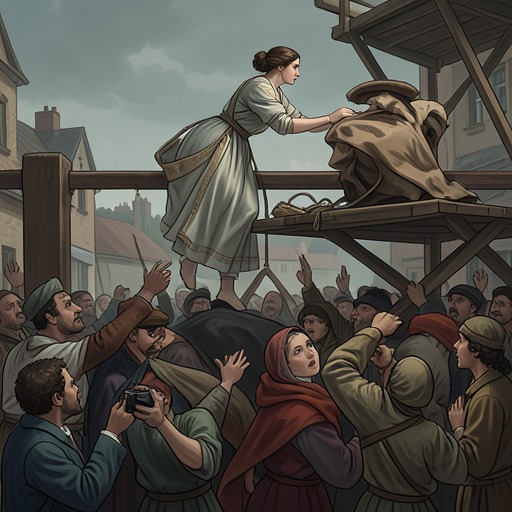
Phoebus is introduced as an armed officer appearing suddenly during Quasimodo’s attempt to carry off Esmeralda. He is fully equipped and has his sword in hand. Fifteen or sixteen archers follow him, part of the king’s police patrolling by order of the guard of the provostship of Paris. Phoebus commands this force, and its arrival turns the attempted abduction into an arrest: the archers surround and bind Quasimodo while Phoebus takes Esmeralda from him.
His official position gives him the authority and physical means to intervene, but the rescue scene also introduces the limits of his concern. Esmeralda looks at him with gratitude and wonder, asks his name, and hears him present himself as Captain Phoebus de Châteaupers, at her service. She then slips from his horse and flees. Phoebus remarks that he would have preferred to keep her. The episode therefore makes his rescue real while complicating any assumption that it reflects a sustained commitment to her safety: his attention turns quickly from the danger she has escaped to his own wish to possess her company.
Esmeralda and the Image of Phoebus
Esmeralda’s regard for Phoebus grows around brief encounters that he treats much more lightly. At the Gondelaurier mansion, Fleur-de-Lys de Gondelaurier invites her betrothed to look at the dancer performing on the church square and asks whether he recognizes her. Phoebus identifies Esmeralda by her goat. At the young women’s urging, he calls and beckons to the dancer from the balcony. His casual manner contrasts with the intensity of the attention he has already awakened in her.
The contrast sharpens when the goat arranges letters on the floor to spell PHOEBUS. Bérangêre calls attention to the result, and Fleur-de-Lys asks whether the goat wrote it. The word makes Esmeralda’s attachment visible to those watching, transforming what Phoebus had treated as a playful recognition into evidence of her fixation. Yet his own language at the balcony is distancing: he says that Esmeralda has probably forgotten him and that he does not even know her name, despite having recognized her by the goat. He agrees to call her only because the young women request it.
Later, Phoebus is found outside the house of his betrothed, cursing, when Jehan Frollo recognizes him. The scene places him again within the social world of his engagement even as another man’s attention is turning toward him. A shadowed figure calls him by his full name and says that he has a rendezvous that evening. When asked who is involved, Phoebus names Esmeralda, apparently without grasping the danger of what he has disclosed. The shadow’s anger makes the encounter a point of collision between Phoebus’s meeting with her and Frollo’s concealed pursuit.
The Rendezvous and Frollo’s Attack
At the private meeting, Esmeralda expresses an extravagant willingness to give herself to Phoebus and to serve him even if she should grow old or cease to be desirable to him. Her words and gestures present him as the object of a total devotion; Phoebus responds physically, kissing her, but the scene gives no corresponding promise of lasting love or protection from him. His heedlessness is important to what follows: he does not see the priest who has broken into the room.
Esmeralda does see him. Above Phoebus she notices Frollo’s convulsed face and the hand holding a poniard. Frozen and unable to cry out, she watches the weapon descend and rise again. Phoebus curses and falls. The attack abruptly reverses the scene’s intimacy into violence, but Phoebus is the target of Frollo’s jealousy, not a knowing participant in the priest’s presence. The assault also makes the danger in the shadowed man’s earlier knowledge of the rendezvous concrete.
Survival and the False Report of His Death
Phoebus’s wound is serious enough that the physician who treats him fears for his life for a week. The novel later corrects the reports that Esmeralda receives: the royal advocate had said Phoebus was dying, while Frollo told her he was dead. The narrator clarifies that Frollo did not know this as fact; he believed it, hoped it, and could not bear to give Esmeralda favorable news about his rival. Phoebus’s survival thus exposes the self-interest behind the priest’s supposed certainty.
While still recovering, Phoebus is questioned by the royal advocate and the official inquisitors, and the interrogation annoys him. Once he feels better, he leaves the physician’s care, leaving his golden spurs as payment. The legal case against Esmeralda nevertheless continues. The authorities have assumed Phoebus to be dead and treat that assumption as sufficient; the narrator presents the proceeding as indifferent to the clarity of the evidence so long as the accused is hanged. Phoebus’s recovery and departure therefore matter not only as a reversal of the report of his death but also because the machinery of the case proceeds without his condition being correctly established.
The Failed Appeal and the Ending
During the search for Esmeralda, Phoebus is among the armed men near the Rat-Hole Hermitage. Gudule has hidden her daughter inside her cell, where Esmeralda remains crouched in shadow. When Frollo’s voice passes close by, calling for Captain Phoebus de Châteaupers, Esmeralda stirs, and Gudule tells her not to move. The name that once promised romantic salvation now sounds within a scene of concealment and imminent capture.
As the search party prepares to leave, Phoebus says that hanging witches is no concern of his as a man of arms and that he will rejoin his company. Esmeralda hears his voice and takes it as the arrival of her friend, protector, support, and refuge. She rushes to the window and calls for his help, but he has already galloped around the corner. Her appeal does not reach him; Tristan l’Hermite has not yet departed and sees the two women. The scene’s painful disparity is between the meaning Phoebus has acquired in Esmeralda’s imagination and the limited, unknowing part he plays in her last chance to remain hidden.
The novel gives Phoebus no further act of rescue or reconciliation. Its closing account says simply that he, too, came to a tragic end: he married. Set against Esmeralda’s devotion, Frollo’s violence, and the failed appeal at the Rat-Hole Hermitage, the terse conclusion makes marriage an ironic anticlimax rather than a romantic reward. Phoebus has survived the wound that others believed fatal, but the story offers no evidence that he understands the consequences of the love Esmeralda placed in him.