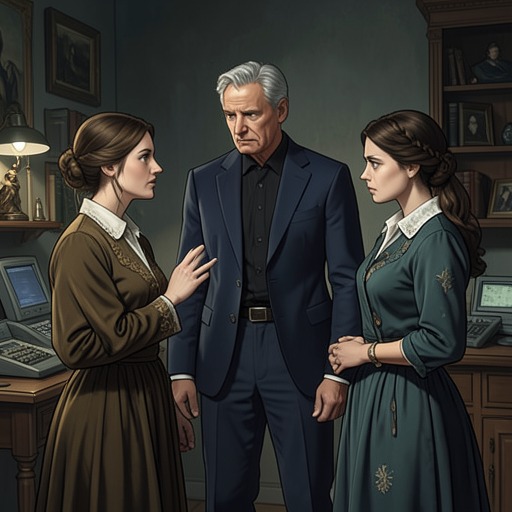
Phoebus–Fleur-de-Lys relationship
The Hunchback of Notre DamePhoebus and Fleur-de-Lys are betrothed, but their relationship is shaped by his long absence, evasive reassurances, and a past connection to Esmeralda that he cannot convincingly conceal. When he returns to the Gondelaurier Mansion after two months away, he quickly wins back Fleur-de-Lys’s warmth; the appearance of Esmeralda on the road to execution then makes the gap between his words and his reactions impossible to ignore.
An Engagement Resumed
Phoebus arrives at the Gondelaurier Mansion one morning on a prancing horse, apparently recovered from an illness and assuming that the Bohemian affair is finished and forgotten. Fleur-de-Lys is his betrothed, and their wedding is planned for three months later. The narrative also presents her as his latest passion but one and emphasizes the appeal of her dowry, placing attraction and material advantage side by side in his approach to the match.
His return follows a two-month absence that Fleur-de-Lys immediately calls to account. She asks where he has been and why, despite staying at nearby Queue-en-Brie, he never visited her. Phoebus answers the first question readily, naming the village; the second leaves him seriously embarrassed. He invokes his military service and illness, explanations that allow him to avoid giving a fuller account of his absence. The scene establishes a recurring imbalance: Fleur-de-Lys asks for an explanation of his conduct, while Phoebus tries to meet the emotional demand with a convenient answer and renewed charm.
Charm, Reproach, and Reassurance
Fleur-de-Lys is embroidering a grotto of Neptune when Phoebus leans over the back of her chair. Her reproaches soften into affectionate speech, and his compliment about her beauty prompts her to smile. Their reconciliation is quick: Madame de Gondelaurier cannot bring herself to scold him, and Fleur-de-Lys’s complaints give way to tenderness. Phoebus is described as intoxicated with her, and his attentions restore an appearance of peace between the engaged couple.
That ease does not amount to candor. Phoebus’s attraction is presented through a sensuous, possessive gaze, directed at the openings of Fleur-de-Lys’s neckline as he stands behind her chair. When she asks him to swear that he has never loved another woman, he gives the assurance she seeks. His passionate looks help make his answer sound sincere to her, but the episode has already shown him avoiding questions about where he has been. The promise therefore reassures Fleur-de-Lys without resolving the history that makes her ask for it.
The scene also makes clear that the prospect of marriage does not restrain Phoebus from testing the boundaries of their intimacy. Once Madame de Gondelaurier leaves the room, the narrator describes the captain as emboldened by being alone with his betrothed and by the return of his former desire for her. The narration does not claim certainty about the exact thoughts passing through his mind; it does show that Fleur-de-Lys is alarmed by his expression and looks around to find her mother gone. The moment marks a limit to the apparent reconciliation: what Phoebus experiences as renewed opportunity unsettles the woman whose trust he has just solicited.
Esmeralda Reappears
The relationship’s concealed strain becomes visible when a procession passes before the mansion. Phoebus has paid no attention to the crowd gathered at the Place du Parvis before Notre-Dame, supposing that it marks a religious procession or festival. Fleur-de-Lys recognizes the condemned young woman in the cart as the Bohemian associated with a Goat. Phoebus, looking toward the cart, turns very pale and stammers in response. The change in him is immediate, and it sharply contrasts with the easy attentions he has just directed toward his fiancée.
When Fleur-de-Lys questions his reaction, Phoebus denies knowing what she means and tries to step back into the room. Her jealousy, once aroused by the same woman, returns. She vaguely recalls hearing of a captain involved in the trial of the accused witch, and her suspicion joins that remembered report to Phoebus’s pallor and denial. She orders him to remain and watch the procession’s end. His response is no longer the fluent flattery with which he answered her earlier reproaches: the episode shows him constrained by her demand to stay while Esmeralda is carried past.
The Limits of Their Reconciliation
Phoebus draws some reassurance from the fact that Esmeralda does not look up from the bottom of the cart. The narrative nevertheless lingers on what he sees: her emaciated face, dull gaze, motionless tear, and broken posture as the tumbrel jolts along. She remains beautiful even in degradation and despair. The contrast between her condition and Fleur-de-Lys’s sheltered presence in the mansion gives the procession a force that Phoebus’s denial cannot cancel. The spectators’ response is not uniform; the narrator notes that even among the hardest, some are moved to pity.
For Fleur-de-Lys, the passing cart revives a suspicion that Phoebus’s recent assurances have only briefly suppressed. For Phoebus, the scene exposes an attachment or involvement he would rather keep outside the engagement: his pallor, hesitation, and effort to deny recognition contradict the composure of a man whose past is settled. Yet the available episode does not show Fleur-de-Lys ending the engagement or Phoebus confessing. It leaves their marriage promised for three months later, while making the trust beneath that promise newly doubtful. Their relationship is thus defined less by a settled reunion than by the collision between Phoebus’s practiced reassurances and the evidence his body gives away.