Pierre Gringoire
The Hunchback of Notre DamePierre Gringoire is a poet and playwright whose fortunes repeatedly turn on the attention of others: a crowd that first waits for his work abandons it, and a chance rescuer later keeps him from execution. A resourceful survivor on the margins of Parisian society, he can make a living from learning and performance, but his retreat from danger with Djali while Esmeralda is left behind exposes the self-preservation beneath his comic ingenuity.
Identity and Background
Gringoire introduces himself as the author of a morality play presented in the grand hall of the Palais de Justice. He shares credit for the production with a carpenter who built its stage and framework, distinguishing the labor of writing from the practical work needed to put the play before an audience. He takes pride in his authorship, and his confidence briefly wins the attention of Gisquette and Liénarde, who had asked whether the promised mystery would be good.
His account of his childhood explains the precariousness behind that professional pride. His father was killed by the Burgundians and his mother by the Picards during the siege of Paris; Gringoire says he was left an orphan at six. He recalls surviving through small acts of charity, with food offered by a fruit seller or baker, and sometimes spending the night in prison after the watch picked him up. He describes himself as thin and without secure prospects, formed by the streets rather than by a settled household.
At sixteen he tried several occupations, including soldiering, monastic life, and work with woodcutters, but found himself unsuited to each. He considered teaching despite not knowing how to read. Eventually, he chose poetry, presenting it as a trade available to a vagabond and preferable to theft. The sequence gives his career a distinctly makeshift character: he does not arrive at authorship through a clear calling or a stable apprenticeship, but through repeated failure and adaptation.
Learning, Work, and Public Reputation
Gringoire credits Claude Frollo, archdeacon of Notre-Dame Cathedral, with taking an interest in him and helping him become a learned man. He claims knowledge of Latin and scholastic, political, and rhythmic subjects. Learning, in his case, is both a genuine resource and part of his performance of status: he deploys literary and philosophical references readily, even when circumstances are dangerous or absurd.
The breadth of his ambitions exceeds the security of his income. He says he has written a six-hundred-page book about the comet of 1465, which he associates with a man being driven mad. He also worked on a great bombard constructed by Jean Mangue; it burst during a test at Pont de Charenton, killing twenty-four spectators. Gringoire recounts the episode among the credentials he offers in explaining why he is a worthy match for Esmeralda, turning even a disastrous technical project into part of his résumé.
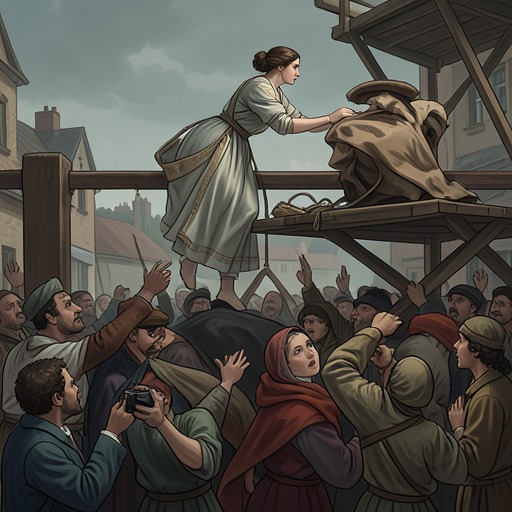
His first theatrical success proves fragile. When the cardinal enters, the audience’s attention shifts from the performance to the visitors in the gallery. Gringoire watches the morality play lose its audience: even people who had recently threatened a revolt because they were waiting for the show now disregard it. He is especially frustrated that the public attends to the cardinal, Jacques Coppenole, Quasimodo, and others rather than to the work itself. The scene makes his professional vulnerability concrete: he can finish a play, but he cannot command the public’s attention once a more immediate spectacle appears.
Survival and Relationship with Esmeralda
Gringoire’s life repeatedly becomes a matter of finding a way out. When he is threatened with hanging by the crowd of outcasts led by Clopin Trouillefou, he identifies himself as the poet whose morality was performed that morning. He argues that poets should count among vagabonds, invoking famous wandering writers and figures. His appeal does not persuade Clopin to spare him, but it shows his instinct to use language and learned allusion even when his life is at stake.
Later, Gringoire follows Esmeralda through the darkening streets around the Saints-Innocents cemetery. The route becomes a maze of alleys, squares, and closed courts; he loses his sense of direction while she proceeds with apparent familiarity. The pillory at the fish market helps him recognize where he is. This episode places his literary cleverness alongside practical dependence: he can describe and interpret, yet in the city’s winding streets he is simply following someone else.
Gringoire’s connection to Esmeralda develops through accommodation rather than romantic ardor. When she holds him off with a dagger, he promises not to approach without her permission and asks for supper. The narration characterizes him as willing to negotiate and wait rather than take a young woman by force. His immediate concern shifts conspicuously to food when she provides bread, bacon, apples, and beer. He later tells Claude Frollo that Esmeralda is his wife, and describes himself as prepared to live with her in whatever arrangement she chooses. He offers marriage, companionship, and his learning as practical terms, while she remains absorbed in thoughts of Phoebus.
Gringoire’s self-description also makes clear how much of his identity is built from improvisation. He presents himself as a poet, scholar, philosopher, and would-be husband, but his fortunes depend on uncertain audiences, patronage, clothing, and shelter. After disappearing for two months, he is found performing in motley red and yellow clothes as a street entertainer. His old clothes had fallen apart, he explains, and he took the stage costume because he needed something to wear. When Claude Frollo encounters him during a performance, Gringoire’s balancing act collapses in the resulting commotion, and he escapes into Notre-Dame Cathedral at the archdeacon’s signal.
Flight and the Choice to Save Djali
Gringoire’s sharpest moral test comes during the attack on Notre-Dame Cathedral. As torches and armed men appear around the church and cries for Esmeralda’s death reach the boat, he considers the danger facing both her and Djali. He fears that the goat will also be hanged if captured. Rather than rescue both, he weighs their fates against each other and decides that he cannot save them both.
When the boat reaches shore, Esmeralda refuses the unknown man’s assistance and clings to Gringoire’s sleeve. Gringoire, occupied with Djali, nearly pushes her away. She jumps onto the wharf alone. In the confusion of the landing, he slips off with the goat into the houses of Rue Grenier-sur-l’Eau, leaving Esmeralda with the stranger. The separation is not presented as a grand plan or a rescue of Esmeralda; it is an act of escape that protects the animal he has chosen to save and abandons the woman who had been his companion and wife.
The contrast between his earlier offer to live with Esmeralda and his departure at the moment of greatest danger defines the limits of that attachment. His concern for Djali is real, and he succeeds in saving her, but his choice also makes his own survival the scene’s governing fact. Gringoire’s characteristic adaptability keeps him moving; it does not make him courageous or self-sacrificing.
Later Career and Narrative Significance
Gringoire’s ending returns him to the profession he had once adopted after failing at other callings. In 1483, after trying astrology, philosophy, architecture, and hermetic studies, he returns to tragedy. He and the carpenter Jehan Marchand receive payment for making and composing a mystery for the entry of the legate at the Châtelet of Paris, including arranging the performers’ costumes and preparing the necessary scaffolding. The account records a payment of one hundred livres. The official detail stands in comic contrast to the audience’s indifference to his earlier play: he eventually receives a recognized commission and payment, though the record emphasizes the practical production as well as the composition.
Gringoire’s trajectory joins professional persistence to moral compromise. He survives as a beggar, scholar, playwright, and street performer, shifting roles whenever circumstances require it. His repeated failures do not prevent later success, but neither does success transform him into a conventional hero. The tale’s comic treatment of his self-presentation sits beside the serious consequences of his final choice: he saves Djali, while Esmeralda is left to face danger without him. His story makes survival itself an unstable achievement—resourceful, sometimes fortunate, and not necessarily honorable.