Place de Grève
The Hunchback of Notre DamePlace de Grève is a riverside square in Paris whose open ground and surrounding houses make it a conspicuous civic stage. In the novel, it holds two faces of public life at once: the noisy aftermath of a festival and the machinery of punishment, where crowds gather to watch the pillory or an execution. The square’s architecture, its permanent instruments of justice, and the characters’ repeated arrivals there turn it into more than a setting: it is a place where the city looks on, judges, celebrates, and fails to protect the vulnerable.
Setting and Urban Form
The square is described as an irregular trapezoid, with a quay along one side and lofty, narrow, gloomy houses along the other three. In daylight, the variety of those buildings offers a compact history of domestic architecture, with examples spanning the eleventh through the fifteenth centuries. Their details mark successive changes in style: the casement beginning to displace the arch, and the Roman semicircle giving way to the ogive. An older house at the corner, beside the Seine and the street with the Tannerie, preserves the Roman semicircle in its lower story. The square thus contains, in a single streetscape, visible traces of architectural change.
Night alters the scene. The houses lose their individual detail, leaving the dark outline of roofs and their sharp angles against the sky. This shift from daylight variety to nighttime obscurity gives the square contrasting forms of visibility: by day, buildings invite inspection; after dark, the place becomes difficult to read. The same urban space can be a lively gathering ground or a threatening, exposed emptiness.
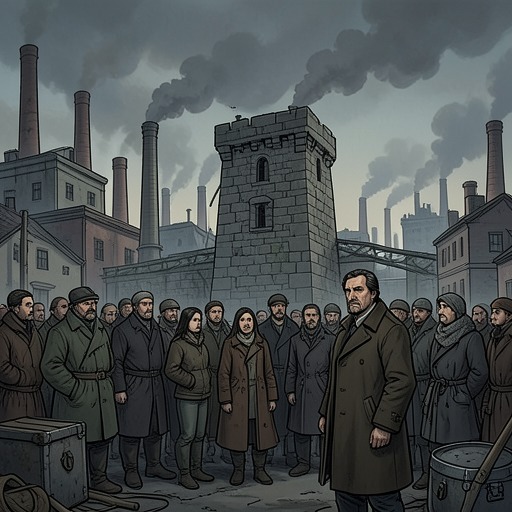
The square also belongs to a larger, divided city. Paris grew outward from the island in the Seine, expanding across the river into the City, the Town, and the University. From the towers of Notre-Dame Cathedral, those districts could be seen as distinct, tangled quarters joined by long streets and by the river’s movement of people between them. Place de Grève’s quay places it within that connected riverside city, while its position as an open square gives it a different character from the maze of streets through which people move to reach it.
Festival, Performance, and the Crowd
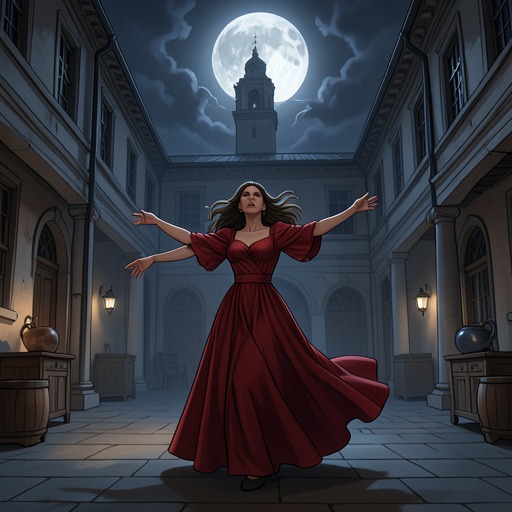
When Pierre Gringoire reaches the square after the failure of his theatrical piece, he is cold and drenched from his journey. He approaches a bonfire at the centre, but a crowd has already formed a ring around it. Within the open space between the spectators and the fire, Esmeralda dances to the humming of a Basque tambourine. The arrangement is almost theatrical: fire and performer occupy the centre, while the assembled public watches from the perimeter. Gringoire, arriving as a failed playwright, encounters a performance that commands the attention his own work did not secure.
The square also preserves the festival in its aftermath. At ten in the morning, its pavement is scattered with ribbons, rags, feathers, wax from torches, and crumbs from the public feast. People turn over the cooled remains of the bonfire; others admire the House of Pillars and the remembered hangings, or inspect the nails that remain after the decorations have been taken down. Vendors roll barrels of cider and beer among the groups, while merchants call to one another from their shop doorways. Talk of the festival, the ambassadors, Jacques Coppenole, and the Pope of the Fools carries the previous day’s public event into ordinary street life. The square’s spectacle is therefore not confined to the moment of performance: its discarded materials and animated conversation extend it into the following morning.
The Pillory and Public Punishment
The festive square has a darker, permanent arrangement at its centre. A gallows and a pillory stand side by side, described as the instruments of justice and the ladder. Their enduring presence makes punishment part of the square’s ordinary geography rather than an exceptional intrusion. The narrative connects these structures with the many people who have suffered there, giving the open pavement a history that lies beneath its traffic and celebrations. In a later period, the fever of Saint Vallier is also associated with the terror of the scaffold, extending the square’s fearful reputation beyond the immediate action.
Place de Grève recurs as a landmark in characters’ movement through Paris. When Gringoire follows Esmeralda after dark, he loses his way among streets, squares, and closed courts; glimpsing the octagonal mass of the pillory helps him recognize where he is. The structure is thus both an instrument of punishment and a navigational marker. It makes the square legible from the surrounding maze, even as the threat it represents gives that recognition a sinister force.
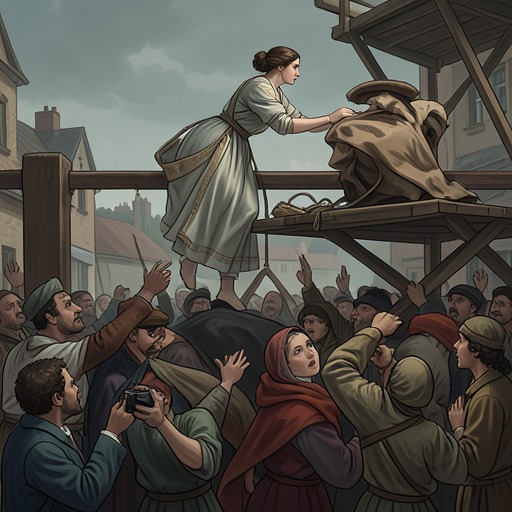
Quasimodo is brought to the pillory bound to the tail of a cart. Once raised onto the platform and secured to the wheel, he becomes visible from across the square, and the crowd greets his appearance with hoots, laughter, and acclamations. His punishment is organized as public viewing: the platform elevates the victim, while the gathered spectators turn his humiliation into a communal spectacle. When he cries for drink, Esmeralda approaches without speaking and gently offers water from the gourd at her girdle. The contrast is stark: the crowd makes a spectacle of suffering, but one person crosses the open space to answer it with mercy. The square becomes the setting for an encounter that changes the meaning of the pillory scene from punishment alone to an act of compassion witnessed by the same public.
Executions and Narrative Convergence
The square is also the appointed destination of Esmeralda’s sentence. After she is convicted, the sentence specifies public penance before Notre-Dame Cathedral and execution at Place de Grève, along with the death of her goat and a payment to the official. Claude Frollo later warns that the sentence will be carried out, and, in the upheaval surrounding the sanctuary, the threat of a decree returning her to the gallows remains a central danger. The square’s permanent gallows makes that danger concrete: it is not an abstract judgment but a place already prepared for its enforcement.
The narrative repeatedly makes the square a meeting point between separate spaces and lines of action. The events at the Rat-Hole Hermitage and the public scene at the pillory unfold in parallel, with only a few women witnessing the former while the gathering crowd watches the latter. Later, an acclamation from one bank of the river reaches the people assembled at Place de Grève and the recluse who is watching the gallows from her opening onto the square. The quay and the open ground connect distant observers by sound as well as sight, allowing the square to gather consequences from events beyond its boundaries.
At the execution, the square’s role as a public viewing place reaches its most devastating conclusion. Louis XI orders Tristan l’Hermite to exterminate the people and hang the condemned woman. Tristan’s procedure keeps the curious at a distance, but a group has assembled by sunrise to watch what is being taken across the pavement. From above, Quasimodo sees a white form being dragged toward the gallows, with a dark shape hanging from it; at the foot of the structure, the ladder is kicked away and Esmeralda is left suspended. Claude Frollo watches as well. The narrative identifies the final tableau through the recurring image of the spider and the fly, bringing the scene’s observers, the execution, and the square’s history of spectacle into a single moment.
Place de Grève’s significance lies in the collision it sustains: architectural inheritance beside civic routine, festival beside punishment, a watching crowd beside an isolated act of care. Its open space makes bodies and actions visible, while the gallows and pillory give that visibility a coercive edge. Across the novel, people arrive there for different reasons, but the square repeatedly transforms their private circumstances into public events.