Place de Grève gallows
The Hunchback of Notre DameThe Place de Grève gallows is more than the instrument of Esmeralda’s execution: it is the visible endpoint of her flight, the brutal answer to Claude Frollo’s coercive demand, and the scene through which Quasimodo witnesses her death. Its black outline first marks the destination of a forced journey across the city; by dawn, its ladder and rope have turned the square into a public killing ground. The gallows gathers the novel’s conflicts over love, power, justice, and looking into one stark image.
Setting and Appearance
The gallows stands in the middle of Grève Square, where Esmeralda recognizes it as the man in black brings her along the quay. It appears as a black, upright structure, likened in the narrative to a cross. That resemblance lends the scene a grim counter-image of sacredness: Esmeralda will later fall at its foot, while the priest who has brought her there remains motionless, pointing toward it.
The structure is not presented as a newly erected device. At the execution, the ladder is set beside the permanent gallows, and the rope is passed around Esmeralda’s neck before the executioner carries her upward. The distinction matters: the ladder enables the immediate act, but the gallows is already part of the square’s landscape, waiting as an established fixture of punishment. At daybreak it grows increasingly distinct, as though the approaching light clarifies rather than diminishes the danger.
Frollo’s Ultimatum
After Esmeralda has been seized and taken toward the square, Claude Frollo tells her that he loves her and claims he can save her completely. He insists that she listen and says he has made up his mind not to hear her hatred again. His offer of rescue thus arrives entangled with a demand that she submit to his terms. When he breaks off, he walks her straight to the gallows and points at it, presenting a choice between himself and the execution structure.
Esmeralda tears herself from his hands and falls at the foot of the gibbet, embracing it. She looks back at the priest and tells him that it causes her less horror than he does. The gesture reverses the choice he has imposed: she clings to the instrument of death rather than accept his supposed rescue. The gallows is not a refuge, but in this moment it is the boundary she chooses over Frollo’s possession. He lowers his arm and gazes at the pavement, while the object he has used to terrorize her remains between them as the material measure of his threat.
The Execution in Grève Square
Frollo’s betrayal brings Esmeralda to Gudule’s cell, where he identifies her as the escaped gypsy and summons Gudule to take vengeance. As pursuit approaches, Gudule refuses to release her daughter, demanding the child she believes was stolen from her. Their struggle ends only when the executioners drag Esmeralda away, with Gudule clinging to her. The gallows, visible as morning begins, draws this private encounter between mother and daughter into a public execution.
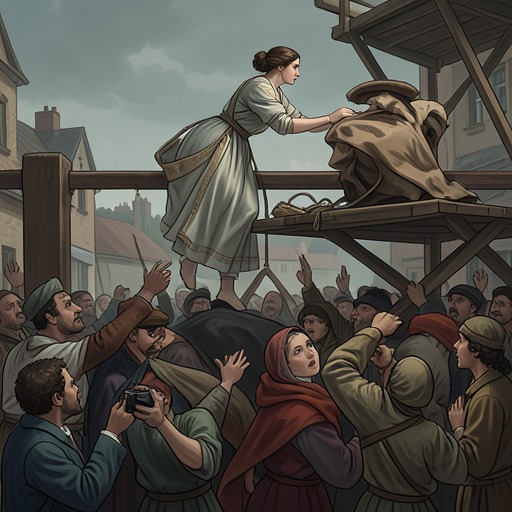
At sunrise, a crowd watches from a distance while soldiers occupy the square. The executioner, Henriet Cousin, pauses at the foot of the ladder, and the narration stresses his pity as he places the rope around Esmeralda’s neck. When she cries out and Gudule clings to her, he struggles to separate them. He finally carries Esmeralda on his shoulder and starts up the ladder. Gudule bites his hand in a last attempt to stop him; after the bystanders pull her away, she falls and dies. Her resistance cannot prevent the execution, but it makes the gallows the point at which the mother’s desperate defense and the state’s lethal procedure meet.
Witness and Meaning
From a tower of Notre-Dame Cathedral overlooking Grève Square, Quasimodo sees the ladder, the soldiers, and a man dragging a white figure with something black trailing from it. A group obstructs his view at first. When the executioner climbs, Quasimodo recognizes the young woman in white as Esmeralda. The gallows turns distance into a terrible spectacle: Quasimodo can see the execution, but cannot intervene from where he watches.
Claude Frollo is also fixed on the scene, kneeling on the balustrade to see better. As Esmeralda hangs above the pavement and the rope twists, the narrator names the paired figures as “the spider and the fly.” This image makes the gallows the center of a predatory tableau: Frollo’s gaze does not offer the rescue he had promised, but watches the death toward which he directed her. Quasimodo sees that gaze and the priest’s demonic laughter, though he cannot hear it. The gallows therefore marks both the physical completion of Esmeralda’s execution and the moral contrast between the two watchers: one witnesses helplessly, while the other has brought her to the scene and contemplates its violence.