Print kills architecture
The Hunchback of Notre DamePrint kills architecture names a historical transfer of cultural power: the printed book comes to displace the building as the chief medium in which a society records and communicates its ideas. First voiced by Claude Frollo while he gestures between a printed volume and Notre-Dame Cathedral, the claim carries both an immediate religious alarm and a broader argument about how changes in communication remake collective expression. Architecture does not simply disappear; it loses its former position as the dominant social art, while print makes thought cheaper to reproduce, easier to circulate, and less bound to one place.
The warning and its two meanings
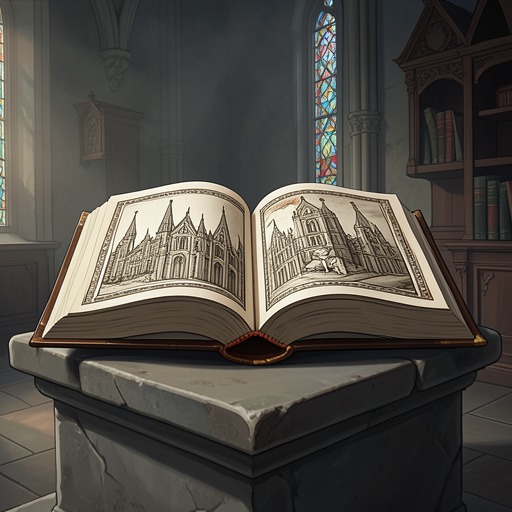
Claude Frollo’s gesture gives the idea its compact dramatic form. With the book open before him and Notre-Dame Cathedral visible beyond the window, he turns his attention from one to the other and laments that the newer medium will destroy the older one. Jacques Coictier initially asks whether the book’s danger lies simply in being printed. Claude confirms that printing itself is the decisive change, describing a small force overcoming a great one: the printed word can triumph over the massive edifice.
The narration interprets the warning as having two connected meanings. Its first meaning is priestly and political. Printing threatens the Church’s authority because it can release human thought from the sanctuary’s control: the pulpit and manuscript face a medium capable of carrying ideas beyond their established setting. In this reading, the press signals a succession of powers, with printed communication weakening the Church’s hold over belief and opinion. Claude’s fear is therefore not merely an objection to a new technology. It registers anxiety that the means of distributing thought can alter who possesses authority over it.
The second meaning shifts from religious power to artistic expression. If each age gives its dominant ideas a characteristic form, then printing changes not only how those ideas circulate but also the form in which a society makes them enduring. The building, once a durable record in stone, gives way to the book, a record on paper. The claim concerns a change of medium and of social function: architecture had expressed a people’s thought collectively, while print increasingly takes on that work.
Architecture as a record of collective life
The argument presents architecture as humanity’s principal register through the fifteenth century. Monuments preserve memory in visible, lasting form; buildings make religious and popular ideas part of the shared landscape. Unlike a manuscript, an edifice requires more than words on a page: it brings together material, labor, technical skill, and resources on a large scale. Its significance lies both in what it represents and in the collective effort required to make it.
The account contrasts the vulnerability of written documents with the endurance of built form. A manuscript can be destroyed by fire, whereas demolishing a monumental record on a comparable scale would require upheaval on a much larger scale. The comparison establishes why architecture could serve as a public memory: it occupied the landscape and outlasted the people and circumstances that produced it. The book later reverses this advantage. A printed work is faster and less costly to make, and it can travel without the heavy material apparatus required to raise an edifice.
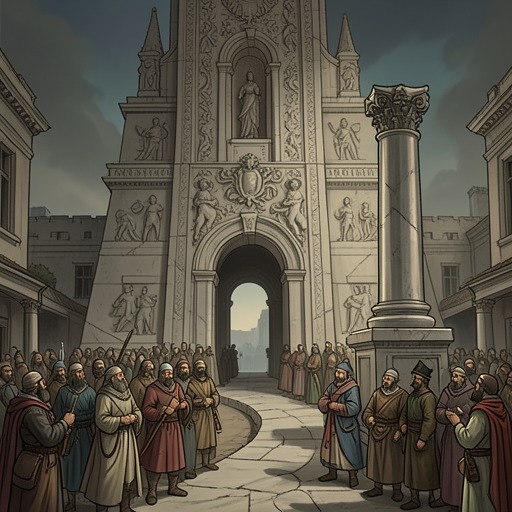
The historical panorama of Paris gives this architectural record a concrete setting. The city began on the island now identified as Île de la Cité, bounded by the Seine, then expanded across the water as successive enclosures and walls were overtaken by the growth of houses. Under Philip Augustus, a new circuit of towers enclosed Paris; later, buildings pressed beyond it and spread outward. The account depicts a city formed through successive generations of building rather than a single, completed design.
From the towers of Notre-Dame Cathedral in 1482, the observer sees roofs, bridges, streets, spires, and bell towers as an immense and varied whole. Its architectural record ranges from modest houses with carved fronts and projecting stories to royal buildings and churches. The city’s three divisions are tangled in their local streets but joined by major routes and the Seine, which carries movement among them. The resulting panorama makes architectural expression appear both collective and locally varied: individual structures contribute to a shared urban composition without losing their distinct forms.
The press and the changing historical order
The fifteenth century marks the turning point in the argument. Gutenberg’s letters of lead are presented as superseding the letters of stone: human thought gains a medium that is at once more durable in circulation and simpler to produce. Architecture’s decline is not attributed to an immediate collapse. At first, the press is still too weak to drain the vitality of powerful building traditions; the change becomes increasingly visible from the sixteenth century onward.
As architecture loses its role as the direct expression of society, it becomes, in the narrator’s account, increasingly governed by inherited classical forms. The Renaissance is described as a magnificent but declining phase: the older Gothic genius still lends radiance to buildings even as a different architectural order becomes prominent. The later sequence from the sixteenth through the eighteenth centuries extends the diagnosis. Geometry and formal rules increasingly dominate the appearance of buildings, while architecture is said to struggle to conceal the resulting rigidity. These judgments belong to the book’s historical thesis: they describe a change in cultural authority, not the literal disappearance of construction or of artistic achievement.
Meanwhile, the energy once invested in buildings flows into print. By the seventeenth century the press has become sufficiently established to preside over a major literary age. In the eighteenth, it takes up the reforming force associated with Luther and, through Voltaire, attacks the old European order whose architectural expression it has already displaced. By the century’s end, the account assigns print a transformative role; in the nineteenth century, it begins to reconstruct. The sequence makes the medium’s consequences political as well as artistic: a change in how thought is reproduced becomes part of a broader change in historical power.
Limits and continuing significance
The argument does not claim that architecture can no longer produce an exceptional monument. It allows for individual masterpieces and even for a future work of extraordinary genius. What has changed is architecture’s status: it is no longer the dominant, collective art that gathers the thought of an entire society into a shared monumental undertaking. Print can be made quickly, costs comparatively little, and reaches beyond the place where it was produced. Those practical advantages help explain why it becomes the more pervasive medium.
Nor does the book dismiss the architectural record. It insists that the past must continue to be read in the monuments that survive, even while recognizing the power of the printed record. The tension is central to the concept: stone offers visible scale, material presence, and a history written into the landscape; print offers mobility, reproduction, and reach. The warning is therefore both elegy and account of succession. In the darkness of the novel, a watcher can still look out from a tower over the city, and the built structure still organizes what can be seen. Yet the historical argument insists that the enduring social voice of a civilization has shifted from the monumental city toward the printed page.