Printing press
The Hunchback of Notre DameThe Printing press is presented as more than a device for reproducing books: it is the agent of a change in how human thought is preserved, expressed, and spread. In the chapter’s central contrast, printed pages succeed the monumental “book of stone,” diminishing architecture’s former place as humanity’s principal record. The claim that “this will kill that” thus points at once to a shift in religious authority and to a transformation in cultural form.
The Printed Volume and Its Significance
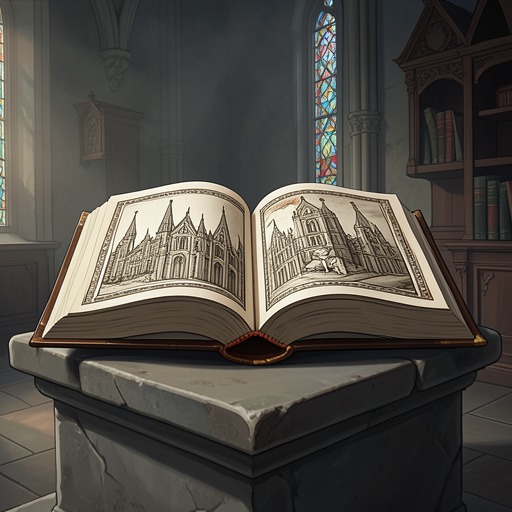
The idea takes shape in Claude Frollo’s cell, where a printed folio lies open on the table. The archdeacon gestures between the book and Notre-Dame Cathedral, then names the coming displacement. Jacques Coictier examines the volume and objects that its text is not new: it is a work by Peter Lombard, printed at Nuremberg by Antonius Koburger in 1474. The exchange distinguishes the age of a text from the significance of its medium. For Claude, the consequential fact is not that the book contains new doctrine, but that it has been printed.
The scene gives the press a concrete presence through the folio, while the chapter expands its significance beyond that single object. Claude’s image of a small thing overcoming a great one frames print as a force whose effects need not match its physical size. The comparison culminates in the book’s prospective victory over the edifice: reproducible letters, rather than stone, are to become the more powerful vehicle for carrying human thought forward.
From Monument to Book
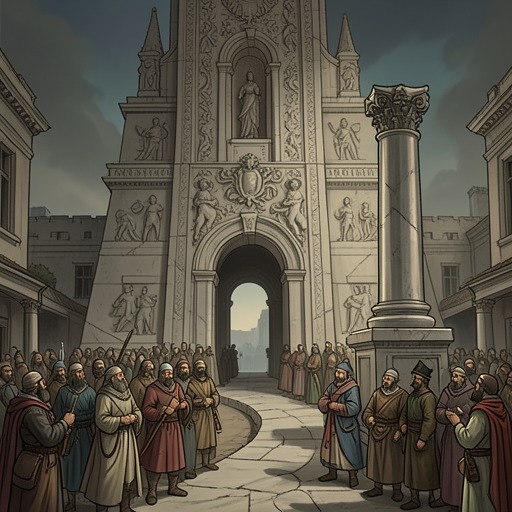
The chapter’s historical argument assigns architecture a former role as humanity’s great register. Before the fifteenth century, it says, complex ideas, popular beliefs, and religious laws were worked into buildings. Monuments preserved traditions by setting them into a visible and durable form, giving collective memory a material record that could outlast the people who made it.
Print changes that balance. The narrative describes the invention of the press as a decisive historical event and casts Gutenberg’s letters of lead as successors to the letters of stone. The contrast is not simply between two kinds of object. Architecture gathers an idea into a particular monument, one tied to a place and an era; printed thought can be multiplied and carried beyond both. The chapter imagines it spreading in every direction, no longer confined to a single monumental form or location.
This comparison turns on durability as well as reach. A building may be ruined by upheaval or physical catastrophe, the chapter argues, while printed thought can persist by moving between copies and surviving communities. Its image of thought changing from a mountain into a flock of birds captures the new medium’s paradox: less fixed in one place, yet harder to extinguish altogether. The press does not merely preserve what architecture once preserved; it alters the conditions under which preservation is possible.
Religious and Cultural Consequences
The chapter first reads Claude’s prediction as a clerical fear. The printed word appears to threaten the sanctuary’s control over ideas: the pulpit and manuscript confront a new means of transmission, while the narrator imagines intelligence and opinion challenging inherited belief. In this interpretation, the press will “kill the church” not by physically destroying it, but by enabling thought to circulate beyond the established religious framework.
The argument then widens from religious power to artistic expression. Once architecture ceases to be the sovereign art that gathers other arts within itself, the arts separate and develop independently. Sculpture becomes statuary, images become painting, and music takes its own course. The chapter links this emancipation to the broader dispersal of human thought: print and the arts’ release from architecture belong to the same historical change.
The press is also assigned a role in the religious conflicts of the sixteenth century. The chapter argues that reform without printing would have remained a schism, whereas the press made it a revolution; it describes Gutenberg as the precursor of Luther. This is presented as a causal claim about the medium’s power to carry dissent, not merely as a chronological association. Print makes opposition capable of spreading on a scale that, in the chapter’s account, changes its political and religious force.
Architecture After Its Displacement
The chapter’s account of architecture’s decline is the other side of the press’s rise. As human thought turns elsewhere, architecture loses its former expressive authority and becomes, in the narrator’s description, increasingly derivative. Other arts no longer sustain it, and buildings repeat inherited forms rather than registering the living ideas of their age.
Michelangelo’s Saint Peter’s is treated as a final exceptional achievement: a last original work that signs the closing monumental record. Later buildings that copy it illustrate the chapter’s distinction between continued construction and continuing invention. It names the Val-de-Grâce in the seventeenth century and Sainte-Geneviève in the eighteenth as repetitions in this succession, alongside copies in other countries. The press’s victory, then, is not the disappearance of buildings. It is the loss of architecture’s former status as the dominant medium through which a civilization expresses and perpetuates its thought.