Quasimodo
The Hunchback of Notre DameQuasimodo is the bellringer of Notre-Dame Cathedral, a foundling whose severe physical deformities and deafness set him apart from the people around him. Raised by Claude Frollo within the cathedral, he comes to experience its walls as his entire world and its bells as beloved companions. The novel repeatedly turns the public’s spectacle of his body into a contrast with his capacity for attachment: he can assist in an attempted abduction, defend the church with extraordinary force, and give Esmeralda sanctuary and care. His story ends in loss, but his final bond with her gives his isolated life its most consequential human connection.
Identity and Early Life
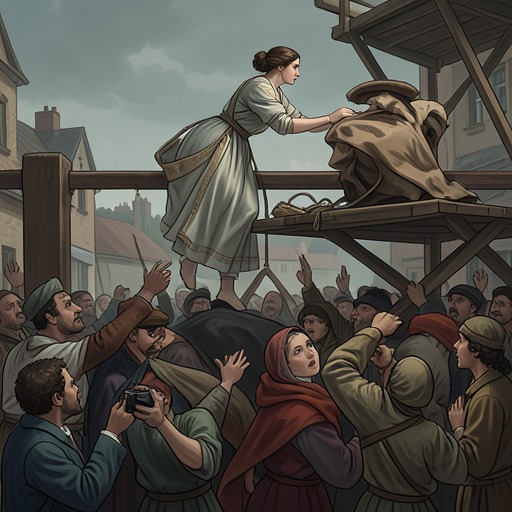
Quasimodo is found as a child in a linen sack during the public presentation of foundlings. The crowd gathers around the struggling child, whose red hair, one visible eye, mouth, and teeth make him an object of alarm and fascination. Claude Frollo, then a young priest, silently pushes through the onlookers and takes him from the sack. The child’s deformities are pronounced: his head sits close to his shoulders, his spine is crooked, his breastbone prominent, and his legs bowed. Yet he is lively and cries with force. The narrative describes Frollo’s compassion as increasing at the sight of him.
Frollo decides to rear the child as an act of charity in the name of his younger brother, Jehan. That benevolence has a deliberately practical edge: Frollo thinks of the deed as good works accumulated in advance for Jehan, should the boy later need them. He baptizes the foundling Quasimodo, a name chosen either to mark the day he was discovered or to express how incomplete the child appeared. The name therefore carries both a trace of circumstance and the judgment of those who see him as unfinished.
By 1482, Quasimodo has become the bellringer of Notre-Dame Cathedral. He is described as hunchbacked and knock-kneed, with one eye; an earlier account of his baptism calls him blind. He is also deaf. The bells that define his work have gradually taken his hearing, making his closeness to them costly as well as intimate. His body draws attention wherever he appears, while his deafness further separates him from ordinary exchange with other people.
The Cathedral and the Bells
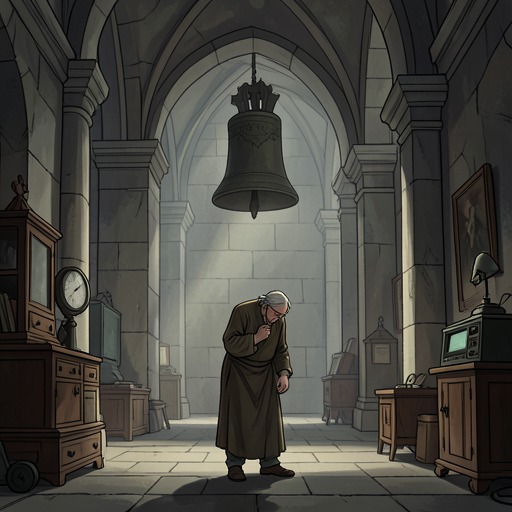
Quasimodo’s upbringing and deformity leave him isolated from the wider world. The cathedral receives him in childhood and becomes, as he grows, his shelter, home, country, and universe. This is more than a workplace or place of refuge: Notre-Dame organizes what he knows and where he belongs. His attachment to it is presented as the outcome of a life enclosed by the religious walls that first took him in.
Within that world, the bells are his deepest delight. He loves and tends them, speaks to them, and understands them; the bells in the spire and towers seem to him like birds raised to sing for him. The contrast is central to his character: the instruments that fill his solitary world with music have also made him deaf. His affection for them is not diminished by that cost. The account compares his tenderness for them to the love of a mother for the child who has caused her the greatest suffering.
His bond with Claude Frollo is the one major human attachment that stands beside his love for the cathedral. Quasimodo exempts the archdeacon from the malice and hatred he directs toward others, and loves him with an extreme, unquestioning devotion. That dependence persists even when Frollo’s actions endanger Esmeralda. Quasimodo can recognize the priest’s betrayal only after other possibilities have failed, and even then gratitude and reverence resist his jealousy and despair.
Public Spectacle and Complicity
During the Feast of Fools, Quasimodo is chosen as Pope of the Fools. His face wins the crowd’s approval as the fullest realization of the grotesque ideal the spectators have been seeking. The spectacle gives him temporary public acclaim, but it is acclaim founded on the same physical difference that elsewhere makes him a target. As he passes the Pillar House in a partly intoxicated state, a man angrily tears away his gilded wooden crosier, the emblem of his mock office.
Quasimodo is not only acted upon by the crowd. When Pierre Gringoire advances to help a young woman held by men, he recognizes Quasimodo as one of them. The moment establishes an early, troubling part in Quasimodo’s relationship with Esmeralda: he takes part in the attempted abduction before later becoming her protector. His later compassion does not erase this beginning, but it makes his changing conduct essential to his arc.
Afterward, Quasimodo is brought in bound and surrounded by a heavily armed watch. He remains gloomy, silent, and tranquil, glancing occasionally at his bonds. The narration emphasizes that his deformity, rather than any threatening action described in the scene, appears to account for the display of force around him. The crowd again identifies him by the roles and features it has made into public labels: bellringer, hunchback, one-eyed man, and former Pope of the Fools. His life is thus repeatedly exposed to an audience that sees his body before it sees his actions.
Esmeralda’s Protector
A decisive reversal comes when Esmeralda is condemned and the executioners prepare to carry out their task outside Notre-Dame Cathedral. Quasimodo descends the church’s façade by rope, knocks down the executioners, lifts Esmeralda, and carries her across the threshold. The cathedral’s sanctuary protects her there: temporal authority ends at its boundary. He runs through the church and appears again at different levels, holding her aloft and proclaiming that she has sanctuary. The public’s applause follows the rescue, turning the spectacle of his strength toward a different purpose.
He brings Esmeralda to a cell in the cathedral and supplies what she needs to recover. He returns with a basket containing a bottle, bread, and provisions, along with a mattress, and directs her to eat and sleep. His care is practical and protective rather than demanding. When she initially recoils from him, he misunderstands her invitation and retreats, limping away with his head lowered. She calls him back, runs after him, and takes his arm. Her touch makes him tremble; he follows her back, visibly affected by the welcome he had not expected.
Their communication remains shaped by his deafness. Quasimodo watches Esmeralda and understands her gestures; when she conveys something to him, his eye fills with tears, though he does not let them fall. His attentiveness and restraint distinguish his care from the possessive pursuit and betrayal that threaten her elsewhere. The cathedral gives her physical shelter, but Quasimodo’s repeated acts—rescuing her, bringing food and bedding, and responding to her gestures—make that shelter a lived relationship.
Defense, Recognition, and Ending
When the Court of Miracles outcasts attack Notre-Dame Cathedral, Quasimodo becomes its formidable defender. He uses the attackers’ alarm at a beam falling from above to prepare further defenses, piling plaster, stones, rough blocks, and masons’ tool sacks along a balustrade. When attackers climb a ladder toward the gallery, he lifts and pushes it away from the wall, then hurls it and its occupants back toward the square. These actions display the force and agility that contrast so sharply with the distorted appearance that made him a public spectacle.
The defense does not prevent Esmeralda from being taken during the upheaval. When Quasimodo discovers her cell empty, he searches Notre-Dame Cathedral in distress. He does not understand that the king’s archers are seeking her; believing the outcasts to be her enemies, he leads Tristan l’Hermite through hiding places and opens secret doors and concealed spaces. His attempt to help therefore assists those whose intentions are fatal to her. Only after he is certain that she is gone does he return, alone, to the cell where she had lived under his guardianship.
Quasimodo eventually concludes that Claude Frollo has abducted Esmeralda. He recalls the archdeacon’s access to the staircase and his earlier attempts to approach her, one of which Quasimodo had aided and another he had prevented. Yet recognition does not immediately free him from his devotion to Frollo. When he later sees the archdeacon carrying Esmeralda, with a noose around her neck, he recognizes her and pushes Frollo from the tower. The action breaks the allegiance that had governed Quasimodo’s life, but it comes too late to save her.
He remains at the balustrade, motionless and silent, watching Esmeralda and Frollo below. Tears flow from the eye that the narrative says had previously shed only one tear. Seeing the woman’s body and the fallen archdeacon together, he mourns all that he has ever loved. Quasimodo disappears from Notre-Dame Cathedral on the day of their deaths, and no one knows where he goes. About eighteen months or two years later, searchers find two skeletons in a burial cavern: a woman’s, with remnants of white clothing and an empty little silk bag, and a man’s, his crooked spine, holding her in an embrace. When others try to separate them, the man’s skeleton crumbles. The ending makes physical what Quasimodo’s life has moved toward: after a world defined by separation, his final recorded gesture is an inseparable embrace.