Quasimodo is elected Pope of Fools
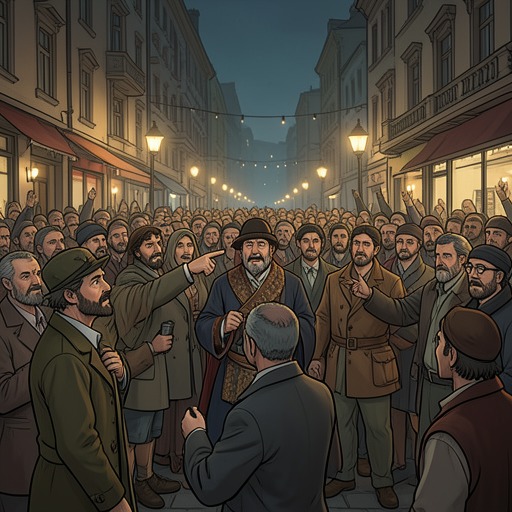
The Hunchback of Notre DameQuasimodo is elected Pope of Fools when a crowd at the Feast of Fools chooses him as the winner of a grotesque grimacing contest proposed by Jacques Coppenole. The election is comic and ceremonial rather than an appointment to real authority, but it gives the isolated bellringer a first taste of public acclaim: for a moment, the people who usually despise him treat him as their sovereign. The scene makes that reversal visible in the contrast between his malformed body, the crowd’s laughter and fear, and the splendid mock procession that follows.
From neglected play to public contest
The election begins with the collapse of Pierre Gringoire’s hopes for his performance. The crowd had once been so impatient to hear the play that it had nearly revolted against the bailiff’s sergeant; now, with the play under way, its interest has evaporated. Gringoire watches his hopes of glory crumble as the audience turns away from his work. When the usher’s monologue ends and the actors resume, Jacques Coppenole, a hosier from Ghent, rises to address the assembly.
Coppenole objects that the stage quarrel contains no actual blows and fails to entertain him. He says he had expected a Feast of Fools and the election of a Pope of Fools, a custom he knows from Ghent. In his account, people put their heads through a hole and the person whose grimace is ugliest wins by acclamation. His proposal offers the audience a more immediate spectacle than Gringoire’s verbal drama. The bourgeois, pleased by Coppenole’s flattering address, receive the suggestion enthusiastically; Gringoire is left without an effective protest as the crowd’s favor flows elsewhere.
The mechanics of the election
The contest is assembled almost at once in a small chapel opposite the marble table. A broken pane in the rose window above the chapel door leaves a circular opening for the competitors to put their faces through. Two hogsheads are stacked to provide access. Candidates of either sex are invited to conceal themselves inside the chapel until their turn, preserving the effect of an unexpectedly revealed grimace; the chapel quickly fills, and its door is shut.
Coppenole directs and organizes the proceedings while the crowd waits for the faces to appear. The contest reduces election to a deliberately crude public test: not lineage, office, learning, or virtue, but the capacity to embody the grotesque most completely. A succession of pentagonal, hexagonal, and otherwise fanciful faces fails to satisfy the audience’s extravagant expectations. When the winning face finally appears at the opening, applause and acclamation overwhelm Gringoire’s interrupted conversation with a magistrate. The election is settled by the crowd’s response, without a formal ballot or deliberation.
Quasimodo revealed as the winner
The face that wins is at first described as an extraordinary grimace, marked by an enormous, irregular nose, a mouth shaped like a horseshoe, one eye obscured by a bristling eyebrow, the other hidden beneath a large wart, broken and uneven teeth, a protruding tooth, and a forked chin. Its expression combines malice, astonishment, and sadness. The decisive surprise comes when the candidate is brought out of the chapel: the grimace is not a mask or performance. It is Quasimodo’s own face, and, as the narration stresses, his whole person seems to extend the same grotesque effect.
Quasimodo is short and broad, with a huge head and red hair, a pronounced hump on his back and a corresponding deformity at the front, legs that meet awkwardly at the knees, large feet, and monstrous hands. Yet the account also emphasizes his vigor, agility, and courage, qualities that sit uneasily beside the crowd’s fixation on his appearance. The spectators recognize him as the bellringer of Notre-Dame, the hunchback, the one-eyed man, and the bandy-legged man. Their shouted recognition makes his identity inseparable from the insults by which the public knows him, even as they acclaim him as their chosen pope.
Procession and temporary sovereignty
After the election, the crowd rushes toward the chapel and brings Quasimodo out in triumph. The spectacle moves beyond the contest: on a litter borne by officers of the Brotherhood of Fools, he appears with crosier, cope, and mitre. The procession gathers distinct groups into a carnival-like public display. Egyptians come first, followed by the Kingdom of Argot and the Empire of Galilee; the corporation of law clerks comes last. Around Quasimodo, the procession’s many instruments produce a deliberately discordant pageant, including the orchestra associated with Gringoire’s play.
As the procession travels from the Palais de Justice to the Place de Grève, Quasimodo experiences the acclaim as a reversal of his usual life. Until then, he has known humiliation, contempt for his condition, and disgust at his appearance. Though deaf, he takes pleasure in the crowd’s cheers. He hates the people because he senses that they hate him, but for this brief interval they constitute a people and he is their sovereign. Their respect is partly derisive, yet the narrator notes that it is mixed with genuine fear of his strength. The election therefore offers him real emotional gratification inside an unmistakably mocking ceremony: the crowd crowns the very body it treats as an object of spectacle, and its temporary celebration neither erases his exclusion nor makes the mock office genuine.
Narrative significance
The episode stages a sharp change in public attention. The crowd abandons Gringoire’s carefully prepared play for an event whose attraction lies in immediate bodily display, and then shifts again as the election becomes a procession. Each spectacle displaces the last, while Gringoire’s disappointment and Quasimodo’s sudden delight register opposite consequences of the same volatility. The contest also makes grotesque appearance the explicit basis of a mock hierarchy: Quasimodo’s physical difference, ordinarily a source of rejection, wins him a crown for a day.
The elevation is consequently both a comic inversion and a fragile one. Quasimodo receives the outward signs of office and the collective recognition of a ruler, but what the crowd celebrates is precisely what marks him as an outsider. His pleasure is not false simply because the ceremony is satirical; it is the first public affirmation he has known. The scene lets that moment stand in its contradiction: the people’s derision briefly becomes the source of his dignity, while their acclamation remains bound to the spectacle of his difference.