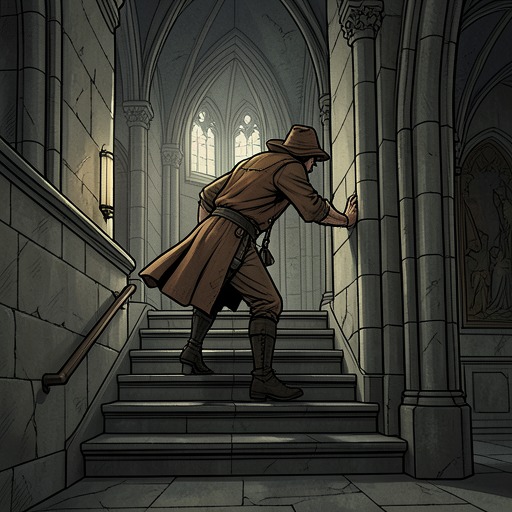
Quasimodo's congenital deformities
The Hunchback of Notre DameQuasimodo's congenital deformities mark him from birth as visibly different, but the novel presents more than a list of bodily traits: they shape the circumstances of his abandonment, Claude Frollo's decision to adopt him, and the way Quasimodo lives in the world of Notre-Dame Cathedral. His later deafness is not congenital; it follows years of ringing the cathedral's bells and deepens an isolation already formed by his body and by other people's response to it.
Discovery and Physical Description
Quasimodo is found not as a newborn but as a little boy, at least four years old, struggling in a linen sack stamped with a bishop's cipher. The onlookers gather around the foundling bed in alarm and hostility. One woman says she would sooner nurse a vampire than the child; another points out his age and ridicules the suggestion. Their reactions make his abandonment a public spectacle before he has any chance to speak for himself.
The narrative describes a lively, angular child whose red hair surrounds a head marked by one visible eye, a crying mouth, and teeth. When Claude Frollo removes him from the sack, his bodily differences become more fully apparent: a wart over his left eye, a head set directly on his shoulders, a crooked spine, a prominent breastbone, and bowed legs. The account also stresses his vigor. Though his lisp is difficult to identify as speech in any language, his cry conveys force and health. His body is described through conspicuous difference, but the child is not lifeless or passive: he struggles, weeps, cries, and bites.
Adoption, Name, and Development
Claude Frollo approaches the foundling after saying Mass and carries him away out of pity. The child's deformity and abandonment move him, as does the thought that his own young brother, Jehan Frollo du Moulin, might someday be left on the same plank. Frollo resolves to raise the child for his brother's sake, treating the act as charity accumulated in advance for Jehan. Adoption changes the child's immediate fate, though it does not remove the physical conditions or social isolation that will mark his life.
Frollo baptizes him Quasimodo. The name may commemorate the day he was found, or indicate how incomplete the child seemed; the narrator connects it to the sense of an almost-finished being. Quasimodo is described as one-eyed, hunchbacked, and knock-kneed. In this account, the name makes his bodily difference part of his public identity from the beginning, rather than a condition that can be separated from how others see him.
Consequences and Life at Notre-Dame
Quasimodo's congenital conditions must be distinguished from the deafness he acquires later. Born one-eyed, hunchbacked, and lame, he learns to speak only through Claude Frollo's patience and effort. At fourteen he becomes the bellringer of Notre-Dame Cathedral. The bells then damage his ears and leave him deaf: an additional infirmity, caused not by birth but by his work in the cathedral.
The loss of hearing closes what the narrator calls the only remaining route through which joy and light reached Quasimodo. He becomes profoundly isolated and, not wanting to make others laugh at the way he speaks, voluntarily keeps silent except when alone. When necessity forces him to talk, his tongue is described as awkward and slow. Yet Notre-Dame Cathedral is also a space he knows intimately: he has explored its heights and depths and climbs its towers without the vertigo or terror they inspire in others. The contrast matters. His life is not represented only as incapacity; within the cathedral, prolonged familiarity and physical practice make a difficult architectural world his home.
Narrative Significance
The account connects Quasimodo's physical difference to both other people's cruelty and one person's charitable response. The crowd's disgust and threats make his body a reason for exclusion; Claude Frollo's pity becomes the immediate cause of his rescue and upbringing. Adoption secures him a place in the world, but it does not undo his deformities, prevent his later hearing loss, or spare him the fear of being mocked.
The narrative also distinguishes the body Quasimodo is born with from the silence that follows an injury acquired in service to the cathedral. His physical traits, his labor as bellringer, and the social consequences of deafness accumulate rather than collapse into a single condition. At the same time, his ease among Notre-Dame Cathedral's towers complicates an account of him based solely on deficiency: the building that is home to him is also a place his practiced body can traverse with extraordinary familiarity.