Quasimodo's social isolation
The Hunchback of Notre DameQuasimodo's social isolation is not simply a matter of living apart: it is a condition formed by abandonment, bodily difference, hostility from other people, and his increasingly complete attachment to Notre-Dame Cathedral. The church becomes his home and his whole known world, while the deafness that cuts him off from human voices and his decision to stop speaking make that separation still harder to cross. The narrative sets the calm of his life among the cathedral's figures and spaces against the ridicule that greets him in the streets, showing isolation as both an enclosure and a refuge.
Origins of the Enclosure
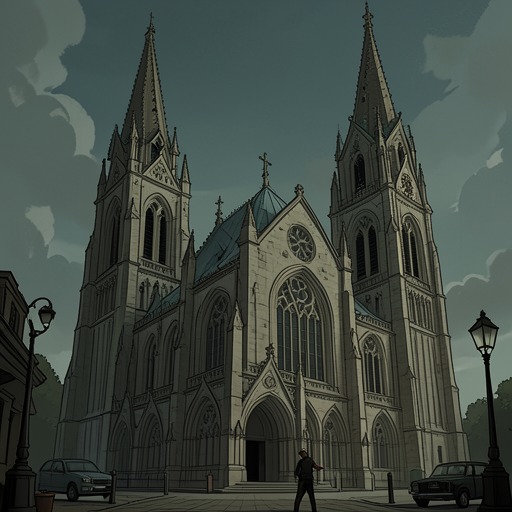
Quasimodo is separated from the world from infancy by two circumstances the narrative emphasizes: his unknown birth and his natural deformity. The walls of Notre-Dame Cathedral receive him, and as he grows up the building becomes, in turn, his shelter, home, country, and universe. This progression makes his isolation spatial as well as social. He does not merely retreat to the cathedral after encounters with people; the cathedral supplies the environment in which his whole sense of the world takes shape.
The description of his early movement through the church makes that attachment seem almost bodily. As a small child, he crawls awkwardly beneath the vaults, his human face and misshapen limbs set against the shadows cast by Romanesque capitals. Later, he climbs and leaps through the cathedral's heights with a familiarity that suggests the structure has become an extension of his life. The image is not of a visitor finding shelter but of someone whose only settled place is the building that has surrounded him since childhood.
A World Made of Stone
The cathedral supplies Quasimodo with companionship as well as shelter. Its statues are a society in which he can remain without the immediate threat of laughter: the figures of kings, saints, and bishops look upon him calmly, while the monsters and demons seem to accept him through resemblance. He treats the saints as friends and the monsters as guardians, spending long periods crouched before the statues in solitary conversation. When an actual person approaches, he slips away, as if this private communion could not survive an outside gaze.
His sense of nature is likewise remade by the building. Painted windows take the place of flowering hedgerows; carved foliage and its stone birds stand in for living shade; the towers become mountains, and the expanse of Paris below them becomes an ocean. These are not incidental comparisons but measures of how completely his experience has been enclosed within Notre-Dame Cathedral. The forms available to him are architectural ones, so the church gives him a landscape, a society, and a scale for imagining the world beyond its walls.
Deafness and Chosen Silence
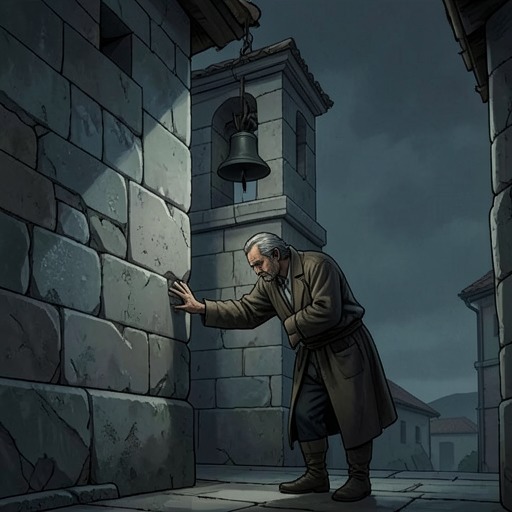
Quasimodo's deafness makes his separation more severe. Born one-eyed, hunchbacked, and lame, he was taught to speak only with difficulty and great patience by Claude Frollo. At fourteen he became the cathedral's bellringer; the bells then damaged his hearing, closing off what the narrative calls the remaining avenue of light between him and other people. The account presents this loss not as an abstract condition but as a change in how he can participate in human company.
When he realizes that he is deaf, Quasimodo chooses silence so that people will not laugh at him. This response turns an impairment into a further barrier, but it also reveals the social pressure behind his withdrawal: he anticipates ridicule and restrains the very speech he had labored to acquire. He speaks only when alone, and when necessity forces him to use his voice, it has become halting and awkward through disuse. His silence is therefore neither simply imposed by deafness nor freely detached from his circumstances; it is a defensive adaptation to a world in which speech has exposed him to mockery.
Rejection in the Streets
Outside the church, Quasimodo's difference draws cruelty rather than accommodation. When he and Claude Frollo pass through the narrow streets near Notre-Dame, they are met with insults, jeering songs, and taunts. The hostility can become physical: a mischievous child risks injury for the pleasure of driving a pin into Quasimodo's hump. Others direct ridicule at the pair, treating the bellringer's body and the archdeacon's presence as invitations to public abuse.
The narrative connects this history of rejection to Quasimodo's own hostility. It first describes him as malicious and savage, then qualifies that judgment: malice may not have been innate, but something he acquired after being cast out, cursed, and hated. He takes up, in effect, the weapon with which he has been wounded. This explanation does not erase the account's harsh language about his character; it places that characterization beside a history of mistreatment, making social cruelty part of the conditions under which his behavior is understood.
Isolation and Its Irony
The public insults often fail to reach their intended targets, but for different reasons. Quasimodo is too deaf to hear most of them, while Claude Frollo is too absorbed in thought. That missed communication does not make the streets welcoming: the taunts continue, and Quasimodo's deafness merely prevents him from receiving some of their content. The contrast underscores the difference between being spared an insult and being accepted by the people who deliver it.
Notre-Dame Cathedral remains Quasimodo's refuge even though its bells caused the loss that deepened his isolation. He continues to live within its community of stone figures and architectural forms, while the human world beyond it is marked by rejection. His condition thus joins two kinds of enclosure: the limits imposed by his body and the social exclusion enforced by other people. The cathedral offers a world in which he can belong, but the need for that world also registers how thoroughly the society outside has denied him a place.