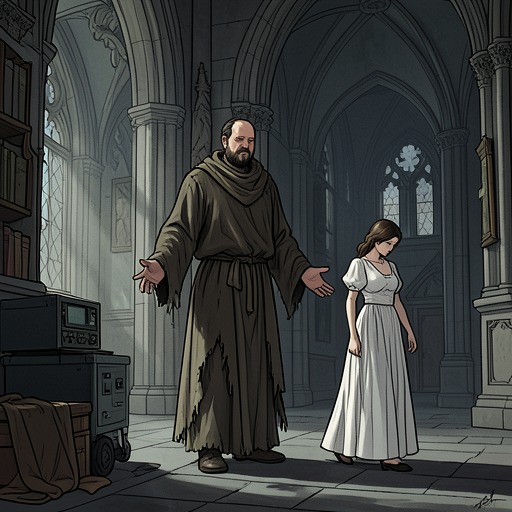
Quasimodo's whistle
The Hunchback of Notre DameQuasimodo's whistle becomes Esmeralda's means of calling for help at the moment Claude Frollo threatens her in the darkness of her cell. Its piercing sound summons Quasimodo, interrupting the attack and turning a small, aging object into the means of her rescue.
Object and Use
The whistle is cold metal, lying within reach as Esmeralda struggles and crawls across the floor. With nothing else coming to her aid, she seizes it in a convulsive hope, raises it to her lips, and blows with all the strength she has left. The sound is clear and piercing, carrying through the dark cell.
The whistle functions as a signal rather than a weapon: Esmeralda cannot overpower Claude Frollo, but she can call someone who can intervene. The sound is followed almost at once by Quasimodo's vigorous arrival. Claude Frollo, unable to distinguish clearly who has seized him in the darkness, hears teeth chattering with rage and sees the blade of a large knife above him. The whistle's call has changed Esmeralda's immediate danger into a confrontation that forces the priest to withdraw.
Rescue and Return
After Claude Frollo retreats, Quasimodo picks up the whistle that has just saved Esmeralda. He hands it back with the observation, “It was getting rusty,” then leaves her alone. The brief exchange establishes both the whistle's prior wear and Quasimodo's familiarity with it; the object is not newly introduced for this crisis but already belongs to his world.
Its rescue does not resolve Esmeralda's wider peril. Shaken by the violent scene, she falls back exhausted on her bed and sobs, while her prospects darken again. The whistle has brought immediate protection, but Quasimodo's departure leaves her alone once more.
Narrative Significance
The scene gives the whistle a concentrated practical and emotional significance. Its small, cold, rusty form contrasts with the force of the sound it releases: in a dark cell where Esmeralda is struggling and no help initially comes, a single blast makes her distress audible and summons Quasimodo. The object briefly reverses the balance of power without ending her vulnerability.
Its importance is also defined by the exchange after the danger passes. Quasimodo retrieves the whistle and returns it to Esmeralda, linking his intervention to an object associated with him while leaving her with the means that has just saved her. The gesture is quiet and brief; the scene closes not in safety, but with Esmeralda exhausted and the earlier gloom returning.