Quasimodo’s final union with Esmeralda
The Hunchback of Notre DameQuasimodo’s final union with Esmeralda is the novel’s last revelation: long after both have disappeared from the world of the living, their remains are found locked together in the charnel-house beneath the Montfaucon Gallows. The embrace gives physical form to Quasimodo’s unreturned devotion, but its setting—among the remains of the executed—makes the ending less a conventional reunion than a final, desolate joining in death.
From Execution to Disappearance
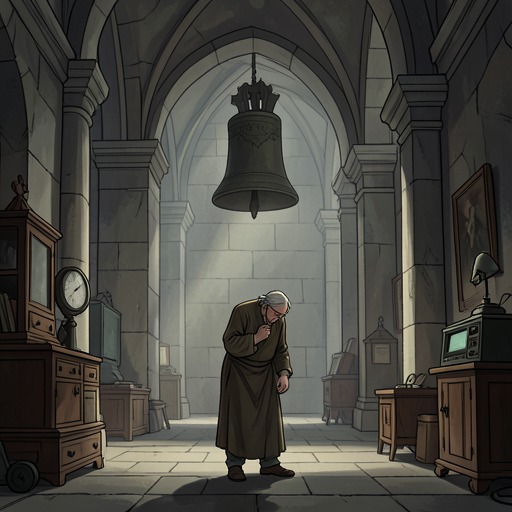
During the night after Esmeralda’s execution, the night men detach her body from the gibbet and carry it, according to custom, to the cellar beneath the Montfaucon Gallows. Quasimodo has vanished from Notre-Dame on the day of Esmeralda’s and Claude Frollo’s deaths; no one knows where he has gone. The narrative offers no witness to his journey or to the moment he reaches the cellar, preserving the final embrace as something reconstructed only from what is found later.
The place itself is a repository for the condemned. Its cellar receives not only bodies removed from the chains of the Montfaucon Gallows but also the remains of people executed at Paris’s other permanent gibbets. Above it, the old structure is already decayed: its beams are worm-eaten, its chains rusted, and grass grows on the unused platform. Esmeralda’s body is thus carried into a public architecture of punishment, where her fate becomes part of a larger accumulation of anonymous human remains.
The Discovery in the Charnel-House
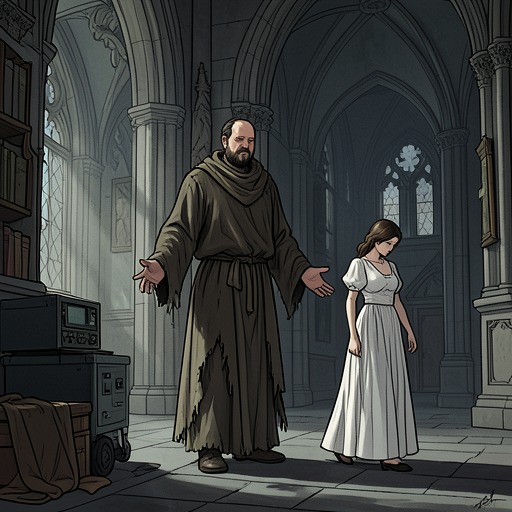
About eighteen months or two years later, men searching the cavern for Olivier Le Daim find two skeletons among the heaps of bones. One is a woman’s, with remnants of a once-white garment and a string of adrézarach beads around her neck; attached to the beads is a small silk bag ornamented with green glass, open and empty. These modest remnants identify the woman as Esmeralda and connect the discovery to the objects she had with her in life.
The other skeleton holds the woman’s in a close embrace. Its crooked spine, head set upon the shoulder blades, and one leg shorter than the other mark it as Quasimodo. The bones show no fracture at the nape of the neck, so he had not been hanged: the account concludes that he came to the cellar and died there. When the searchers try to separate the skeletons, the man’s falls to dust. The gesture survives only as a posture preserved in bone, and even that evidence cannot be disturbed without vanishing.
The Meaning of the Final Union
The chapter is titled “THE MARRIAGE OF QUASIMODO,” but the discovery gives that title its starkly figurative force. There is no witnessed ceremony or account of a shared life after Esmeralda’s death. Instead, the only certainties are her body’s customary removal to the cellar, Quasimodo’s disappearance, and the later finding of his remains clasped around hers. The ending makes the embrace his last known act and the sole answer to the mystery of where he went.
The final image also reverses the social meaning of Quasimodo’s body. In life, his visible deformity separates him from others; in death, the same crooked spine and shortened leg identify him and make the embrace unmistakably his. Yet recognition arrives only after the body has become a skeleton, and separation reduces it to dust. The novel closes not with rescue or restored life, but with a bond that the narrative can recognize and name only in the place where society has gathered its dead.