Quasimodo’s physical deformity and deafness
The Hunchback of Notre DameQuasimodo’s physical deformity and deafness are not merely features of his appearance: in the final events at Notre-Dame Cathedral, they shape what he can perceive, how he acts, and how the story’s last discovery identifies him. His deafness helps turn his loyalty to Esmeralda into an unintended aid to those pursuing her, while his deformed skeleton provides the unmistakable trace of his body after death.
Deafness and Misrecognition
When Quasimodo discovers that Esmeralda has vanished from her cell while he was defending her, his response is physical and immediate: he clutches his hair, stamps in pain and surprise, and searches the church, calling and crying out. At the same moment, the king’s archers enter Notre-Dame Cathedral looking for her. Quasimodo believes the outcasts are her enemies, so he helps the archers pursue their own fatal purpose without understanding it.
He conducts Tristan l’Hermite through the church’s hiding places, opens secret doors, and shows him the double bottoms of altars and the rear sacristies. The tragedy lies in the distance between Quasimodo’s intention and the consequence of his actions: he is trying to protect Esmeralda, yet his failure to recognize who the searchers are would have led him to deliver her to them had she still been inside. Once the search yields nothing, he continues alone, circling the church repeatedly and looking into every recess.
Following Claude Frollo
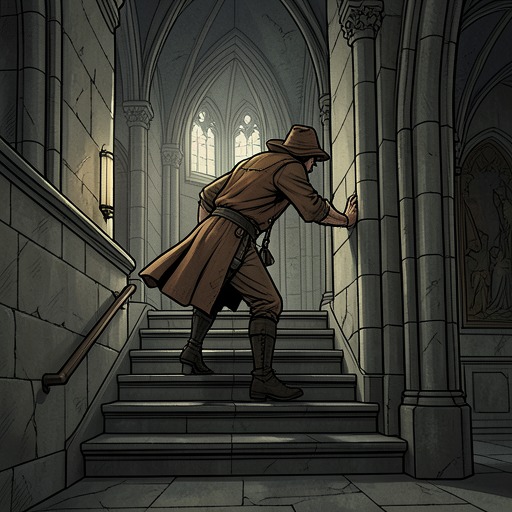
At daybreak, Quasimodo sees Claude Frollo crossing the upper level of Notre-Dame Cathedral and entering the north tower. He follows him, though he cannot say what he means to do or what he wants. His response is divided between fury and fear, because the priest and Esmeralda have come into conflict in his heart. The account identifies him as deaf at the moment he watches Claude disappear into the stairway; it presents his pursuit as an act of uncertain, bodily urgency rather than a clearly formed plan.
At the summit, Quasimodo pauses in the shadow of the stairs and cautiously studies Claude, whose back is turned as he looks down toward the town. The scene places Quasimodo in a position of watching and following, still unable to resolve the competing attachments that draw him there. His deafness is part of this isolation, but the episode does not reduce his response to it: the narrative also stresses his fury, fear, and divided loyalty.
The Body Identified in Death
About eighteen months or two years after the events, a search for Olivier Le Daim’s body in a cavern uncovers two skeletons locked in an embrace. The woman’s remains retain scraps of a once-white garment, beads, and an open, empty silk bag. The man’s skeleton is identified by its crooked spinal column, head resting on the shoulder blades, and one leg shorter than the other—the bodily signs associated with Quasimodo’s deformity.
The remains show no fracture at the nape of the neck, and the account concludes that the man had not been hanged: he came to the cavern and died there. When those searching try to separate him from the woman he holds, his skeleton falls to dust. The final physical evidence therefore does more than establish his bodily difference; it confirms the enduring embrace with Esmeralda and gives his story an ending in which the body that had set him apart becomes the means by which he is recognized.