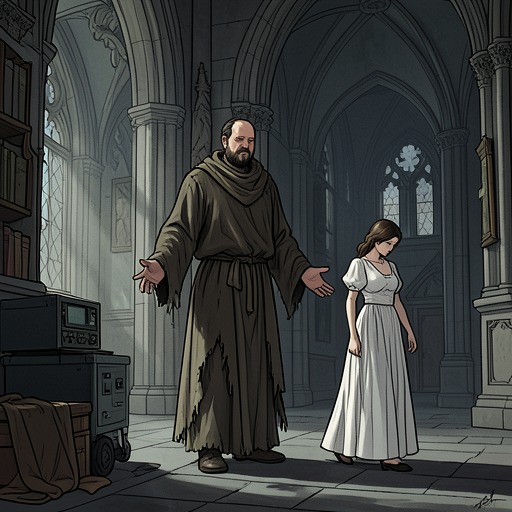
Quasimodo’s unrequited, selfless love
The Hunchback of Notre DameQuasimodo’s unrequited, selfless love is defined not by a declaration of possession but by the choices he makes when Esmeralda’s feelings belong elsewhere. He recognizes her attachment to Phoebus, accepts that his company is unwelcome, and continues to care for her unseen. When Claude Frollo threatens her, Quasimodo is ready to put himself between them, even at the cost of his own life. The pattern is one of devotion without expectation: Esmeralda does not return his love, yet his care persists without requiring her gratitude or presence.
Recognition and Renunciation
After Phoebus kicks him, Quasimodo’s eye flashes and he makes a movement as if to attack the captain. He checks himself, however, and tells Phoebus how fortunate he is to have someone who loves him, emphasizing the words that name the privilege Quasimodo himself lacks. He then releases the horse’s bridle and sends Phoebus away. The moment brings jealousy and restraint into the same scene: Quasimodo feels the impulse to retaliate, but does not act on it, and his parting words acknowledge Esmeralda’s love for another man rather than challenge it.
That recognition is painful precisely because it is clear-eyed. Quasimodo does not mistake Esmeralda’s affection for his own, nor does he treat her love for Phoebus as a claim he can contest. His words turn attention away from his injury and toward the emotional good fortune of being loved. The contrast establishes the asymmetry at the center of the relationship: he understands what Esmeralda wants, while knowing that he is not the person she wants.
Withdrawal and Unseen Care
When Esmeralda tells him to go, Quasimodo leaves. He would rather endure her abuse than cause her distress, and keeps his own pain to himself. From then on, he stops visiting her cell. She sometimes glimpses his face high on the towers, turned sadly toward her; as soon as she notices him, he disappears. His withdrawal is not a demand for attention or a test of whether she will call him back. It is an effort to respect her displeasure, even though absence costs him the only direct contact he has had with her.
Esmeralda is not deeply grieved by his voluntary absence and is, at heart, grateful for it. The narration makes the unequal attachment explicit rather than presenting his devotion as secretly reciprocated. Yet she senses the presence of a benevolent guardian. While she sleeps, provisions are replenished by an unseen hand; one morning a cage of birds appears at her window. A sculpture above the window, which had frightened her and which she had pointed out to Quasimodo, is broken one night. The text notes that whoever climbed to reach it must have risked his life. These acts connect his attention to details she has revealed in passing: he remembers what frightens her and responds without asking to be seen or thanked.
At times Esmeralda hears a sad, unusual song from beneath the bell tower’s wind screen. Its unrhymed lines, the narration observes, are characteristic of what a deaf person can make. The song asks her to look beyond a person’s face and consider the heart, contrasting outward beauty with inward deformity. Its meaning resonates with Quasimodo’s own position, but the care remains indirect: he offers a thought through song rather than asking Esmeralda to change her feelings. Her gratitude for his absence and her awareness of an unseen protector therefore coexist without resolving the difference between them.
Protection at Esmeralda’s Door
The devotion becomes direct again when Claude Frollo menaces Esmeralda. She sees that the roles have abruptly changed: the priest is threatening, while Quasimodo is the one pleading. At her door, Quasimodo kneels and tells Claude Frollo that he may do as he pleases afterward, but must kill him first. He presents his knife. The gesture makes his priorities unmistakable: in the immediate crisis, he places Esmeralda’s safety before his own.
Esmeralda takes the knife before Claude Frollo can seize it and holds him at a distance. She insists that Phoebus is not dead, and Claude Frollo leaves. Quasimodo then picks up the whistle that has just saved her and returns it, remarking that it was getting rusty. The brief exchange closes with care rather than a request for closeness: after helping protect her, he hands back the object and leaves her alone. The scene also preserves Esmeralda’s agency; she takes the knife herself and confronts the priest, while Quasimodo’s intervention gives her protection without replacing her action.
The Meaning of an Unanswered Devotion
Across these scenes, Quasimodo’s love takes several distinct forms: restraint when Phoebus is present, disappearance when Esmeralda asks him to leave, practical care carried out at night, and a willingness to die before allowing Claude Frollo to harm her. These actions are not evidence that Esmeralda secretly loves him. The text instead records her relief at his absence and her appreciation of an unseen benevolence, keeping his devotion and her preference separate.
That separation gives the love its selfless character. Quasimodo does not turn his suffering into a claim on Esmeralda, and the story does not make his kindness a bargain that guarantees affection. Even the song about looking to the heart does not secure a change in her feelings. His devotion matters through what it enables him to do: notice her fears, protect her, and withdraw when she wants distance. The result is a bond that is emotionally significant but unequal, sustained by his care rather than by mutual attachment.