Rat-Hole Hermitage
The Hunchback of Notre DameThe Rat-Hole Hermitage is a small, windowed cell in the Tour-Roland Hermitage, set against one of the busiest public squares in Paris. Created as a place of lifelong mourning and prayer, it became a refuge for women in grief or penance. Its stark enclosure makes private suffering visible to the city: passersby can look in, leave alms, and encounter the embroidered shoe that embodies its occupant’s loss. In the later pursuit of her daughter, the cell’s role as sanctuary is tested by armed force.
Setting and Architecture
The cell occupies the ground floor of the old Tour-Roland Hermitage, hollowed into the thickness of its walls at the corner of the façade facing the square. It has no door; its sole opening is a narrow, arched window crossed by two iron bars. That aperture admits only a little light and air, while leaving the recluse exposed to the sounds and movement of the public square outside. The narrative emphasizes the contrast: the cell’s profound quiet lies within a place that swarms and cries with life.
A public breviary is fixed beside the window, protected from rain by a small penthouse and from theft by a grille that still allows its pages to be turned. The arrangement makes the opening more than a source of light: it is also the point where the enclosed woman and the city meet. The book invites passersby to stop and pray; prayer, in turn, is meant to remind them to give alms, so the recluse does not perish through hunger or neglect.
The interior intensifies the sense of confinement. It is small, broader than it is long, and capped by an arched ceiling. Its bare flagstones and single corner leave little room for anything but the body of the person enclosed there. When Mahiette and her companions peer in, the recluse is crouched on the floor, knees drawn to her chest and long gray hair falling across her face and legs. The opening frames her against the darkness, making the cell seem at once a real room and a tomb-like retreat.
Foundation, Inscriptions, and Names
The cell’s founding story reaches back nearly three centuries. Rolande de la Tour, mourning her father, who had died in the Crusades, had the room hollowed out in the wall of her own house. She walled up its door, kept the window open in every season, and gave the rest of her palace to the poor and to God. For twenty years she waited there for death, praying for her father, sleeping on ashes without a stone for a pillow, and living on bread and water left on the window ledge by passersby. In this way, she received charity after having bestowed it.
Before her death, Rolande left the cell in perpetuity to women who wished to pray for others or themselves, or to withdraw into a great grief or penance. The poor mourned her and treated remnants of her clothing as relics, though she was never canonized. The city’s public breviary perpetuated her memory while serving a practical purpose: it linked devotion with the charitable acts on which later recluses depended. The room’s history therefore joins an act of personal renunciation to an ongoing civic obligation.
An inscription above the window gives the cell its devotional instruction: TU, ORA. Because there is no door above which to place a motto, the words are carved over the opening. The public’s more earthy name for the damp, gloomy cavity is the Rat-Hole. That name trades the inscription’s piety for a vivid description of the place, holding together two views of the same enclosure: a sacred retreat and a cramped, unwelcoming hollow.
The Recluse and the Shoe
At the time of the story, the cell is occupied. It has rarely stood vacant since Rolande’s death; women have come there to mourn relatives, lovers, or their own faults. The recluse whom Mahiette calls Paquette la Chantefleurie is first seen as a nearly immobile figure, hunched in a brown sack with gray hair obscuring much of her face. The barred window allows the women outside to look in, but their gaze and tears do not disturb her.
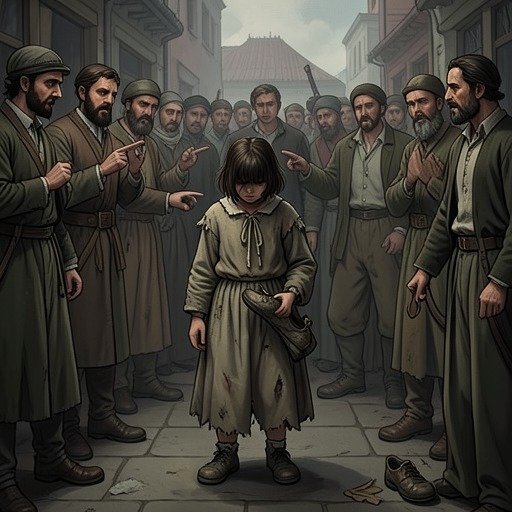
In the corner toward which the recluse’s eyes are fixed lies a tiny pink satin shoe, embroidered with gold and silver designs. The object is a concentrated remnant of a life beyond the cell: its fineness stands out against the bare stone, the coarse sack, and the woman’s severe stillness. The women recognize that the shoe belongs to the story of her lost child, and its presence explains why the recluse’s attention remains fixed there. The cell preserves her grief not through speech, but through the repeated, silent act of looking at this small keepsake.
Refuge Under Threat
The Rat-Hole Hermitage later becomes the hiding place where Gudule tries to protect her daughter, Esmeralda. Hearing that armed men are coming to search for her, Gudule hides Esmeralda in a shadowed corner, arranging her so that neither hand nor foot can be seen from outside. She spreads her own black hair over Esmeralda’s white robe and places her jug and paving stone before the hiding place, as if these meagre possessions could conceal her. The cell’s darkness, which has long enclosed the recluse’s sorrow, becomes a practical defense.
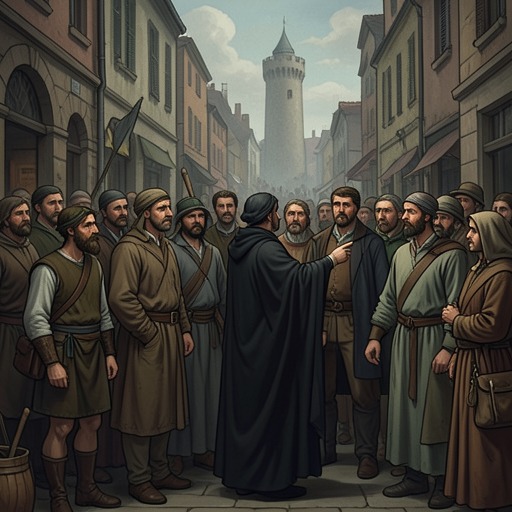
The hiding place is soon surrounded by armed men and horses on Grève Square. The priest identifies the location as the Rat-Hole Hermitage, and Captain Phoebus de Châteaupers is also summoned there. When the commander demands that Gudule give up the girl, she insists that Esmeralda is her daughter. The soldiers then bring picks and crowbars to break through the wall, removing a course of stone beneath the window to widen the opening. Gudule throws her paving stone at the workmen; trembling, she misses, and it falls beneath the commander’s horse.
This assault exposes the limit of the cell’s protection. Its barred window and thick wall once defined a chosen withdrawal from the world, but they cannot secure the occupant against the organized force of the search party. Yet the defense is more than architectural: Gudule uses the cell’s darkest corner, her own hair, and the few objects it contains to shield Esmeralda. The Rat-Hole Hermitage thus gathers the novel’s opposing forces into one confined space—prayer and public life, memory and present danger, a mother’s desperate care and the violence that threatens to overcome it.