Renaissance
The Hunchback of Notre DameIn the book’s account of architectural history, the Renaissance is both a moment of brilliance and the beginning of a rupture. Its luxury, inventive forms, and idealized sculpture could make Paris more beautiful, yet the movement did not merely add a new layer to the medieval city: it also sought room by removing what came before. The resulting tension between aesthetic splendor and historical loss makes the Renaissance a turning point in the fate of Gothic architecture and in architecture’s changing place in society.
A New Layer in the City
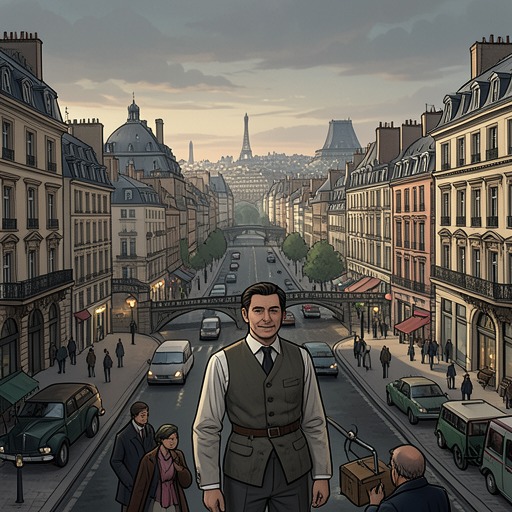
The narrator first presents medieval Paris as a coherent historical whole, shaped chiefly by Romanesque and Gothic layers. About fifty years later, the Renaissance began to mingle with that unity. Its architectural vocabulary combined Roman round arches, Greek columns, and Gothic bases, while its sculpture was described as tender and ideal. Arabesques and acanthus leaves supplied a distinctive decorative language, and its architectural paganism marked a departure from the city’s medieval character.
This new Paris could, in the narrator’s estimation, be more beautiful than before, even as it became less harmonious to the eye and to thought. The distinction matters: the critique is not that Renaissance architecture lacked beauty, but that its beauty belonged to a less unified architectural world. The period appears as a dazzling enrichment whose variety also unsettled the continuity that had made the earlier city legible as a single historical creation.
Splendor and Destruction
The Renaissance, in this account, was not content simply to build. It required space, and the narrator makes that appetite visible through a sequence of construction and demolition: Saint-Jacques de la Boucherie had scarcely been completed when the old Louvre began to be demolished. Gothic Paris, therefore, existed in its fullness only briefly. The new style’s achievement and its destructive consequence are joined in the same historical movement.
The broader attack on medieval buildings is attributed not only to one period or one cause. Time gradually wore their surfaces; political and religious revolutions damaged their sculpture and windows; and successive fashions altered their forms under the banner of good taste. The narrator judges fashion especially destructive because it did more than injure or remove ornament: it imposed new designs upon Gothic buildings and disorganized their underlying artistic structure. Renaissance deviations are placed at the start of this longer sequence, whose later decorative excesses are traced from Catherine de Medicis’s oratory to the boudoir of the Dubarry.
Paris as a Record of Changing Styles
The changing architecture of Paris gives the argument a citywide scale. The narrator describes successive versions of the city through buildings associated with different rulers and regimes: Catherine de Medicis at the Tuileries; Henri II at the Hôtel de Ville; Henri IV at the Place Royale; Louis XIII at the Val-de-Grace; Louis XIV at the Invalides; and Louis XV at Saint-Sulpice. Later examples extend the sequence to the Pantheon, the School of Medicine, the Place Vendome, and the Bourse.
These buildings are not all identified as Renaissance works. Rather, their contrasting forms show what followed the brief unity of Gothic Paris: brick façades and stone corners, squat masses and heavy domes, gilded grandeur, elaborate stone ornament, and later imitations of classical architecture. The succession makes the city seem like a record repeatedly rewritten. The narrator’s question about what replaced Gothic Paris is pointed: a sequence of styles can fill the city without restoring the coherent historical whole that has been lost.
Architecture and the Rise of Printing
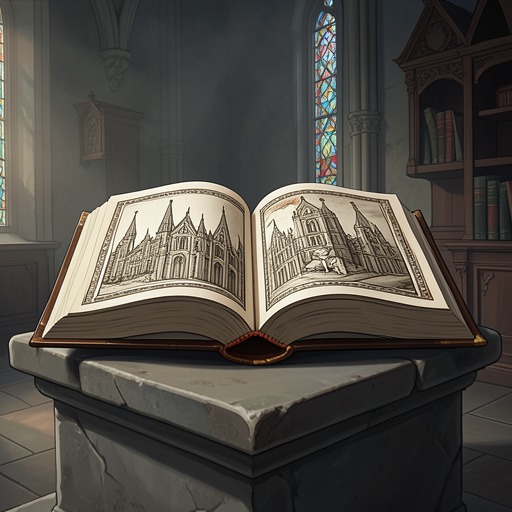
The Renaissance also belongs to a larger account of changing forms of expression. With the discovery of printing, the narrator argues, architecture gradually withers as the thought of a people withdraws from it. The change is slow at first: in the fifteenth-century setting, the press is still too weak to overcome the vitality of powerful architecture. But from the sixteenth century onward, the decline becomes visible. Architecture ceases to express society in the same direct way and turns toward a pseudo-classical mode, moving from what the narrator calls a Gallic, European, indigenous art toward forms modeled on Greek and Roman precedents.
The contrast rests partly on the different means each art requires. A building calls for several arts, substantial wealth, stone, timber, and the labor of many people; a book can carry thought through paper, ink, and a pen. As printing offers a more practicable vehicle for ideas, architecture loses its former centrality as their public expression. The Renaissance is thus framed as a magnificent sunset rather than a simple dawn: its remaining Gothic energy still illuminates hybrid structures of Latin arcades and Corinthian columns, but that lingering brilliance can be mistaken for the beginning of a new architectural vitality. The period’s significance lies in this double movement—formal invention accompanied by the weakening of the older art’s social and historical authority.