Right of sanctuary
The Hunchback of Notre DameThe Right of sanctuary gives a person who reaches a recognized sacred place protection from immediate seizure and punishment by secular authorities. In the novel, that protection is neither a pardon nor a secure release: it depends on remaining within the sanctuary, can leave a fugitive exposed to capture, and is tested by authorities willing to override it. Esmeralda’s rescue at Notre-Dame Cathedral makes the rule tangible, while the attempts to reclaim her reveal how vulnerable sacred refuge is when legal jurisdictions and political power collide.
Definition and operation
The narrative presents sanctuary as a long-standing feature of medieval French urban life. Churches, royal palaces, and princely residences could provide refuge; some cities could also be designated as places of asylum. Such sites formed protected enclaves within a city where punishment was otherwise severe. The protection began at the threshold: a person who entered the asylum was treated as sacred and could not ordinarily be touched there by the authorities pursuing them.
That protection had a strict geographical limit. A fugitive who left the sanctuary fell back under the reach of ordinary justice, with the instruments of punishment waiting beyond its boundary. The account therefore treats asylum as a refuge that could also confine. Some condemned people remained for years within a cloister, palace enclosure, or church precinct, unable to leave without again becoming vulnerable. Sanctuary interrupted punishment without erasing the sentence or guaranteeing a path back into ordinary life.
The rule was powerful but not absolute. The narrative says that a formal decree of Parliament could, on rare occasions, violate asylum and return a condemned person to the executioner. It also recounts exceptional cases in which justice proceeded despite church protection. The severity attached to forcibly breaking a sanctuary is illustrated by the punishment of two marshals who had broken the doors of a church while pursuing a comparatively low-ranking accused man. In this telling, the breach mattered not only because of the person sought, but because armed force had crossed a boundary whose authority the community was expected to respect.
Sanctuary within Parisian jurisdiction
The rule operates within a city divided among overlapping authorities. The novel describes Paris as three distinct parts: the City on the island, the Town on the right bank, and the University on the left. Each had its own character and institutions. The island belonged to the bishop, the right bank to the provost of the merchants, and the left bank to the rector; above them stood the provost of Paris, a royal rather than municipal officer. Ecclesiastical refuge thus occupied a legal landscape where jurisdiction was already divided, rather than a single system in which one authority controlled every place and proceeding.
The contrast between these jurisdictions shaped the practical meaning of law. The narrative notes that offences committed by scholars on the left bank might be tried in courts on the island and punished on the right bank, subject to the rector’s intervention and the privileges of the University. It also says that some such privileges had been won through revolt and mutiny. This background makes sanctuary part of a broader pattern: different institutions claimed authority over people and places, and the balance among them could be contested. A church threshold was one especially consequential boundary because crossing it could suspend the action of temporal justice without settling the underlying accusation.
Esmeralda’s refuge at Notre-Dame Cathedral
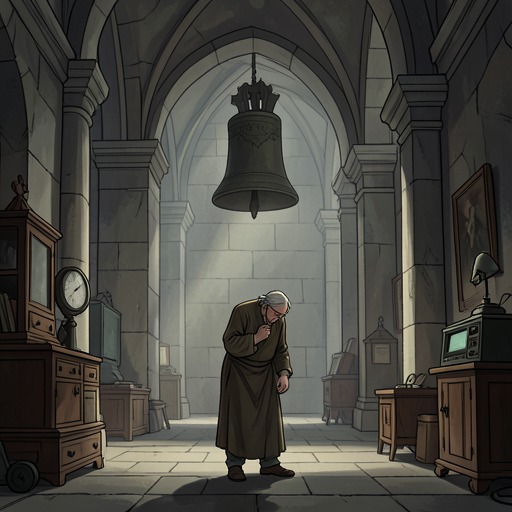
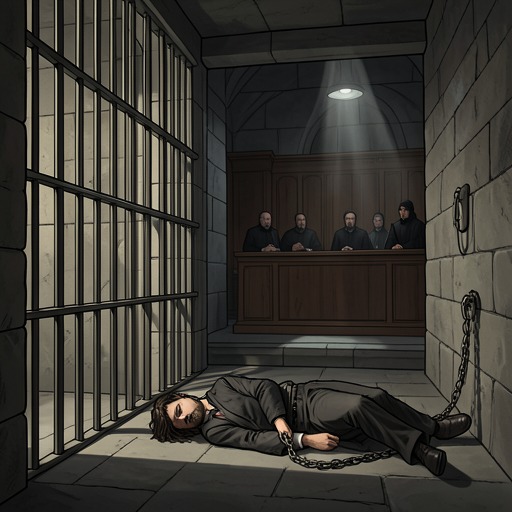
Esmeralda’s case brings the rule from institutional description into the plot. After Parliament’s court sentences her to death, she is brought before Notre-Dame Cathedral for public penance before the execution is to be carried out at Place de Grève. Quasimodo descends from the cathedral façade, knocks down the executioners, lifts her away, and carries her across the threshold. The crowd recognizes the importance of the act, but its acclaim is not what makes her untouchable: within the cathedral, the account explains, temporal jurisdiction ends.
Quasimodo takes Esmeralda to a small refuge cell on the roof of the side aisle, beneath the flying buttresses. Once she is there, he gently removes the cord that has bruised her arms and warns her that she must not leave the church, by day or by night, or she will be killed and he will die as well. His warning expresses both the rule’s practical condition and its cost. The cathedral protects her only so long as she remains inside it; it does not undo her condemnation, make her safe beyond its precincts, or restore the life she has lost. When she understands that she has been taken from the executioner, she also remembers that Phoebus de Châteaupers is alive but no longer loves her, so rescue brings safety without resolving her grief.
The refuge is also precarious because the legal sentence remains active. Claude Frollo tells Pierre Gringoire that justice will reclaim Esmeralda within three days and that she will be hanged at Place de Grève. He proposes that Gringoire enter the watched church, exchange clothes with her, and let her leave disguised in his garments, even though Gringoire might be executed in her place. The plan shows that sanctuary’s protection creates a narrow interval in which escape might be attempted; it does not, by itself, dissolve the danger waiting outside.
Contested protection and political force
The struggle over Esmeralda’s sanctuary widens when Clopin Trouillefou leads the outcasts against Notre-Dame Cathedral. He argues that the church owes Esmeralda refuge and that the threatened seizure of someone sheltered there makes the church’s own sacred status seem compromised. His appeal turns the legal privilege into a public claim: if the church is sacred, he insists, the person under its protection must be treated as sacred too. The confrontation is therefore not simply an effort to reach Esmeralda; it challenges who has the authority to decide whether sanctuary will be honored.
Royal power answers that challenge on its own terms. When Olivier Le Daim reports that Esmeralda has taken refuge in Notre-Dame Cathedral and that the people are besieging it, Louis XI first understands the attack as directed against the church under his protection, and consequently against himself. He then orders the forces sent to crush the crowd and seize Esmeralda, despite the sanctuary. His response exposes the contradiction at the heart of the episode: the king acknowledges the religious and political significance of the protected place but still chooses to enforce the sentence against the person inside it. The novel presents the royal decision as an intentional override, not as a routine consequence of the refuge rule.
The king’s hesitation makes that conflict explicit. Asked whether Esmeralda must be taken despite sanctuary, he recognizes the obstacle, then decides that she must nevertheless be hanged. He kneels and asks the Virgin for forgiveness, offering religious precedents and promising a silver statue before ordering the operation. The scene shows royal power seeking religious sanction even as it prepares to breach a religious protection. Sanctuary remains a recognized principle in the king’s own reasoning, but recognition does not prevent him from setting it aside.
Narrative significance
The Right of sanctuary links intimate rescue to the novel’s larger portrayal of divided authority. Quasimodo’s act succeeds because he carries Esmeralda across a boundary that the executioners cannot lawfully cross, but the sentence, the threat of royal force, and the siege all continue to press against that boundary. The rule can shield a condemned person from immediate capture while leaving her confined, exposed to renewed pursuit, and dependent on others to preserve the refuge.
The episode also distinguishes protection from justice. Esmeralda’s sanctuary does not establish her innocence, reverse the court’s decision, or settle the claims of the church, the king, and the crowd. Instead, it creates a contested space in which each authority reveals what it considers binding. Quasimodo treats the refuge as a reason to protect her; Clopin turns it into a collective demand; Louis XI treats its violation as permissible when it conflicts with his command. The cathedral threshold is thus both a practical shelter and a test of power: its protection is real, but the story shows that it can be challenged by the very institutions that recognize its force.