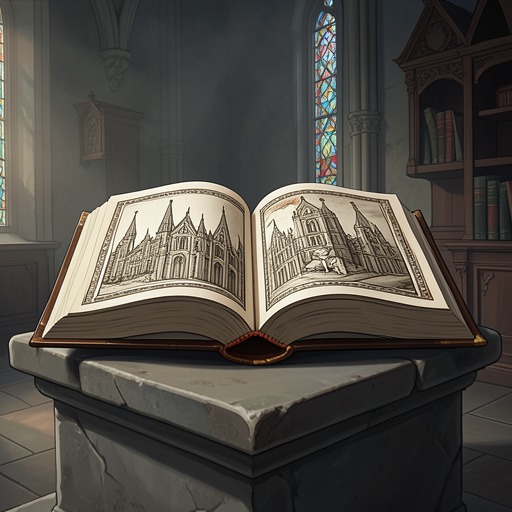
Romanesque period
The Hunchback of Notre DameThe Romanesque period is the foundational layer in the book’s account of Christian European architecture: a tradition organized around the round arch and associated with religious authority, symbolic permanence, and a society ordered by the Church. It is not merely a label for a set of shapes. The period’s architecture is treated as a historical record, one whose formal limits and later transformations register changes in how power, religion, and popular life were expressed in stone.
Definition and Architectural Position
The book places Romanesque architecture at the oldest and deepest level of a three-part sequence: the Romanesque zone, the Gothic zone, and the Renaissance zone, which it also describes as Greco-Roman. The round arch characterizes the earliest layer; it appears again in the Renaissance, supported by the Greek column, while the pointed arch occupies the intervening Gothic zone. These divisions describe clear architectural tendencies, but they do not imply that every surviving monument belongs neatly to one period. At their boundaries, styles mingle, producing buildings that are Roman at the base, Gothic higher up, or otherwise composed of successive layers.
The Romanesque tradition itself is not presented as geographically uniform. Depending on locality, climate, and peoples, it may be called Lombard, Saxon, or Byzantine; the book describes these as related forms derived from the round arch, each with a particular character. Its distinction from later architecture is therefore both formal and historical. In the book’s broad scheme, Romanesque represents the first major Christian architectural order, while Gothic marks a subsequent transformation rather than a simple replacement that leaves no trace of what came before.
Historical and Religious Meaning
The account connects Romanesque architecture to the early organization of medieval Christian Europe. In a landscape of ruins inherited from earlier civilizations, Christianity is described as gathering the fragments of Greek and Roman building traditions into a new hierarchical world. Romanesque masonry emerges within that process as an emblem of religious unity. The architectural language, like the society it represents, is associated with the primacy of the priest and the authority of the Catholic Church; its forms make visible an order in which collective life is organized around a sacred center.
This interpretation gives Romanesque architecture a particular political and intellectual character. Its governing qualities are continuity and resistance to change: established forms are preserved, and attempts to alter them can appear, within the system’s own logic, as violations of sacred meaning. Even a deformation in a form is not simply a flaw to be corrected; it can carry significance and become inviolable. The book compares this rigidity to a second petrifaction, as though the fixity of religious doctrine had spread through the stone itself. The result is an architecture whose visual language is not intended to be freely revised according to individual taste, but to sustain inherited symbolic authority.
The Romanesque and the Gothic
The contrast with Gothic architecture makes the Romanesque period’s place in this history especially clear. In the book’s interpretation, the Gothic style follows the Crusades, which are described as a popular movement that releases a spirit of liberty and unsettles established authority. Social power begins to divide: feudal lordship presses against theocracy, and the common people press against lordship. Architecture changes with this altered political climate. The pointed arch returns from the Crusades alongside the nations’ new sense of liberty, and Gothic building becomes more communal, progressive, and responsive to popular life.
The contrast is not simply between round and pointed arches. Romanesque architecture is characterized as immovable, bound to inherited types, and subordinated to symbolic rules; Gothic masonry, by comparison, is described as capable of movement, originality, and continual improvement. Its sculptural and decorative forms can be corrected and enriched, and its buildings are more readily intelligible to ordinary viewers. The book thus treats architectural style as a social language: Romanesque form signifies a theocratic order, while Gothic form expresses a greater place for the citizen and the people. This is a sweeping historical interpretation, but its central claim is consistent: buildings register changes in the ideas and institutions that shape collective life.
Transition and the Example of Notre-Dame
Notre-Dame Cathedral demonstrates why the Romanesque period cannot be understood as a sealed, uniform category. The book classifies the building as a monument of transition, neither a complete Romanesque church nor a pure Gothic one. Its Saxon architect had completed the first pillars of the nave when the pointed arch arrived and was set upon large Romanesque capitals originally intended to support round arches. The pointed arch then governed the construction of the rest of the church. At first it rises cautiously, restrained by the weight of the older pillars, rather than reaching the soaring forms found in later Gothic cathedrals.
The building’s distinct parts preserve this overlap in detail. The pillars of the nave, massive enough to recall the Carlovingian Abbey of Saint-Germain des Prés, sit in striking contrast to the Little Red Door, whose delicacy approaches the Gothic art of the fifteenth century. The book suggests that the difference between these elements is as if six centuries separated them. Such contrasts do not make the monument an imperfect example to be dismissed. Transitional buildings preserve a stage of artistic development that would otherwise be lost: they show the pointed arch grafted onto the round arch and make visible the process by which a new architectural language takes hold within an older structure.
Significance as a Historical Record
The Romanesque period matters in this account because its architecture is both a style and a means of preserving historical thought. Monumental building develops over generations: one artistic tradition can continue a structure begun by another, adapt what it inherits, and finish the work in a changed form. Individual authors recede within these long collective undertakings; the book presents time as the architect and the nation as the builder. In this view, the Romanesque layer is not only a record of a particular religious order but also the foundation against which later transformations can be read.
That historical function explains the importance of transitional monuments. A building that combines Romanesque and Gothic elements records more than a mixture of techniques: it preserves the moment when one social and artistic order is being reshaped by another. Notre-Dame Cathedral makes that process legible in its heavy early supports and its later pointed-arch construction. The Romanesque period therefore remains essential to the book’s account of architectural history even where it does not survive in a pure form: its material presence, its symbolic rigidity, and its adaptation by later builders reveal how architecture can carry both inherited authority and the evidence of change.