Surdus absurdus
The Hunchback of Notre DameSurdus absurdus is a Latin pun that links deafness with absurdity, and its force in the novel lies in the courtroom that gives it life: the judge and the accused are both deaf, yet the judge proceeds as if the examination were functioning normally. Recalled when Quasimodo is left at the pillory after being scourged, the expression makes a verbal joke expose the absurdity of a justice system that mistakes the appearance of listening for justice itself.
The Phrase and Its Judicial Setting
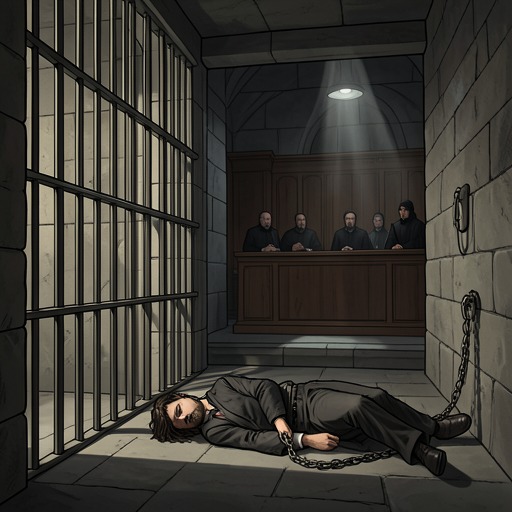
The expression appears in connection with Master Florian Barbedienne, the auditor of the Châtelet. His deafness is presented as an inconvenient truth that he works to conceal. Before examining Quasimodo, he reads the written complaint, learning the accused’s name, titles, and alleged misdeeds in advance; this preparation lets him anticipate questions and maintain the appearance of conducting an ordinary hearing. The document functions as a substitute for the speech he cannot hear, while any lapse can be mistaken by observers for profundity or imbecility rather than deafness.
The performance depends on appearances. Barbedienne believes it is enough for a judge to seem to listen, and his deafness even seems to him a minor defect. Before questioning Quasimodo, he raises his head and half-closes his eyes in a pose of majesty and impartiality. The narration observes that he is then both deaf and blind, making his judicial composure an image of deliberate inattention as well as physical impairment.
The Deaf Judge and the Deaf Accused
The hearing brings together two people who cannot hear one another. Quasimodo receives no sign that the judge has asked his name, so he continues staring and does not answer. Barbedienne, unaware that the accused is deaf, takes the silence for a response and moves on to ask his age. The exchange is not merely a failure of communication: the judge’s confidence in the procedure prevents him from recognizing that the procedure has failed.
The narrator calls this a case not provided for by law: a deaf man obliged to question a deaf man. That collision gives the pun its immediate meaning. Barbedienne’s disability is not the same as judicial incompetence, but his concealment of it, reliance on prior paperwork, and inability to notice Quasimodo’s silence turn the hearing into a performance whose outward order masks its breakdown. The phrase consequently points beyond either man’s deafness to a court that treats seeming to hear as sufficient.
The Pun at the Pillory
After the scourging, Quasimodo is still required to endure an hour at the pillory. The narrator attributes this additional punishment to Barbedienne, who had added it to the sentence of Messire Robert d’Estouteville. At this moment the Latin expression returns as the name of an old play on words: “Surdus absurdus: a deaf man is absurd.” Its recurrence ties the earlier courtroom miscommunication to the public punishment that follows.
The joke has a double edge. It recalls the absurd exchange between judge and accused, but it also attaches the insult of absurdity to deafness itself, even as the narrative has shown the court’s own absurd conduct. Quasimodo remains fastened to the plank after the scourging is finished; justice, in the phrase’s bitter logic, must be carried through to its prescribed end. The expression thus compresses the episode’s central irony: a system that cannot hear the accused nevertheless confidently imposes punishment in the name of judgment.