The people’s hour
The Hunchback of Notre DameThe people’s hour is the turning point at which grievances shared by ordinary people gather force as public action and put established authority at risk. In the exchange between Jacques Coppenole and Louis XI, it is neither a royal concession nor a predictable appointment: it will be recognized by the sounds of revolt. The phrase carries a political warning, but the city’s divided jurisdictions, its punitive institutions, and the king’s confidence in the Bastille also show how formidable the powers it names remain.
A City of Divided Powers
The idea of a popular challenge takes shape against a Paris organized into three distinct divisions: the City, the Town, and the University. Each has its own character and principal institutions: churches cluster in the City, palaces in the Town, and colleges in the University. Authority is divided as well. The island belongs to the bishop, the right bank to the provost of the merchants, and the left bank to the Rector, while the Provost of Paris exercises royal rather than municipal authority across them. The city’s inhabitants therefore live under overlapping jurisdictions, not one uniform civic government.
That fragmentation has practical consequences. Offences by scholars on the left bank are tried on the island and punished at Montfaucon, unless the Rector intervenes. The students’ privilege of being hanged on their own grounds is presented as one among rights wrested from kings through revolts and mutinies. In the narrator’s account, political privilege is not simply bestowed from above: rulers yield when people force the issue. The people’s hour gives this recurring struggle a more dramatic scale, imagining the point when pressure can no longer be contained by local custom or royal command.
The history of sanctuary offers a related measure of the powers at stake. Churches and other privileged sites can shelter fugitives from ordinary punishment, but protection ends if they cross the boundary; royal or parliamentary intervention can also override it. Louis XI’s decision to make all Paris a place of refuge in 1467 shows that the king can alter the city’s legal status by decree. The example does not make popular power equivalent to royal power. Rather, it sets the terms of the tension: institutions can protect, punish, or redefine people’s freedom, while the possibility of collective resistance remains rooted in the city itself.
The Hour Announced
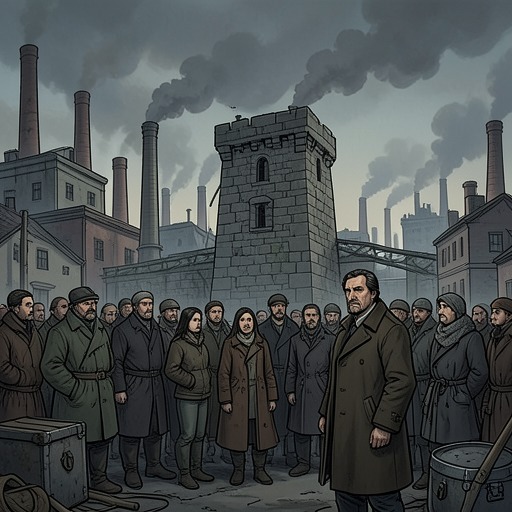
Louis XI asks when the people’s hour will arrive. Coppenole’s answer makes it something to be heard rather than calculated. He directs the king’s attention to a landscape of political and military power: a donjon, a belfry, cannons, bourgeois, and soldiers. The hour will strike when the belfry sounds, the cannons roar, the donjon falls, and civilians and soldiers are caught in violent conflict. These are not signs of a peaceful transfer of authority. They describe a breakdown in the structures that ordinarily secure it.
The king’s response gives the image its immediate force. After listening, Louis looks somber and dreamy, then gently pats the thick wall of the Bastille as if testing the confidence he has placed in it. His gesture answers Coppenole without disproving him: the fortress appears solid, yet the conversation has made its solidity a question. The people’s hour is thus imagined as a crisis of confidence as well as a physical uprising. A ruler may trust walls and troops; Coppenole insists that their endurance depends on forces beyond the ruler’s command.
From Discontent to Collective Action
Coppenole describes revolt as a process with recognizable beginnings. First comes discontent in a city, which he presents as common rather than exceptional. Its development depends on local character and on a grievance capable of making accumulated anger speakable. His hypothetical example begins with a report of unfair treatment or an increased levy. Coppenole leaves his work, comes out of his hosiery stall, and calls people together from atop a broken cask, giving public voice to what he says is already on his heart.
The crowd’s growth is practical as well as emotional. People gather, raise the alarm, take weapons from soldiers, and are joined by market people before setting out together. In this account, revolt does not begin with an army or a formal political program. It starts in ordinary working life and spreads through speech, shared grievance, and the visible acts of assembling and arming. Coppenole’s description also makes the process conditional: popular action grows from discontent in a particular social setting, rather than appearing as an abstract force detached from daily relations between rulers and ruled.
The example is offered as an explanation of how a revolt might be made, not as proof that every grievance will produce one. Coppenole links the recurring possibility of rebellion to the structure of society itself, in which lords, townspeople, and peasants occupy unequal positions. His account makes collective action intelligible as a response to those relations. It does not claim that a crowd will always prevail, or that the moment of gathering automatically becomes a successful revolution.
A Warning, Not a Victory
The surrounding narrative complicates any easy idealization of the people. The crowd watching Quasimodo at the pillory takes pleasure in his punishment; the narrator describes its cruelty as characteristic of a populace still held in moral and intellectual ignorance. The same urban multitude that may become a political force can also participate in public humiliation. Popular power, as the novel presents it, is not identical with justice or compassion.
Likewise, Coppenole’s prediction does not end with the Bastille falling or royal authority being overthrown. Louis remains king in the scene, and his hand rests on the fortress wall. The exchange preserves the imbalance between a ruler’s present command and a future collective force that may challenge it. The people’s hour names a possibility whose arrival cannot be scheduled and whose consequences are not guaranteed; its signs would be audible and visible in the city’s streets, defenses, and crowds. By locating political change in ordinary grievances and collective movement, the concept turns Paris itself into the setting where authority is tested—and where the people may, one day, make their power unmistakable.