Tour Roland Hermitage
The Hunchback of Notre DameThe Tour Roland Hermitage is a secluded stone cell whose small opening faces the Place de Grève. For its recluse, the space has become a world organized around the tiny rose-colored shoe of her lost child; yet the view from the cell also exposes her to the public life and violence beyond it. The hermitage’s defining tension is between grief enclosed in stone and events that force their way through its narrow aperture.
The Cell and Its Vigil
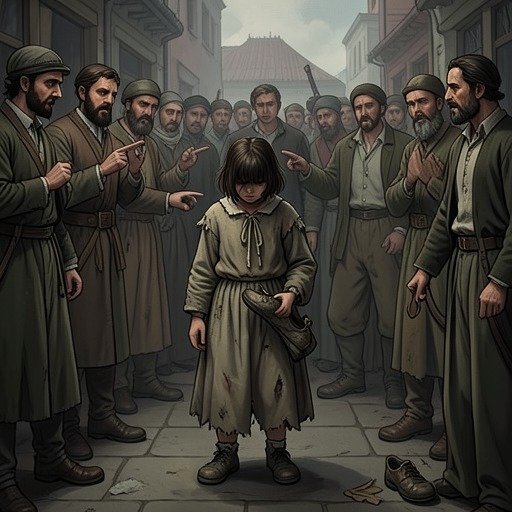
On a May morning, as the sun rose against a dark-blue sky compared to the backgrounds in Garofolo’s Descents from the Cross, the recluse knelt in contemplation of the shoe. She had adored the object for fifteen years. The cave-like cell had held her imprecations, complaints, prayers, and sobs, while the shoe gathered the memories of a child whose absence had made it both consolation and torment.
The cell does not fully shut out the world. When children’s fresh cries pass nearby, the recluse usually retreats into its darkest corner, trying not to hear or see them. This time, however, their words break through her habitual withdrawal: one child says that a gypsy is to be hanged that day. The cell’s isolation gives way to alertness, and she rushes toward the opening.
The Opening onto the Place de Grève
The hermitage’s air-hole looks onto the Place de Grève, making the public square visible from within the recluse’s confinement. From it, she sees a ladder raised against the permanent gibbet and a hangman’s assistant adjusting chains rusted by rain. People have gathered nearby. The execution ground, ordinarily outside the cell’s private world, is now close enough to inspect and question.
The opening also allows the recluse to identify a priest beside the cell. He appears to be reading the public breviary, but his attention repeatedly shifts toward the gallows; she recognizes him as the archdeacon of Josas. Her question about who is to be hanged brings the square’s impending execution into direct contact with the hermitage’s hidden life.
A Threshold Between Private Grief and Public Violence
The hermitage’s small aperture works as more than a view: it is the point at which the recluse’s long-guarded mourning meets an immediate public event. Children’s voices carry news into the cell, and the view of the gallows turns that news into something she can witness. The contrast is sharp: inside, a mother’s attention has remained fixed on a child’s shoe for fifteen years; outside, a crowd and the execution apparatus prepare for another loss. The Tour Roland Hermitage thus joins private suffering to the exposed spectacle of punishment without dissolving the separation between them.