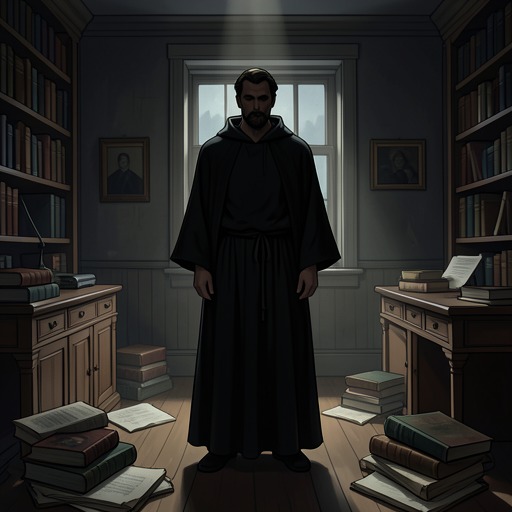
Tournelle Prison
The Hunchback of Notre DameThe Tournelle Prison is depicted as a subterranean place of confinement beneath a courthouse, where Esmeralda is held after being condemned to death. Its inpace turns the threat of execution into a physical condition of isolation: she is hidden below ground, unable to see or hear the world above, while the sentence awaits its appointed day. The prison’s role in the novel is sharpened by the contrast between such confinement and the competing jurisdictions and sanctuaries of medieval Paris.
Setting and Place in Paris
The novel places the Tournelle Prison within the dense, divided geography of fifteenth-century Paris. The city comprises the City on the island, the University on the left bank of the Seine, and the Town on the right bank. These three districts have distinct institutions and privileges, yet each depends on the others. The Tournelle is named as a boundary point in the University’s extent, which runs from the Tournelle to the Tour de Nesle; the account does not, however, specify the prison’s precise position within that district.
Paris’s divisions are also divisions of authority. The island belongs to the bishop, the right bank to the provost of the merchants, and the left bank to the Rector, while the provost of Paris exercises royal rather than municipal authority across the city. The novel illustrates how jurisdiction could cross these boundaries: offences by scholars on the left bank might be tried on the island and punished on the right bank, subject to the University’s privileges. The Tournelle Prison belongs to this broader landscape of overlapping powers, although the account does not identify it as the seat of any particular court or jurisdiction.
A Prison Beneath the Courthouse
The Tournelle’s prison is described as an inpace, a sloping underground cavity among the oubliettes associated with Saint-Louis. The courthouse looms above it, and the prison’s position makes the condemned person seem buried beneath the machinery of justice. Esmeralda is placed there after her death sentence because those holding her fear she might escape. The narrator emphasizes the imbalance between her and the massive structure over her: she is no threat to its stones, yet they separate her from the world.
Her cell contains little beyond straw, a jug, and a loaf. Its walls allow damp to gather on the floor, and there is neither a lamp nor an air-hole. In darkness and silence, Esmeralda loses track of whether it is day or night. At first she tries to count time by the drops of water, but eventually abandons the effort and falls into a stupor. The prison therefore does more than secure a prisoner: its conditions make time difficult to measure and ordinary contact with the outside world nearly impossible.
Esmeralda’s Imprisonment and Sentence
Esmeralda’s confinement follows a public sentence that specifies both the punishment and its route. She is to be taken to the portal of Notre-Dame Cathedral, required to make an apology, and then led to the Place de Grève for execution by hanging; her Goat is also condemned. The judgment attributes sorcery, magic, debauchery, and murder to her, including the attack on Phoebus de Châteaupers. From the prison, this public legal formula becomes a personal prospect: she remembers being sentenced and carried away, then waking in darkness, unable at first to understand where she is.
Her imprisonment is thus connected to both the court’s verdict and the spectacle planned outside it. The cell conceals her from view, but it does not cancel the sentence. Rather, it holds her until the authorities are ready to carry out the prescribed public punishment. The difference between the hidden dungeon and the public route to the gallows gives the prison a transitional function: it is the interval between judgment and execution.
Sanctuary and the Limits of Protection
The prison’s function gains significance beside the novel’s account of sanctuary. In medieval cities, churches and other privileged places could shelter fugitives from ordinary punishment; once inside, a person was protected, but leaving the sanctuary meant falling back into danger. Such refuge could itself become a form of imprisonment, since a condemned person might remain confined within a church or other protected enclosure. The account also notes that a decree of Parliament could sometimes override sanctuary, while armed violations of it were treated as grave offenses.
This legal landscape makes protection conditional rather than absolute. Louis XI is said to have made all Paris a refuge in 1467, but the general history of asylum does not change Esmeralda’s immediate circumstances in the Tournelle. She is already condemned and locked in a prison cell, not described as taking refuge there. Her eventual protection at Notre-Dame belongs to a different place and legal condition. The contrast clarifies the prison’s narrative purpose: it represents custody under a sentence, while sanctuary offers a precarious alternative whose safety depends on remaining within its bounds.
The Prisoner and the Visitor
At an uncertain hour, when midnight and midday are indistinguishable in the dungeon, a noise above the cell interrupts Esmeralda’s isolation. A trapdoor opens; a lantern is lowered, and a priest enters. In the confined space, the two remain silent at first, facing one another. When Esmeralda asks who he is, he identifies himself as a priest. She asks why he has come, and he answers that he has come to die. When she learns that her execution is set for the following day, her brief lift of hope gives way to resignation.
The later encounter makes the visit urgent and personal. The priest sees blood on his fingers, then pleads with Esmeralda to leave with him before the execution. He offers to save her and accepts that she may hate him afterward, but she refuses to follow. His plea cannot undo the sentence or restore the freedom the cell has taken from her. The Tournelle remains the setting in which the approaching execution, the priest’s desperation, and Esmeralda’s refusal meet, turning a hidden prison into the threshold of the final public events.