Tristan l’Hermite
The Hunchback of Notre DameTristan l’Hermite is the provost of the marshals serving Louis XI, a royal officer who turns the king’s decisions into arrests, releases, and armed action. He is presented less through private history than through his work: silent beside a door, issuing instructions to archers, and preparing to lead a force against the people gathered at Notre-Dame Cathedral. His scenes make him an agent of authority in a story where jurisdiction is divided and even a church sanctuary can become the object of royal force.
Office and Context
Tristan’s office gives him responsibility for marshals and the men available to their provostship. When Louis XI orders a response to the disturbance at Notre-Dame Cathedral, Tristan is the person expected to assemble and direct the king’s forces. The role places him within the machinery of royal power, rather than among the judges who determine guilt or the officials who pronounce a sentence.
That distinction matters in the novel’s Paris. The City, the University, and the Town have separate privileges and jurisdictions, while the provost of Paris represents royal rather than municipal authority. The island belongs to the bishop, the right bank to the provost of the merchants, and the left bank to the Rector. The account of this divided city stresses that legal authority is distributed among competing institutions; Tristan’s position, by contrast, makes him an executor of the Crown’s reach across those divisions.
The same tension shapes the right of sanctuary. Churches can shelter a condemned person from ordinary arrest, but protection depends on remaining within the refuge and may be challenged by a formal political decision. In Esmeralda’s case, the court has sentenced her, yet she has taken refuge at Notre-Dame Cathedral. Tristan’s later question about whether she must be seized despite sanctuary shows that enforcement is not a simple continuation of the trial: it raises a direct conflict between royal punishment and ecclesiastical protection.
Prisoners and the King’s Orders
At the king’s gathering, Tristan stands motionless beside the door until Louis XI signals to him. The king identifies a prisoner for Tristan, who responds by quietly instructing two archers to lead the vagabond away. The brief exchange establishes his practical function: he does not debate the accusation or explain a legal finding, but carries out the order and transfers the prisoner into the custody of armed men.
Tristan is also present when Pierre Gringoire’s fate changes. After the king decides to release Gringoire, Tristan opens the door, though with conspicuous ill grace. Soldiers escort Gringoire out, pushing him along with blows that he bears stoically. The king’s unusually good humor, stirred by news of the revolt against the bailiff, has produced a moment of clemency; Tristan’s displeasure makes that reprieve visible as a reversal of the punitive course he might otherwise have helped enforce. His sour reaction does not prevent the release, but it distinguishes the king’s discretionary mercy from the officer’s hard-edged execution of commands.
The Notre-Dame Crisis
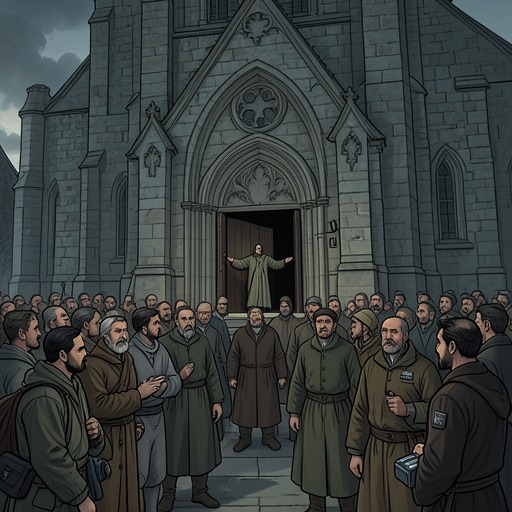
When Olivier reports that a condemned sorceress has taken refuge in Notre-Dame Cathedral and that a crowd is trying to remove her by force, Louis XI’s mood turns from amusement to fury. He orders Tristan to take several groups of armed men to the cathedral: the fifty lances of the Vicomte de Gif, amounting to three hundred horse; the unattached archers of Monsieur de Châteaupers; the men of Tristan’s own provostship; and forty archers of the dauphin’s new guard stationed at the Hôtel Saint-Pol. The scale and variety of this force show the king treating the siege not merely as a local disturbance but as a challenge to royal authority and public order.
The command is explicitly violent in its intended outcome, and the king includes the condemned woman among those he wants punished. Tristan bows and accepts the assignment. He then raises the legal difficulty himself: if the sorceress is still inside Notre-Dame Cathedral, must she be seized in defiance of sanctuary? The question identifies him as an enforcer who nevertheless recognizes that the order meets a competing privilege. It also sharpens the scene’s institutional conflict: the king insists on punishment, while the church’s protection remains a serious obstacle rather than an irrelevant custom.
Narrative Role
Tristan’s appearances are brief, but they link decisions at court to consequences outside it. A motion of the king’s finger sends a prisoner away; a decision to spare Pierre Gringoire is carried through the door; and an order concerning the crowd at Notre-Dame Cathedral places a large armed force under Tristan’s command. These episodes make royal power tangible through the officer who acts on it.
His contrast with Louis XI is especially clear in the Gringoire episode. The king’s mood permits an unexpected release, while Tristan’s unsmiling manner and reluctance at the door preserve the atmosphere of coercion surrounding the court. In the sanctuary crisis, that coercive capacity expands from managing individual prisoners to directing troops against a crowd. Tristan therefore embodies the practical force behind decisions made by the Crown, while the questions of judgment, sanctuary, and political responsibility remain contested among the king, the courts, and the church.