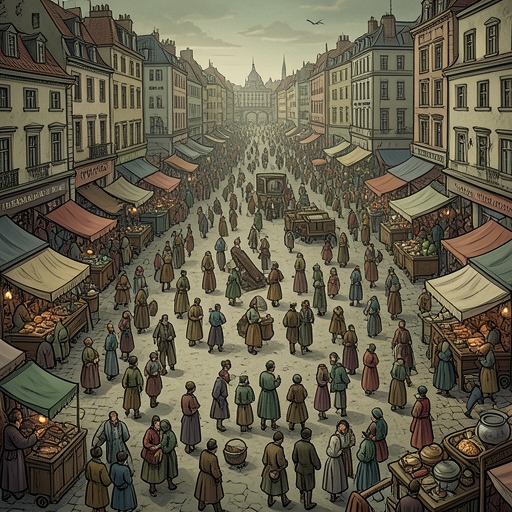
University Quarter of Paris
The Hunchback of Notre DameThe University Quarter of Paris is the left-bank division of fifteenth-century Paris, a walled district of colleges, churches, and closely packed streets whose separate identity never makes it independent of the city around it. From the towers of Notre-Dame Cathedral, it appears as a compact urban mass spilling down Mount Sainte-Geneviève toward the Seine. At street level, its turns and boundaries shape movement, privilege, and refuge; seen from above, it forms one part of a single city joined across the river.
Position and Civic Boundaries
In the novel’s account of Paris in 1482, the capital consists of three distinct divisions: the City on the island, the Town on the right bank, and the University on the left. The University extends from the Tournelle to the Tour de Nesle, following the left bank and enclosing the hill of Sainte-Geneviève. Its northern and southern reach is marked by the river, while its own wall and gates set it apart from the surrounding countryside. The district is therefore not merely a neighborhood within Paris: it is one of three historically formed urban territories, each with its own character, customs, privileges, and history.
The city’s growth gives those boundaries a layered history. Paris began on the island, with the Seine serving as its moat and two bridges connecting it to the banks. As the island became too confined, settlement crossed the water and spread outward. Walls and towers were added as the city expanded; housing eventually overflowed successive enclosures and extended into the plain. The University’s own wall, built by Philip Augustus, belongs to this process of expansion and containment. Its six gates—Saint-Victor, Bordelle, Papale, Saint-Jacques, Saint-Michel, and Saint-Germain—made the district’s perimeter both a defensive line and a set of controlled passages.
Streets, Buildings, and the View from Above
The University’s street plan is described as a tangled network, but not as an isolated one. Two major routes ran across Paris from north to south, changing names as they crossed from one division to another and crossed the river by bridges. The University and the City also had their own lengthwise thoroughfares. These larger lines formed a framework beneath the smaller, twisting streets, linking the three divisions even as local street patterns gave each its own form. The Seine likewise divided the banks while carrying people and traffic between them, making the river both boundary and connection.
From the summit of Notre-Dame Cathedral, the University appears dense, homogeneous, and compact, its roofs pressed together like a single mass. The hill of Sainte-Geneviève rises within it; from there, narrow, crooked streets and clusters of houses descend toward the water, seemingly clinging to one another on the slope. The movement of people in the streets turns this fixed arrangement into a shifting scene. Beyond the rooftops, fragments of the old wall, round towers, and crenellated gates mark the edge of the built-up district; farther out lie green fields and increasingly scattered suburban houses.
Its architecture is varied without losing the impression of a coherent whole. The forty-two colleges are distributed across the district, their crests and roofs repeating related geometric forms. Mansions and abbeys punctuate the dense building fabric, while churches rise above it with towers, spires, and pinnacles. The churches also register successive architectural periods, from round arches to pointed ones. The account presents the University’s buildings as a layered ensemble: colleges occupy a position between the world of the mansions and that of the abbeys, while church towers give the district a distinctive skyline. It also stresses how much of this architectural inheritance has since disappeared.
A District of Study and Public Life
The University’s identity is associated above all with learning. In the three-part division of Paris, churches are concentrated in the City, palaces in the Town, and colleges in the University. The Sorbonne is named as its leading institution, and the quarter’s forty-two colleges make education visible throughout its urban landscape. That scholarly character coexists with ordinary commerce and noisy public life rather than replacing it.
The wine shop called Eve’s Apple stands at the corner of the Rue de la Rondelle and the Rue de la Bâtonnier. Its low, vaulted ground-floor hall is organized around a large yellow-painted wooden pillar, with tables, pewter jugs, and a street-facing window. A vine marks the entrance; above it, a weathered sheet-iron sign painted with an apple and a woman turns on an iron pin. At night the candlelit interior stands out in the dark square, crowded with drinkers and lively with feasting and argument. Its placement in the University gives the district a social scene as well as an institutional identity: the same network of streets that contains colleges also supports taverns, gathering places, and everyday traffic.
Jurisdiction, Privilege, and Refuge
The three divisions of Paris are also jurisdictions. The island belongs to the bishop, the right bank to the provost of the merchants, and the left bank to the Rector; over all three stands the Provost of Paris, a royal rather than municipal officer. This overlapping arrangement means that movement across the city can also cross between legal authorities. The account notes that offences committed by scholars on the left bank are tried in courts on the island and punished on the right bank at Montfauçon. The Rector can intervene, however, when the University asserts its strength against the king’s authority. The narrator presents the resulting privilege with pointed irony: students may be hanged on their own grounds.
These privileges are described as gains wrested from kings through revolt and mutiny, not as disinterested concessions. The University’s boundary therefore has a political meaning as well as a physical one: it encloses a community capable of contesting royal power, even while its members remain subject to the jurisdictions of the wider city. Paris’s sanctuaries form another, separate layer of that legal geography. Churches and other privileged places can shelter a fugitive, but protection ends if the person steps beyond the sanctuary; the surrounding authorities and places of punishment remain close at hand. The account says that Louis XI made all Paris a refuge in 1467, showing how the city’s boundaries and protections could also be altered by royal decree.
Movement and Narrative Function
The University is experienced differently from within and from above. A panoramic view from Notre-Dame Cathedral reveals the district’s overall form, its hill, walls, churches, and routes. At street level, that order gives way to uncertainty: narrow lanes can loop back on themselves, and a traveler may lose a sense of direction within the city’s maze. The novel makes this contrast part of its urban portrait, setting the city’s legible large-scale structure against the disorientation of individual movement.
The quarter also becomes a passage through which characters move under pressure. After circling the enclosure of the University, Claude Frollo recognizes landmarks including the spire of Saint-Sulpice and the towers of Saint-Germain-des-Prés. He avoids the guarded precinct and the Bourg Saint-Germain, reaches the Pré-aux-Clercs, and continues to the water, where a boat carries him up the Seine toward the City. His route connects the quarter’s walls, open ground, and river edge, while his effort to avoid people makes the city feel like a sequence of boundaries and detours. In this way, the University Quarter of Paris is both a clearly defined civic territory and part of a larger spatial system: walls separate, streets funnel movement, and the river repeatedly reconnects what it divides.