Witchcraft accusations and superstition
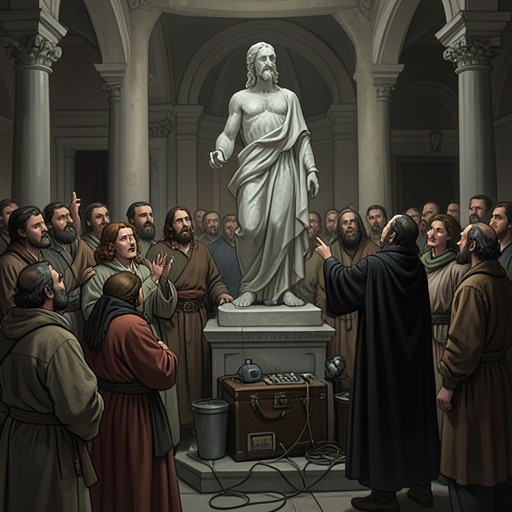
The Hunchback of Notre DameWitchcraft accusations and superstition transform uncertain events into apparent proof of supernatural crime, and the trial of Esmeralda and Djali shows the human cost of that transformation. A missing crown, a dead leaf, a priest who vanishes, and a goat’s practiced tricks are assembled into a story of magic; once accepted by the court, that story overwhelms Esmeralda’s denials and leads to a death sentence. The episode makes superstition more than a popular belief: it becomes a way for suspicion to pass through legal procedure and acquire the force of judgment.
Rumor and the Crown
The accusations begin with La Falourdel’s account of a violent night at her house. She says she saw a priest swimming toward the city, called the watch, and then found her room in disorder, an officer lying motionless, Esmeralda apparently lifeless, and Djali frightened. Her account also includes a crown that she believed had been given to her by the officer; when she later sought it, she found a dead leaf in its place. The details are disturbing, but they do not establish that magic occurred. The supposed priest’s identity remains uncertain, and the leaf becomes the story’s most portable piece of alleged proof.
The listeners supply the supernatural explanation themselves. One hears magic in the phantom and the goat; others seize on the leaf, and a third concludes that Esmeralda is a witch in league with the surly monk and intent on robbing officers. Their conclusions turn suspicion into a settled narrative before the court has tested the testimony. The leaf’s exchange for the crown is treated not as a gap in the witness’s knowledge but as confirmation that a demon must have been involved.
When the court examines La Falourdel, Jacques Charmolue calls the leaf a birch leaf and presents it as further proof of magic. Asked which of the two men had handed her the crown, she identifies the officer. That answer leaves the central transformation unexplained, yet the proceedings do not resolve the uncertainty. Instead, the leaf circulates through the hall, passed from one official to another, gathering institutional weight as it goes. Its physical smallness contrasts with the large conclusion imposed upon it.
Performance Recast as Evidence
The examination of Djali makes the court’s interpretive error especially clear. The prosecutor threatens the goat with the gallows or the stake if the alleged demon continues its acts of witchcraft. Jacques Charmolue then uses the tambourine to prompt Djali to perform. Asked the time, the goat strikes seven blows with a gilded hoof; Charmolue also elicits other tricks connected with the date and month. These are performances the reader has already encountered, but in the courtroom they are treated as signs of possession.
The narrator identifies the shift in interpretation as an effect of the setting: spectators who may have applauded Djali’s innocent tricks in a public square are terrified by the same acts beneath the roof of the Palais de Justice. The place changes the apparent meaning of what they see. Rather than testing whether the acts have an ordinary explanation, the audience accepts that Djali must be the devil. The episode thus shows superstition working through collective expectation: the court’s ominous framing turns familiar entertainment into incriminating spectacle.
The letters Djali wears around the neck provide a second, more consequential performance. When the procurator scatters them on the floor, Djali selects the letters spelling Phoebus. The court treats the name as proof that the witchcraft charge against Esmeralda is established. The alphabet, an object associated with a trick, becomes an apparent link between Esmeralda and the officer’s attack. With that interpretation in place, the dancer who had once drawn admiration from passers-by is recast in the spectators’ minds as a supernatural threat. Her act does not independently establish the charge; its force comes from the meaning the court and audience impose upon it.
The Accused and the Judgment
Esmeralda is so overwhelmed during the examination that neither Djali’s performance nor the court’s threats appear to reach her. An officer has to shake her to bring her attention back, and the president confronts her with the court’s version of events: that she, as a Bohemian, conspired with the bewitched goat to murder Phoebus with charms and the powers of darkness. Her response is that she does not know what happened and that an unknown priest pursues her. The judge takes this reference to a priest and folds it into the existing image of the surly monk, rather than treating it as a claim requiring independent investigation.
The decision follows without the judges leaving the room. They assent without giving reasons, and a clerk writes the sentence. Esmeralda is condemned to public penance before Notre-Dame and then to be hanged at the Place de Grève; Djali is sentenced as well. The sentence also demands payment to the ecclesiastical official for crimes the court declares confessed. Yet Esmeralda has continued to deny knowledge of the alleged events. The judgment’s language converts an accusation into a confession and fixes the court’s interpretation as fact, even as the account has supplied no independent confirmation of supernatural agency.
Law, Authority, and the Force of Belief
The novel situates the trial within a Paris divided among distinct jurisdictions. The City belongs to the bishop, the Town to the provost of the merchants, and the University to the rector, while the provost of Paris exercises royal authority over all three. The account of the city’s legal arrangements emphasizes that proceedings and punishments could fall under different authorities: offenses by scholars on the left bank could be tried on the island and punished on the right bank, subject to university privilege. The witchcraft trial unfolds within this larger setting of overlapping powers, where the accused encounters not a single, impartial system but institutions capable of turning their own assumptions into enforceable outcomes.
The account of sanctuary supplies a related measure of that legal world’s severity. Churches and other sites could offer asylum, making a fugitive temporarily safe, but leaving the refuge could return that person to the threat of punishment. The protection was therefore real but constrained, and the narrator describes it as both refuge and a kind of prison. This context sharpens the consequences of a judgment like Esmeralda’s: legal authority could define the accused as guilty, while protection from that authority depended on a separate and precarious jurisdiction.
The accusations’ power comes from this joining of popular fear and official procedure. Rumor interprets the leaf; the courtroom transforms a goat’s tricks into diabolic evidence; the verdict then gives those interpretations the consequences of law. The narrative does not confirm that magic explains the events. Instead, it shows how uncertain testimony and ordinary performances can be made to appear supernatural when witnesses, spectators, and judges are already prepared to see witchcraft. The tragedy lies not only in belief itself, but in a system that treats belief as proof and makes its conclusions irreversible.