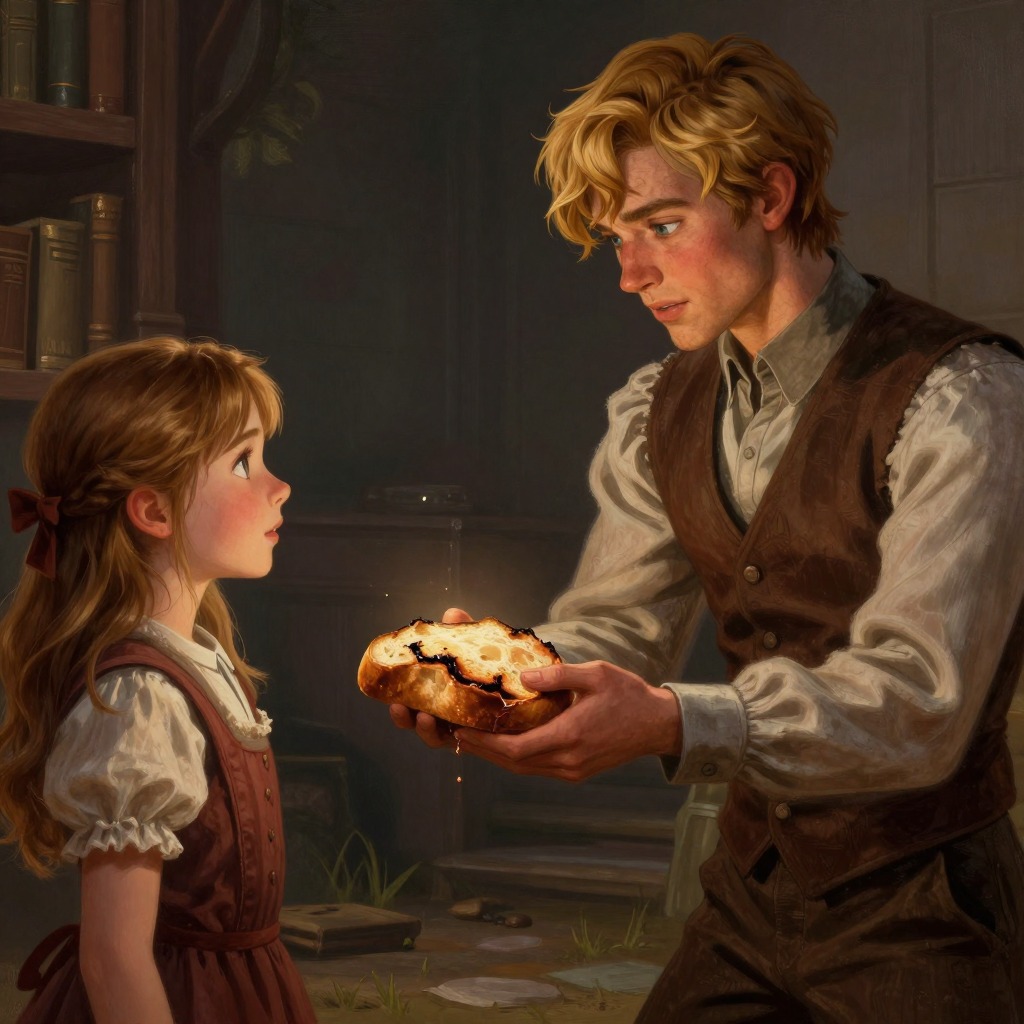
Peeta Mellark
The Hunger GamesPeeta Mellark, the male tribute from District 12 in the 74th Hunger Games, is the baker's son whose quiet strength, strategic mind, and public declaration of love for Katniss Everdeen transform him from a seemingly gentle competitor into a pivotal figure whose actions—from giving her bread as a child to saving her life in the arena—ultimately force a rule change and a shared victory.
Identity and Background
Peeta Mellark is the son of the baker in District 12, a merchant-class family living above their shop in the town's nicer part. He has two older brothers, and his mother is a harsh woman who once struck him across the face for burning bread. Despite having enough to eat growing up, Peeta's family subsists largely on stale goods; he notes that "practically everything we eat is stale." He is stocky, strong from hauling bread trays, and has ashy blond hair and blue eyes. At school, he is a skilled wrestler, placing second in the annual competition. His father, the baker, knew Katniss's mother when they were children and once told Peeta he had wanted to marry her, but she "ran off with a coal miner" because "when he sings … even the birds stop to listen." This story, along with hearing Katniss sing the valley song on the first day of school when they were five, sparked Peeta's lifelong, unspoken crush on her. He remembers everything about her, from the red plaid dress she wore to the way she shot squirrels through the eye.
Arc Through the Plot
Peeta's name is drawn at the reaping, and he takes his place on stage with a calm, steady demeanor, though his blue eyes betray alarm. On the train to the Capitol, he helps the drunken mentor Haymitch Abernathy clean up after vomiting, an act of kindness that Katniss finds more dangerous than enmity. During the opening ceremonies, he holds Katniss's hand in the chariot, a gesture Haymitch later calls "the perfect touch of rebellion." In training, Peeta excels at camouflage, a skill he developed decorating cakes, and in hand-to-hand combat. He receives a training score of eight. At the televised interview, he makes a stunning confession: he has had a crush on a girl "ever since I can remember," and when Caesar Flickerman asks why winning won't help his case, Peeta reveals, "Because … because … she came here with me." This declaration of love for Katniss transforms her into a desirable figure and wins them the "star-crossed lovers" narrative.
Key Actions and Objectives
In the arena, Peeta's actions consistently protect Katniss, often at great personal cost. At the bloodbath, he shakes his head at her, trying to stop her from running to the Cornucopia for the bow, a distraction that saves her life. He then allies with the Career Tributes, a move that initially seems like betrayal but is later revealed as a strategy to stay close to them and protect Katniss. When the Careers discover her in a tree, Peeta argues against attacking her at night, buying her time. After she drops a tracker jacker nest on them, he finds her hallucinating near Glimmer's body and, despite being wounded himself, shoves her away, screaming "Run!" He fights Cato to allow her escape, receiving a deep sword cut to his leg that becomes infected. He later hides in a muddy bank, camouflaged so perfectly that Katniss almost steps on him. When she finds him, he is feverish and near death from blood poisoning. Katniss nurses him back to health, and they form an alliance. During the feast, Peeta, knowing he is dying, tries to stop Katniss from risking her life for the medicine, threatening to follow her and yell her name to attract the Careers. She drugs him with sleep syrup to go anyway. After receiving the medicine, he recovers and they face the final confrontation together.
Relationships and Conflict
Peeta's relationship with Katniss is the emotional core of his arc. He is the "boy with the bread" who, years ago, threw her two burned loaves when she was starving, an act of kindness she has never forgotten and feels she owes him for. In the arena, he consistently puts her survival above his own, even as she struggles to trust his motives. His public confession of love creates the "star-crossed lovers" narrative that wins them sponsors, but it also complicates their private reality. After the Games, when Katniss reveals that Haymitch coached her to play up the romance, Peeta is devastated, asking, "So, what you're saying is, these last few days and then I guess … back in the arena … that was just some strategy you two worked out?" He drops her hand, and the pain in his voice is palpable. He also has a tense relationship with Haymitch, whom he challenges on the train by shattering a glass of spirits, earning a punch to the jaw. Yet he also helps the drunk mentor, showing a capacity for both confrontation and care.
Change and Ending
Peeta undergoes a profound transformation from a gentle baker's son into a determined survivor. He tells Katniss on the roof of the Training Center that he wants to die as himself, not as a monster, and that he wishes he could show the Capitol they don't own him. This desire for defiance culminates in the berry incident: when the Gamemakers revoke the rule allowing two victors, Peeta and Katniss prepare to eat poisonous nightlock berries together rather than kill each other. Peeta kisses her gently and says, "The count of three." Their bluff forces the Gamemakers to declare them both victors. After the Games, Peeta loses his leg below the knee due to the tourniquet Katniss applied, but he does not blame her, saying, "Yes, it's your fault I'm alive." On the train home, he confronts Katniss about the authenticity of her feelings, and the distance between them grows. He extends his hand one last time for the cameras, saying, "One more time? For the audience?" His voice is hollow, and Katniss dreads the moment she will have to let go.
Thematic Significance
Peeta Mellark embodies the tension between kindness and survival in a brutal system. His love for Katniss, whether genuine or performed, becomes a tool of rebellion that exposes the Capitol's control over narrative and emotion. His willingness to die rather than kill her, and his insistence on maintaining his identity even in the arena, challenge the dehumanizing logic of the Hunger Games. He represents the possibility of integrity within a corrupt system, and his final, hollow gesture for the cameras underscores the cost of performing love for a watching nation.