
Secrecy and the Limits of Truth
The IPCRESS FileRestricted disclosure protects operations but repeatedly creates the confusion that allows conspiracies and false accounts to flourish.
increasing Bearing strength in each event
 decreasing
Bearing strength in each eventdecreasingA Cabinet Summary
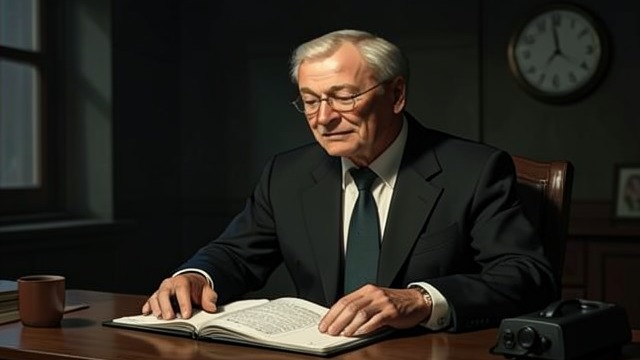
A Cabinet Summary
A Personal Account Requested
The narrator is asked to explain a complicated dossier in his own words. The Minister wants a story that can withstand political questioning, not simply a faithful recitation of the file.
Memory as a Distortion
The narrator’s account is framed as subjective and incomplete, with characters remembering events in self-protective ways. Even official testimony cannot promise a single, final version.
The opening establishes that the novel’s central evidence will remain shaped by perspective and institutional purpose.
Files Behind Doors

Files Behind Doors
Classified Knowledge
The narrator encounters separate security levels, color-coded files, and restricted access to personnel records. Information is divided so that a collection of facts may mean nothing until assembled correctly.
The IBM Machine
Dalby’s machine correlates fragments that humans cannot easily connect, making the office powerful and dependent on controlled access. The system can reveal patterns, but it also gives its operators authority over what counts as a pattern.
Secrecy becomes both a protection and a source of concentrated institutional power.
A Message Misrouted
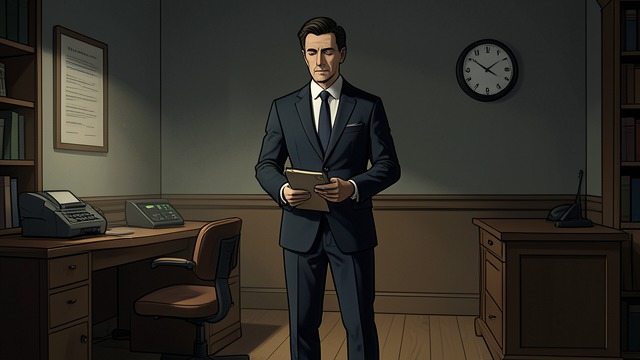
A Message Misrouted
Competing Channels
Keightley passes material to Ross without authorization, creating a dispute over who is entitled to receive it. The narrator reacts sharply because an uncontrolled route can expose civilian sources and operations.
Secrecy as Rivalry
The argument is partly about protection and partly about departmental boundaries. The narrator himself uses threats to enforce a secrecy system he cannot fully control.
The episode shows how confidentiality can safeguard lives while also serving as a weapon in bureaucratic competition.
The Narrator Is Classified
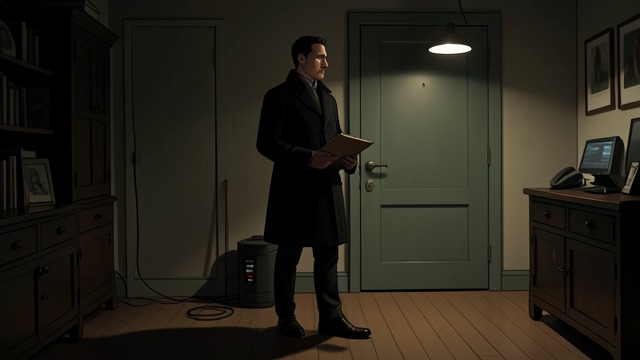
The Narrator Is Classified
Evidence Withheld
The Brigadier has records and film that the narrator cannot inspect freely. The narrator must respond to accusations without knowing what the investigators have already decided.
A One-Sided Account
Because the narrator is treated as a security risk, ordinary channels of appeal are restricted. The system’s secrecy makes it easier to confuse legitimate suspicion with a manufactured case.
The protagonist experiences classification not as abstract procedure but as a barrier between himself and his own defense.
The Story Left Open

The Story Left Open
A Useful Version
The narrator’s report helps officials handle parliamentary questions, but the account cannot provide certainty about every motive or connection. The Minister’s interest in convenient answers contrasts with the narrator’s lingering questions.
Contradiction as Record
The Henry file remains thin, and the narrator admits that some evidence cannot be reconciled. What survives is not a perfect truth but an account assembled from conflicting memories and partial disclosures.
The conclusion treats uncertainty as a lasting condition of espionage rather than a flaw that a final revelation can remove.
At the opening, when the Minister asks for the story
During the narrator’s first months in WOOC(P)
During the screening at the War Office cinema
After the Tokwe explosion, during detention
At the epilogue, after the Minister’s meeting
