42 Acacia Drive
The IPCRESS File42 Acacia Drive is the secluded house identified as the likely source of a suspicious car and then searched in a covert police operation. Its conventional ground and first floors concealed a purpose-built upper level, where investigators found small wooden rooms and, in a separate room, a water tank containing pieces of a tape recorder and a harness. The address matters not for its outward appearance but for the hidden architecture that turns an otherwise ordinary suburban house into evidence of a carefully concealed installation.
Identification and Setting
The house emerged from a practical process of elimination. The narrator asked a constable to think beyond what could be proved in court and consider a house where unfamiliar people had recently come and gone, preferably one secluded enough for a driver to enter directly from a garage. The constable described number 42 as unusually private: its owner had bought the undeveloped sites on both sides. Number 40 was occupied by flats, mostly young married couples, while number 44 was a low building whose resident worked as a waiter in the West End. The constable recalled that he could not remember the occupants of number 42, although building work had been done there around February and he imagined it had been converted into flats. There were no letting signs, but he noted that tenants could find accommodation by word of mouth.
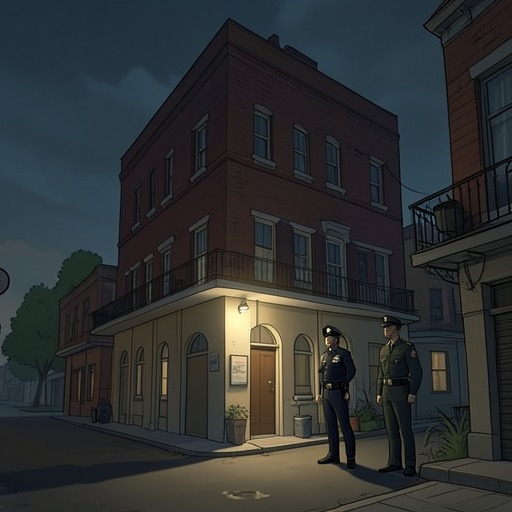
The street's surrounding details reinforce the difficulty of distinguishing a suspicious address from an ordinary one. Acacia Drive is described as a wide, wet suburban street, where London seems to advance stealthily through the suburbs. Soot-coated hedges rise above small trees caged in iron, and weak light leaks through dirty net curtains to mingle with the faint street lighting. That drab normality is not incidental: it gives the investigators few obvious signs to separate a concealed operation from the neighborhood around it.
Planning and Entry
Murray prepared the raid with a street photograph and a diagram marking garden-wall heights and the deployment of twenty-five men. He appeared to have persuaded an inspector that he held a higher rank than his actual one, and the police sergeant deferred to his instructions. The plan was then expanded by five men, whom Murray marked in with a propelling pencil fitted with interchangeable colored leads. The narrator invited the police to accompany the team but placed the operation under complete blackout, warning that a leak would be actionable under the Official Secrets Act confidentiality obligation.
The preparation combined elaborate operational planning with improvised practicalities. Murray requested a military-police Champ vehicle equipped with radio, reasoning that it could approach the house without drawing the attention that a conspicuously parked vehicle might attract. The vehicle's radio was checked against the Scotland Yard wavelength. Murray also pointed out that bringing a Provost vehicle supplied a revolver, ammunition, and other useful equipment. The narrator found Murray's competence surprising enough to decide to check his security clearance again the next day.
At the house, two gates opened onto a semicircular drive of crunchy gravel. A very small top-floor window was lit. While the last men took position, a man in a cloth cap searched a row of covered cars, lifting the silver covers until he found the vehicle with the number plate he wanted, then drove it away. Once the street had become quiet again, the Champ's radio operator listened to reports from plainclothes officers positioned in the back garden. Murray and the narrator chose a side window for entry: Murray had a jemmy, while the narrator had brown paper coated with golden syrup, an improvised aid for forcing the window while limiting noise.
Ordinary Rooms and Concealed Floor
The rooms on the ground and first floors offered little outward indication of what lay above them. Their furniture was old and worn, the carpets balding, and the wallpaper gloomy. In contrast, the modern kitchen was well stocked with fresh and tinned food and had a machine for mincing and washing away waste. The bathroom was unusually well equipped for an English house, with a shower, scales, a pink mirror, and extensive indirect lighting. These domestic amenities make the contrast with the upper floor sharper: the house was not an empty shell, but its familiar lower rooms did not explain its unusual structure.
One ground-floor room had been arranged as an office. In a corner stood a wooden telephone booth with glass panels; a small device fitted into the telephone dial and prevented the phone from being used when locked. The remaining books included a Roget, a business directory, a thick blue-bound volume, a French edition of a road atlas, the AA Road Book, the ABC Railway Guide, and a Chambers's Dictionary. New filing cases held a couple of hundred blank file cards. These objects establish a working interior organized around communication, reference, and records, while the absence of completed files leaves the cases' intended use unresolved.
The route to the top floor was itself conspicuous. The staircase between the first and second floors had been removed, and a cheap, unpainted wooden ladder rose through a dim ceiling opening. The narrator climbed it while Murray and Chico stayed below. Above, several unshaded 25-watt bulbs lit an uneven wooden floor. Damaged plaster exposed brickwork beneath a poor coat of distemper. Small wooden rooms divided the space; some windows looked inward onto the cobbled courtyard at the center of the house, built as a hollow square, while the outward-facing windows had been bricked up. The arrangement concealed the upper floor from the street while preserving openings onto the interior courtyard.
The Water Tank and the Discovery
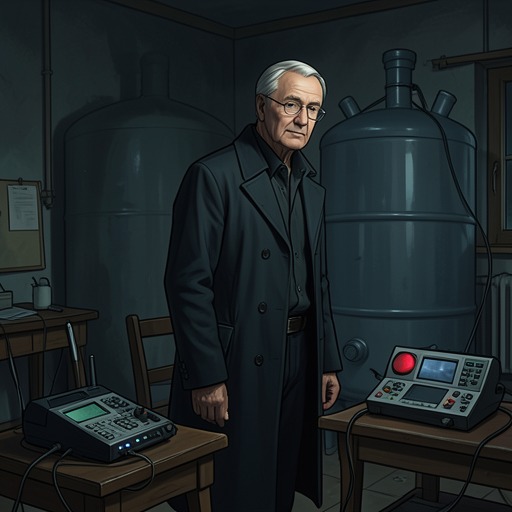
The largest room measured about 20 by 25 feet. At its center stood a heavy metal tank, eight feet square and five feet high, filled to a depth of four feet with water. Waterproof cloth had been roughly tacked across the floor around it. When Chico probed the tank with a stick found in the garden, he located something submerged. Police took nearly an hour to recover all the pieces of a tape recorder and a harness from the tank. The discoveries gave the otherwise puzzling upper floor a more concrete significance, although the evidence here does not establish how the equipment had been used or who had put it there.
The search continued beyond the immediate discovery. Film crews from Charlotte Street and two investigators from the forensic laboratory were in the hallway downstairs, and the narrator left the house to them for several hours. By dawn, after coffee, the narrator returned to work with memoranda from Alice and sent money to Adem for fauna preservation, observing that he considered himself fauna too. That closing shift back to routine does not resolve the house's secrets; it marks the transition from the sudden physical discovery to the further examination of what the investigators had found.