Barbarossa Club
The IPCRESS FileBarbarossa Club is a members-only cabaret and gambling venue where public entertainment sits above a concealed vantage point over the gaming room. When the unnamed narrator comes there in connection with a proposed deal with Jay, the club’s layered interior becomes central to finding Raven and trying to recover him.
Setting and Public Face
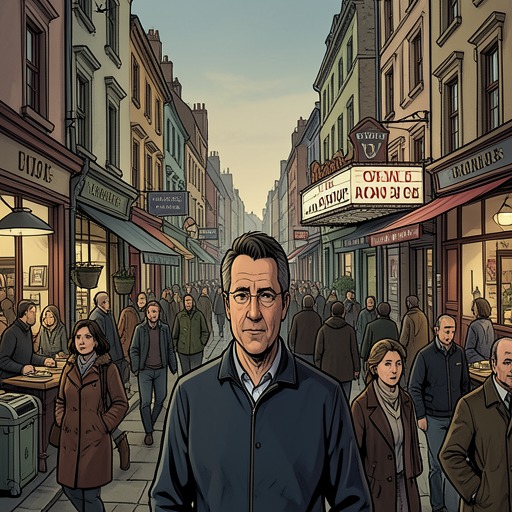
The club presents itself as a place of continual performance. Its auditorium has about sixty seats and a small stage; on the unnamed narrator’s visit, a singer performs amid drums, cymbals, changing lights, and a succession of chorus girls. The narrator sees a shabby room in the dark, while Housemartin appears content to watch the show. The performance gives the club a noisy, ordinary public face even as the narrator waits on business with Jay.
The audience includes middle-aged men gathered around the bar, and a cigarette seller moves among them offering cigarettes and souvenirs. As she sells the narrator a packet, she quietly tells him to go home because nothing can be gained there. Her warning is a brief, private interruption to the club’s routine, but the narrator does not leave; he watches her disappear into the audience and continues looking for Raven.
Rooms Above the Auditorium
The club’s upper floors lead away from the public spectacle. Jay goes upstairs by a staircase marked for club members, while the narrator waits below with Housemartin. After Housemartin excuses himself, the narrator climbs past a locked door and a staff-only entrance into a corridor lined with rooms. A manager’s office contains liquor, a large armchair, a studio couch, and a television; another room is a dressing room where chorus girls change costumes.
At the corridor’s end, the narrator finds a large, bare room with blocked windows and six armour-glass panels set into the floor. Through them he can see the gaming room beneath: a green baize table with cards, ashtrays, and gold-painted chairs, as well as a roulette wheel and the colored markings on the gaming table. From above, the glass offers a view of the players’ cards. The upper room thus functions as a concealed observation point, sharply contrasting with the crowded entertainment spaces below.
Raven and the Recovery Attempt
Looking through the glass, the narrator spots a pale man in a dark jacket and pin-striped trousers lying full length across the gaming table. He believes the man is Raven. Because he has not yet offered Jay a deal, the narrator understands that finding Raven leaves him with an immediate obligation to recover or seize him, whatever the exact terminology.
The narrator returns to the manager’s office, takes a heavy typewriter, and carries it to the observation room. Two chorus girls see him passing and mistake him for a returning reporter. A figure then enters the gaming room below: Housemartin, whose camel-hair coat now has a grease stain on its lapel. Housemartin lifts the limp Raven from the table and carries him out through a far door.
The narrator lets the typewriter fall through one of the large glass panels. It shatters the glass and strikes the roulette wheel before continuing down toward the floor. The narrator kicks at the broken edges, tears the seat of his trousers as he squeezes through, and drops onto the gaming table. The loudspeaker music stops, and a stripper runs upstairs shouting. The club’s hidden architecture has turned the narrator’s search into a conspicuous breach, while Housemartin has already carried Raven away from the room.
Narrative Significance
Barbarossa Club brings the novel’s espionage action into a space organized around watching and being watched. The narrator moves from a public audience, where entertainment and business mingle, to the hidden room from which unseen observers can inspect the gamblers below. His discovery of Raven depends on that elevated view, but the vantage point does not give him control: Housemartin can enter the gaming room and remove Raven before the narrator reaches him.
The club’s successive doors and floors make the search a physical progression from performance to surveillance and then to violent exposure. The narrator’s improvised use of the typewriter breaks through the barrier between the observation room and the gaming table, converting a concealed view into a public disturbance. Barbarossa Club is therefore not merely a meeting place; its layout shapes the recovery attempt, reveals the limits of the narrator’s position, and gives the episode its abrupt, disruptive turn.