British Military Intelligence
The IPCRESS FileBritish Military Intelligence is depicted as a security organization whose methods depend on secrecy, accumulated records, and the movement of information between people and agencies. Its history reaches back to wartime offices, while its postwar investigations expose a department trying to make patterns visible in a world where evidence is deliberately fragmented. The contrast between files that promise control and networks that evade them gives the organization both its authority and its vulnerability.
Wartime Headquarters and Later Work
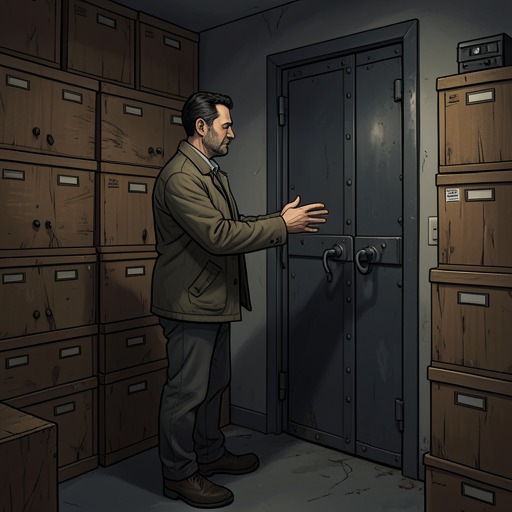
In 1939, British Military Intelligence used Wormwood Scrubs Prison as its headquarters after the prisoners had been evacuated. Former cells became offices, and each was locked when vacated as a security measure. When a bomb destroyed part of the building, the department moved to office accommodation in St James’s Street, where it remained until the end of the war. The change of premises preserves a practical image of the organization: even its working spaces were shaped by security requirements and wartime disruption.
In the later period, the department is associated with senior-level conferences and concerns that cross institutional boundaries. Dalby reports attending a Senior Intelligence Conference where the British Home Office was alarmed by the disappearance of leading biochemists. One scientist had left home at 7:45 in the morning and never reached the laboratory. The case belonged to another department, and Dalby says the British Home Office was not asking his organization for help; nevertheless, he saw the possibility that finding the missing man could weaken that department and bring its files into his own. The episode presents intelligence work as investigation joined to bureaucratic competition.
Files, Patterns, and the Limits of Analysis
After the Burgess and Maclean defections, the department assigned Carswell to conduct a statistical analysis with the Metropolitan Police missing-persons registry. Rather than begin with a chosen suspect or theory, Carswell first processed the figures and searched for patterns afterward. He and a sergeant clerk expanded the inquiry from missing-person records to combinations among high-level security clearances, using sorting machines to test for common features across groups that had few obvious occupational or geographical similarities. The method makes analysis appear both systematic and open-ended: patterns could emerge from data before investigators knew what they were looking for.
That openness did not make the findings safe to pursue. Carswell’s statistics began to expose the larger IPCRESS plot, and Ross arranged to hide him because he feared for Carswell’s safety. The department’s information system therefore produces an important reversal: the analytical work that makes a conspiracy legible also places the analyst at risk. Carswell’s disappearance from accessible records further shows how the protection of a person can become indistinguishable, to an outside investigator, from the loss of evidence.
Intelligence Networks and Compartmentalization
The department operates in a wider environment of overlapping information channels. C-SICH is described as the body through which information available in Great Britain is shared with appropriate branches; large commercial firms with industrial-espionage teams must also submit monthly reports to it. One such report assesses Jay’s income as substantial but irregular and drawn from diverse sources, rather than as regular payments from the Russian government. The detail shows how private commercial reporting can supplement official intelligence, while also making a person’s financial life part of a broader network of surveillance and assessment.
The narrative also stresses that intelligence depends on informal relationships as well as official channels. The narrator describes agents’ separate circles of friends as a kind of insurance: contacts made across national borders, occupations, and other loyalties may exchange implied messages without a formal arrangement or code. A practical example appears when two cablegrams reach the narrator through different routes. Grenade’s message signals that the narrator is in danger and points him toward funds in a Swiss bank account; Charlie Cavendish’s cable, sent under the name Artemidorus, carries a separate warning. The messages reveal a system in which relationships and oblique communication can move information beyond ordinary reporting structures.
Exposure and Institutional Vulnerability
The department’s own channels do not guarantee that information remains protected. Skip explains that material recovered from EW 192 is appearing verbatim in the files of the opposing side: discoveries made in American laboratories are being relayed across the world. The account identifies Room 192 in the East Wing of the Central Intelligence Agency as a suite handling intelligence gathered from highly restricted parts of foreign governments, making it an especially useful point from which to examine the loss of American information. This is a parallel intelligence problem rather than a British operation, but it clarifies the scale of the danger facing the department’s world: confidential findings can be copied before their owners understand how they escaped.
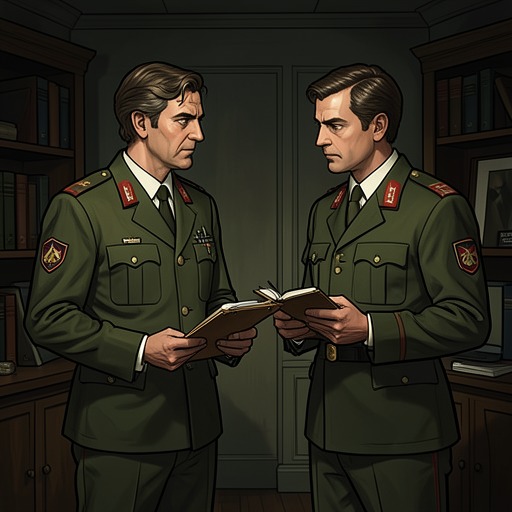
The most direct challenge to institutional trust comes when the narrator sees Dalby, K.K., and Jay together. Jay had been elusive, and his presence in conversation with the department’s head overturns the narrator’s assumption that the two sides were approaching the same conclusion independently. The encounter does not, by itself, explain every connection among them, but it places the department’s leadership inside the very network the narrator has been trying to understand. British Military Intelligence is thus presented not as an all-seeing authority but as an organization whose files, analyses, and security procedures remain vulnerable to concealed alliances and incomplete knowledge.