Carswell
The IPCRESS FileCarswell is a career soldier turned statistician whose patient, open-ended analysis turns bureaucratic records into a lead on the IPCRESS conspiracy. Introduced as a cautious, unassuming officer from H.38, he begins by looking for patterns without knowing what they might mean. His work gradually links senior security personnel, unusual illnesses, and residential clusters to the methods used for thought reform. The story makes his apparent eccentricity consequential: a man whom Unnamed narrator fears may be pursuing an obscure statistical hobby has, by coincidence and persistence, found evidence that others need to keep him safe.
Identity and Background
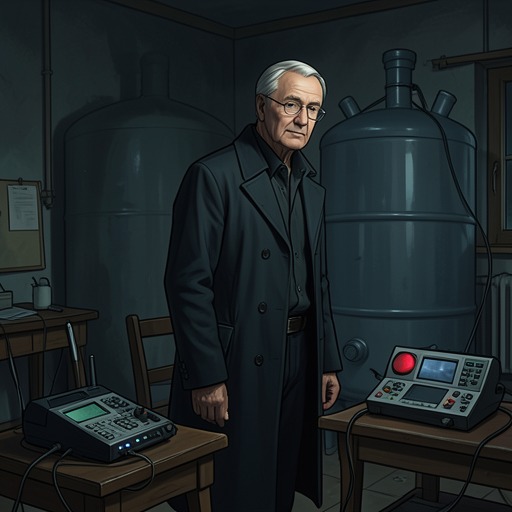
When Carswell first attends a meeting with Dalby, Unnamed narrator estimates him to be about fifty-three and either a captain or a major, with little prospect of further promotion. He has hair whitened by the Indian sun, gold spectacles, a cheap ready-made suit, and a regimental tie. His large hands remain on his briefcase as he waits to disclose the statistics he has brought from H.38. His careful manner and official, report-like speech initially make his account seem dry, but once he settles into it, his enthusiasm for the work becomes apparent.
Carswell’s army career is shaped by his father’s expectations. His father had required him to enter the regiment, and Carswell grew up amid the inherited world of polo, pig-sticking, punitive actions, horses, and mess dinners. After his father died, Carswell requested a posting as far away from that life as he could manage: the Indian Army Statistical Office in Calcutta. He had neither interest nor aptitude for statistics at first; he took the post as a quiet act of rebellion against the future laid out for him. His later discovery of a kind of freedom in abstract analysis therefore reverses the original purpose of the work: what began as a refuge from his father’s world becomes the skill by which he changes the course of the investigation.
From Records to Patterns
After the Burgess and Maclean affair, Carswell’s department was tasked with statistically analysing records in conjunction with the missing-person registry at the Yard. Rather than begin with a suspected culprit or a theory to confirm, he obtained permission to process the figures first and look for patterns afterward. He and a sergeant clerk ran records through sorting machines without a specific common feature in mind. Carswell generously credited the clerk, while Unnamed narrator suspected that Carswell himself had found a kind of musical freedom in working with abstract combinations.
The analysis moved away from missing-person figures and towards combinations among the highest security clearances. Dalby assigned Carswell to work with Unnamed narrator, who arranged a small private office for Carswell and Sergeant Murray. Carswell was promoted to temporary major and given a properly fitting suit; he and Murray worked from nine in the morning until six in the evening, then returned to their homes and wives in Fulham and Bromley. Their first apparent common factors included owning two cars, taking long holidays, visiting America, and travelling in North Africa. Carswell recognised that such patterns could arise simply because the people being compared had similar ages, incomes, and education, so the overlaps were not, by themselves, convincing evidence.
The more distinctive results came from groups of security personnel concentrated at particular places, which Carswell called Concens. Within these groups, there was an above-average presence of people who had belonged to political or quasi-political organisations, almost all with right-wing aims. Further characteristics included an unusually high number of people who had suffered a serious illness in the preceding five years, often a fever; no left-handed members; many bachelors; and a slightly elevated number of decorations for valour. Public-school backgrounds and divorced parents occurred at roughly average levels. Unnamed narrator wrote the profile on a sheet of paper and pinned it above his desk, making Carswell’s statistical portrait a visible part of the office before its significance was understood.
The Concens, Evacs, and the Limits of the Evidence
Carswell next examined senior officers who had experienced housebreaking or burglary, considering whether those incidents might have been connected with espionage. As the work expanded, he needed Murray’s help to establish whether the apparent patterns held up. The Concens no longer looked like isolated annual peaks: smaller groupings could be found across the period, forming a wave of varying height. The question became how far a concentration had to rise above average before it counted as abnormal.
The same analysis also identified places where the number of senior security personnel was unusually low. Carswell mapped these areas with green crosshatching, graded according to how far below average they fell. He called the areas Evacs and the individual officers temporarily outside them evacs. Unnamed narrator, who did not consider himself a statistician, thought the whole approach seemed foolish. Carswell was not someone he suspected of playing a practical joke, but the elaborate terminology and the housebreaking figures tested his patience. He began to wonder whether Carswell and Murray were leading him on or whether Carswell was trying to secure himself a niche in the army. This doubt matters to the investigation: Carswell’s conclusions initially lack the kind of direct proof that would make them easy for a man of action to accept.
Discovery of the IPCRESS Connection
Carswell’s results were still provisional when he returned with a brief extract, stressing that the evidence needed more work before it could be made genuinely convincing. He wanted Murray to handle calls and field enquiries, with permission to identify Murray as being from the Special Branch Metropolitan Police. Their proposed checks included hospitals, private nursing homes, and convalescent homes. Carswell was pursuing a statistical hunch, not presenting a finished case, and Unnamed narrator’s willingness to let the work continue was qualified by concern that the scheme might damage the department’s reputation.
The later explanation reveals why the statistical coincidences mattered. The fever rate among the Concens was high because fever was used as a physical debility in preparing people for brainwashing. The clusters Carswell had identified corresponded to people concentrated in private nursing homes, an alternative to the conspicuous haunted-house facilities: nursing homes required less construction and did not need to be converted back after the operation moved on. The victims were brought into the homes before fever was induced. Carswell had not set out to uncover that system; his data happened to expose a pattern produced by it. The conjunction of fever and predominantly right-wing political associations also proved relevant to the operation’s application of Communist thought reform.
Ross arranged for Carswell to be hidden as soon as the significance of the findings became apparent. That concealment explains why Unnamed narrator could find no trace of Carswell’s existence through Charlie at C-SICH: Ross feared for Carswell’s safety. Jean later points out that, if Jay remained silent, Carswell might be the only available guide to the extent of IPCRESS. The researcher once dismissed as a harmless eccentric had become a protected source whose records could help map an operation that its organisers had kept out of ordinary view.
Later Role and Significance
Carswell remained part of the effort to understand and contain the conspiracy. Painter, the psychiatrist who had helped return the captive Raven towards normalcy, was given a room with Carswell on the top floor at Charlotte Street. Unnamed narrator considered the two of them essential if Jay could not be made to disclose what he knew. Carswell’s presence there places his statistical work beside the treatment and recovery of a victim: the investigation depended both on interpreting the pattern and on dealing with the people caught within it.
At the final conference involving Carswell, Painter, Ross, and Unnamed narrator, the outcome was a new department working directly between Ross and Unnamed narrator. Jay was paid £160,000 to open it. Carswell is not given a separate final resolution, and the account does not specify his later position in the department. His decisive contribution is nevertheless clear. The investigation first treats his abstractions as possibly meaningless, then discovers that they describe the hidden infrastructure of IPCRESS. His trajectory turns a statistical method without a target into evidence of a system, while the delay between finding the pattern and understanding it preserves the story’s uncertainty about what data can prove—and how dangerous it can be to the person who finds it.