Dalby
The IPCRESS FileDalby is the powerful head of WOOC(P), a covert intelligence department reporting directly to the British Cabinet, and one of the narrator’s most consequential superiors. For much of the story he appears to be a capable, cultivated officer managing difficult investigations; the eventual revelation that he has been working with Jay recasts that authority as a means to conceal and advance a conspiracy. His skill is never in doubt, but the explanation for his betrayal remains unsettled: the narrator comes to suspect a pursuit of money and power rather than psychological manipulation.
Identity and Position
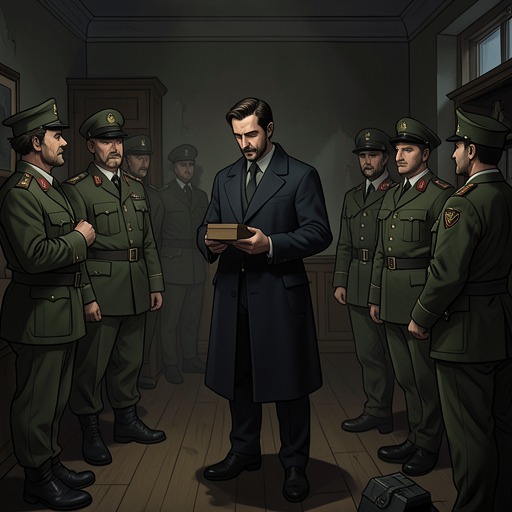
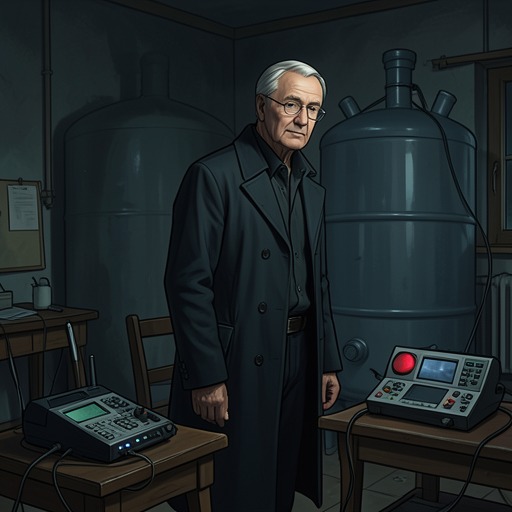
Dalby is described as an elegant, languid Englishman educated at a public school, tall and carefully dressed, with long fair hair and a small signet ring. His cultivated appearance is set against the modest, untidy office where he works: the furnishings are plain, the papers arranged in precise heaps, and the premises bear the sign of an inquiry bureau staffed by former police detectives. The contrast suits a man whose polished manner belongs to a world of privilege while his work takes place at the neglected edges of official intelligence.
His authority is exceptional. WOOC(P) reports directly to the British Cabinet, and its head is envied, criticized, and opposed by other intelligence organizations. Service in the department effectively removes personnel from ordinary Army life and from most War Office records; anyone returning to regular duty may be enlisted afresh under a new serial number and a different pay scale. The narrator’s transfer to Dalby’s organization is therefore more than a change of office: it places him inside a compartmented system where ordinary institutional visibility has been deliberately reduced.
Dalby’s wartime record helps explain his standing. A visit to a German university in 1938 left him with a small scar, but also proved useful experience; in 1941 he won the Distinguished Service Order and bar, an unusual distinction in his intelligence group. The narrator notes the absence of public citations, consistent with the secrecy surrounding Dalby’s work. His credentials are real, and so is the competence that makes his later deception credible.
Methods and Command
Dalby’s methods combine institutional discretion with an appetite for unconventional instruction. He argues that staff should visually study the people and practices of espionage so they can better anticipate an adversary’s thinking. To illustrate the idea, he invokes Montgomery’s knowledge of Rommel, though the narrator remains unconvinced by the example and points instead to the importance of material strength. The episode establishes both Dalby’s interest in training through images and his readiness to turn an anecdote into a working doctrine.
When senior biochemists begin disappearing, Dalby reports the crisis from a Senior Intelligence Conference. The British Home Office is alarmed, and committees have multiplied, but the practical urgency is conveyed by a fresh disappearance: a scientist left home at 7:45 in the morning and never reached the laboratory. Dalby brings the problem into the narrator’s department, where incomplete intelligence and competing responsibilities complicate the response.
Later, Dalby gives the narrator temporary control of the whole department, explaining that the arrangement should last about three months, perhaps less. The offer carries a mixture of trust and teasing: Dalby jokes that the narrator lacks a classical education and is not especially clever, while asserting that he can overcome those disadvantages. The appointment shows that Dalby is willing to delegate substantial authority and recognizes the narrator’s usefulness, even as his own motives remain hidden.
Dalby also intervenes in the department’s organization, approving expense sheets for Carswell and Sergeant Murray and directing that Carswell and his sergeant leave when the office becomes overcrowded. At this point these decisions appear to be routine management. In retrospect, they sit within a larger pattern of controlling access, personnel, and information while the scientific investigation develops.
The Narrator’s Assignment and Suspicion
Dalby brings the narrator into the next American nuclear test, telling him that the Minister wants them present. The US Defense Department claims it can jam seismographs and cause Russian readings to be doubled. Dalby says that a file exists on British scientists at the test; the narrator clarifies that it covers eighteen of the fifty Britons there, a total that includes eleven laboratory assistants. The assignment links the disappearance inquiry to a much larger contest over scientific intelligence and nuclear testing.
One evening the narrator enters his office expecting an intruder and finds Dalby there instead. Dalby pours him a drink, then asks whether he has ever seen a bomb explode before telling him that he is about to do so. He explains the request to attend the test and the intelligence file on the scientists. In the scene, Dalby appears to be bringing the narrator into a consequential operation. Its later context makes the invitation more troubling: the Tokwe test will become the setting for a staged incident designed to implicate the narrator.
Suspicion also gathers around the narrator himself. Jean tells him that one intelligence department believes he is working for the KGB and has reported the accusation directly to the Central Intelligence Agency. Dalby, she says, is not certain either way, though the Americans are inclined to believe it because the narrator killed two of their Navy personnel years earlier. Dalby is also unhappy that another department has granted the narrator a higher clearance than his own while he is working away from the office. His uncertainty and professional resentment make him appear compromised by a tangle of institutional rivalries, even before his own role is exposed.
Dalby later admits that the campaign against the narrator was deliberately extended. The first stage was meant to keep him under suspicion briefly; then a second stage was arranged to draw a high-ranking suspect into helping to destroy him. The narrator is told to continue appearing to suffer. Dalby’s disclosure presents him as an insider in the operation against the narrator, but also as someone who can reveal its design while still withholding the larger reason for it.
Collaboration with Jay and the Tokwe Frame
After the conspiracy comes into view, the narrator explains that Ross had partly guessed what was happening when he transferred him to WOOC(P). Ross placed Murray there to investigate. When the narrator nearly faced arrest at a strip club, Ross let Dalby know that he was suspected. The move was dangerous, but it prompted Dalby to perform an effective operation in Lebanon, apparently to prove his loyalty. Dalby’s actions there included shooting everyone in the car carrying Raven. How much this operation went against Jay’s wishes remains unknown, leaving the relationship between the two men marked by cooperation and possible conflict rather than a fully explained chain of command.
The Tokwe scheme shows how far Dalby’s operational skill served the conspiracy. A wooden device, about six feet long when assembled and fitted with a red automobile light at each end, was later produced by The Brigadier. Photographs of a battered motorcycle recovered from the sea helped the narrator recognize the mechanism: a plank had been bolted to the bike, making it resemble the lights he had followed across the island on the night he was arrested. The motorcycle’s small size kept it from registering on radar.
Dalby moved the device across the road and connected high-tension wires to kill the sole witness. He used the High-speed TV transmission unit, then threw it into the sea near the narrator’s car so that its discovery would appear to implicate him. Dalby took the motorcycle away by crossing open country after leaving the road and later dumped it off another part of the island. The misdirection extended beyond the physical evidence: two members of Jay’s network working for the United States Medical Department told the British authorities that the Americans were holding the narrator, while the Americans were told that the British had requested his return. Jay then took over and brought the narrator into the United Kingdom as a hospital case. Dalby’s plan thus depended on both mechanical concealment and confusion between agencies.
The narrator also identifies the intended purpose of the wider frame. Dalby and Jay needed a scapegoat to provide an apparent explanation for the kidnappings and clear the way for their new plan. Their arrangement was to have the narrator found with Raven and a hypodermic in his pocket during a police raid. The narrator’s impatience disrupted the timing before the setup could run as intended. The plan’s failure does not make its design less deliberate: Dalby was not merely managing an investigation but arranging evidence, location, and timing to make the narrator appear responsible.
Exposure, Death, and Narrative Significance
After the arrests, the narrator and Jean discuss the scale of the plot. The narrator says that Dalby had been working for the other side, while Ross had masterminded the operation that caught him. He also explains why Carswell’s statistics exposed the conspiracy: their initial significance was accidental, but Ross soon hid Carswell because he feared for his safety. By concealing him, Ross also made it impossible for the narrator to find a record of Carswell through Charlie at C-SICH. The surviving evidence could still make Carswell the only guide to the extent of IPCRESS if Jay remained silent.
Dalby’s end is reported in the aftermath of the investigation. On the day Jay is paid £160,000 to open a department working directly between Ross and the narrator, a Jensen 541S sports car leaves the Maidstone bypass at extreme speed. Dalby is its sole occupant, and his death is said to be instantaneous. The account establishes the crash and its timing but does not establish that it was arranged or explain what Dalby intended to do next.
The narrator later tells The Brigadier that brainwashing may not explain Dalby’s conduct. He suggests that people can be driven simply by money and power, and that a feud between Dalby and Jay may have been close to breaking out when the scheme collapsed. This remains an interpretation rather than a proven motive; the narrator explicitly says they are not sure whether Dalby was brainwashed. That uncertainty is central to Dalby’s role. His refined manner, official distinction, and evident ability never provide a reliable guide to allegiance. In a story about thought reform and engineered suspicion, he is at once a trusted authority, an accomplished conspirator, and a man whose final motives cannot be securely separated from the competing explanations around him.