Dalby's converted farmhouse
The IPCRESS FileDalby's converted farmhouse is a secluded domestic setting that becomes a place of concealed business and revelation. On the narrator’s first visit, its soft furnishings, firelit books, and drinks cabinet present an image of comfortable respectability; behind that surface, a hidden safe contains agent-payment files. When the narrator later watches through a window, the same room reveals Dalby in the company of Murray, K.K., and Jay, turning the house from a private retreat into evidence of a secret connection.
Setting and Approach
Dalby lives in a small stone house set well back from the road, approached by a short driveway. The narrator reaches it by taking the 283 toward Chiddingfold rather than the roads to Hindhead or Haslemere. Near a large, low Tudor-fronted inn, he signals with his headlights and receives an answering flash from a parked vehicle. Its black Ford Anglia has a spotlight on the roof; Waterman is following in it. The details establish the house’s distance from the main road while also showing that the approach is not beyond surveillance.
The visit takes place in darkness and continuing rain. The narrator backs his Austin partway up the driveway and leaves it unlocked, with the keys on the floor beneath the seat. Waterman parks on the far side of the road and stays in his car. At 6:59, the narrator listens for the seven o’clock news; Charlie Cavendish has still not been mentioned. He then walks up the path alone. The separation between the parked cars and the house gives the approach a measured, watchful quality: even before entering, the narrator is moving between the obligations of surveillance and the need to speak privately with Dalby.
Domestic Interior and Hidden Compartments
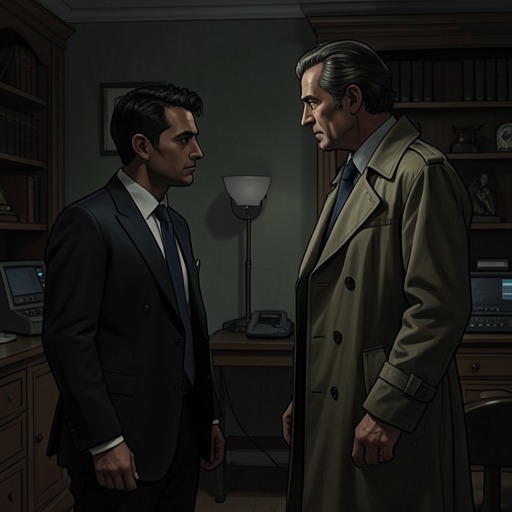
The farmhouse has been converted, and its interior is described as contemporary in the manner of women’s-magazine décor. Outside the mauve front door stands a flower-filled wheelbarrow; an electric coach lamp is fixed beside it but is unlit. The brass lion’s-head knocker offers a formal, almost theatrical point of entry. Dalby opens the door and attempts to register surprise, while the narrator notices the carefully composed public-school blandness of his expression.
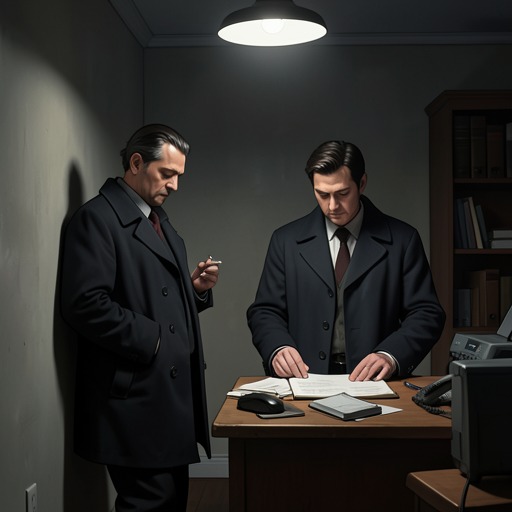
Inside, the narrator sits on a large, soft sofa with Go, Queen, and Tatler scattered across it. Two fruit-tree logs burn in the fireplace, filling the room with a smoky fragrance. Across from him is a huge bookcase whose old editions of Balzac, Irving, and Hugo catch the firelight. The arrangement makes the room seem settled and cultivated, but one of its most conspicuous pieces of furniture is not what it appears to be: the bookcase opens to reveal a cocktail cabinet, its mirrored glass reflecting labels from Charrington to Chartreuse. The hidden function is presented as a polished domestic trick, an apt counterpart to the less genteel concealment that will emerge later.
A separate concealment is built into the wall. During the visit, Dalby produces files from a wall safe hidden behind an abstract painting. They concern payments to agents working in South American countries. The house thus contains successive layers of access: a respectable room, furniture disguising a drinks cabinet, and a painting masking a safe. The narrator’s business with Dalby is not merely suggested by the setting; the files physically bring that business into the room.
The Visit and Its Business
The narrator says he must leave because he wants the office keys. Dalby instead insists that he stay for dinner, but the narrator declines and the two exchange polite conversation. Beneath the civility, the narrator remains uncertain: Charlie Cavendish is dead, yet Dalby either does not know this or does not want to discuss it. The unspoken death weighs on the meeting without becoming its subject. The narrator decides to leave the matter until they are at the office.
Dalby gives him the two files on the South American agents as well as the keys. The narrator promises to work something out for Dalby by ten the next morning at Charlotte Street. He leaves at 7:50 p.m., anxious to be away because Waterman is expected to come at an exact one-hour interval. Only after starting back down the driveway does he register how exposed he may be: before morning, he could be arrested on a murder charge. The thought sharpens the contrast between the house’s gracious interior and the danger waiting beyond it. Charlie’s name has not been spoken, and the practical exchange of files and keys proceeds amid a threat the participants do not resolve there.
Surveillance and Revelation
On a later approach, the narrator comes without lights, parks, and walks toward the house. It is dark; gaps in the curtains throw some light across the flower beds. Moving carefully among the plants and over the gravel, he reaches the window of the room where he had spoken with Dalby. The position reverses his earlier entrance: rather than sitting on the sofa as Dalby’s visitor, he is outside, watching the room through double glass.
Dalby is only a few feet away, pouring a drink from the disguised cabinet. Murray sits on the sofa and listens as Dalby talks. A third person, initially outside the narrator’s view, approaches the drinks cabinet. The narrator recognizes him as K.K., the same man associated with Waterman’s description of a contact. K.K.’s presence is already a shock, but the scene’s decisive change comes when Dalby and K.K. look toward another person and Jay enters the narrator’s line of sight. The narrator recognizes Jay after hours of screenings and previous sightings in Led’s, on the street, and in theatre clubs.
The window makes the farmhouse’s two roles impossible to separate. It is the setting of Dalby’s apparent hospitality and of the narrator’s formal work with him, but it also exposes Dalby meeting figures whom the narrator understands as adversaries or hidden players. Recalling Dalby’s earlier claim that they were moving toward the same conclusion from opposite ends, the narrator now sees how misleading that assurance was. The sight of Jay in the same room as the head of the department, and of K.K. beside them, turns the farmhouse into a crucial point in the narrator’s emerging picture of their connections. The house does not explain the whole conspiracy; it gives him the startling visual evidence that makes his previous assumptions untenable.