Discovery of neutron-bomb intelligence in the Japanese bunker
The IPCRESS FileThe discovery of neutron-bomb intelligence in a Japanese bunker on Tokwe converts a ruin left by the World War II Pacific theater into evidence of a live, technically sophisticated operation. Accompanied by Jean, the Unnamed narrator finds a hidden cache of modern equipment and a message that he can identify as referring to a neutron bomb, though he cannot read Russian. The scene’s force lies in the collision between the bunker’s abandoned military past and the fresh, carefully concealed objects inside it—and in the narrator’s decision to destroy only part of what he finds.
The bunker and the investigation
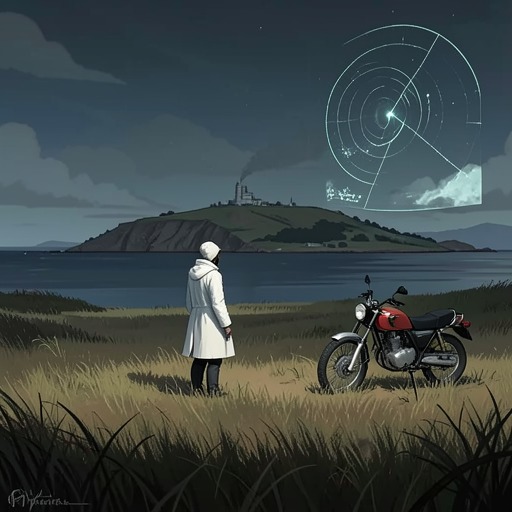
Jean wants to see the part of the site she missed the previous night. The two leave the road and cross a shoreline littered with wartime debris: rusted landing craft, one of them charred and its steel doors warped by heat. The defensive position is difficult to distinguish from the uneven terrain. The Unnamed narrator does not recognize the large blockhouse until he sees Jean standing in its doorway. Built from tree trunks with steel rails and patches of poor-quality cement, it has been worn by weather and overrun by vegetation. Its low entrance leads through a narrow passage into a cold, dark room.
Evidence that someone has recently entered the bunker is present before the hidden cache is found. Jean says she followed Dalby as far as the entanglement after he had told her to wait by the car. In the damp ground outside, the Unnamed narrator notices her shoeprints and Dalby’s deeper impressions, especially at the heel. Inside, Jean points out the firing position where she saw Dalby’s torch. His presence connects the decaying blockhouse to the current investigation, but the scene does not establish what he did there or what he knew.
A modern cache inside a wartime position
The room is crowded with olive-coloured metal boxes bearing faint English lettering, along with broken wooden boxes, cartridge clips and rotting leather straps. The Unnamed narrator moves the green boxes to climb onto the gun platform. On their undersides, protected while they were stacked, the paint remains fresh enough to show a stencil identifying a .5 machine-gun for the US Army, with a 1942 number. The old military markings and the damaged emplacement make the bunker appear to belong entirely to the past, until the search reaches the corner firing position.
There, beneath a crate marked with the name Harry Jacobson, a 1944 date and an Oakland address, lies a newer cardboard box. Its printed label advertises frozen cranberries, but the contents are anything but ordinary food: a new seven-inch cathode-ray tube, about a dozen transistors, a white envelope and a long-barrelled machine-pistol wrapped in a yellow duster and shining with fresh oil. The discrepancy between the mundane packaging and the weapon and electronics inside it makes concealment part of the evidence. The cache is not merely a forgotten relic; its components are modern and deliberately hidden in a place already crowded with military remnants.
The neutron-bomb message
The envelope contains a slip of paper about two inches by six, covered in roughly fifty words. The Unnamed narrator can make out a very-low-frequency radio wavelength, a compass bearing and mathematical symbols too advanced for him to interpret. Jean asks whether he can read Russian. He cannot, but recognizes the Russian script for neutron bomb. That limited recognition changes the meaning of the entire find: the otherwise obscure technical note concerns a weapon, while its wavelength and bearing suggest information linked to communications or location. The text does not give the narrator enough knowledge to decode the message, identify its sender or determine the equipment’s precise purpose.
The hidden cathode-ray tube and transistors sharpen the mystery without resolving it. Jean asks why anyone would carry a cathode-ray tube up there, but the discovery supplies no answer. The bunker’s old firing apertures, hidden position and recent traces of Dalby’s passage offer a setting in which the cache could be concealed, not proof of who placed it or how the items were meant to work together. The episode therefore reveals the existence of neutron-bomb intelligence while preserving uncertainty about the operation behind it.
What the narrator leaves behind
The Unnamed narrator handles the paper carefully by its edge, returns it to the cranberry box and burns the envelope, grinding the ash beneath his heel. He does not remove the note or the equipment. This partial destruction is consequential: he eliminates the envelope but leaves the message, weapon and electronic components where he found them. The action is not presented as a completed recovery or as an explanation of his motive. Instead, it closes the discovery with the material evidence still in the bunker and the narrator eager to leave.
The wider story gives the find a place in a crisis already marked by missing scientists and compromised technical secrets. Dalby has reported that eight senior figures have disappeared in six and a half weeks, while American intelligence later describes discoveries from its laboratories being relayed to the other side of the world almost verbatim. Separately, Carswell’s statistical analysis of missing persons and security-clearance patterns helps expose the larger plot; Ross hides him for his safety. These developments make the bunker’s neutron-bomb note part of a broader intelligence struggle, but they do not by themselves prove that the cache caused the disappearances or identify its custodians. Its narrative importance is the sudden, tangible arrival of a weapons secret inside an apparently abandoned wartime ruin: a few concealed objects make the island’s past an active part of its present.