Jay
The IPCRESS FileJay is an intelligence broker whose career crosses political regimes, national services, and private networks, making him both an elusive subject of investigation and the organizing mind behind the IPCRESS operation. His reported history explains his adaptability, but not a stable allegiance: he trades information and people for money, then attempts to make a network loyal to himself. Arrested when the conspiracy is exposed, he re-enters intelligence work under supervision, while the Unnamed narrator remains wary of treating him as a friend or a dependable intermediary.
Identity and Background
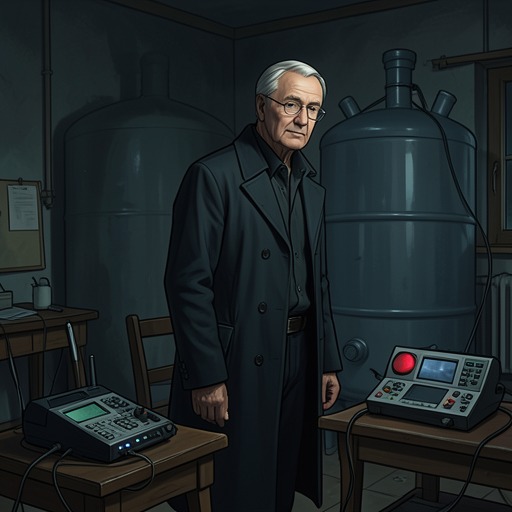
Jay is the code-name the Unnamed narrator gives the Minister when asked to describe his first meeting with him. The narrator explains that Jay’s code-name has been changed to Box Four, a small disclosure that captures the layers of naming and concealment surrounding him. The later file identifies him as Christian Stakowski, while his other identities include WOWC, Mr Aristo, Maximilian, and Eichelhauer, the German name by which he was known. The multiplicity is not merely a disguise for one operation: it accompanies a career repeatedly adjusted to the political order of the moment.
A green, high-security file gives the Unnamed narrator a fragmented account of Jay’s early intelligence work. Recruited into Polish Army Intelligence in London, Stakowski made two hazardous journeys into southern Poland; on the second, the planned air pick-up failed to make contact. He next appeared in Cairo and reported to the Polish Army, which awarded him the VM in December 1942. After returning to England, he completed an eight-month course at Horsham. By then, the Polish cells with which he had worked had been devastated. Polish counter-intelligence considered the possibility that he had made a deal with the German Abwehr, and a later letter pointed to a German investigative department as the common factor in arrests along his chain. The file presents suspicion and circumstantial pattern, not a definitive resolution of that wartime question.
A Career Across Changing Regimes
In September 1945, carrying papers as a Polish sergeant named WOWC, Stakowski returned to Poland among soldiers released from German prisoner-of-war camps. In Warsaw he obtained a junior secretarial post with the new Communist Government and reported to an intelligence outfit financed, unusually, by the Board of Trade. His reports concerned industrial espionage, especially the movement of German reparations production into Russia. By 1947 his reporting had dwindled. A file note suggested that the U.S. Central Intelligence Agency might have recruited him under an eight-year arrangement that promised agents a small pension and resettlement in the United States after eight years in the field; the surviving record, however, did not establish that this happened, and it showed no pay-offs from 1955 onward.
In 1950, still only the tenth secretary in a timber bureau and with little promotion, Jay used the pretext that he was under suspicion to flee to England on a passport obtained through his job. There he settled into the Right-wing Polish community as readily as he had entered the Communist Government in Poland. His ability to inhabit opposed political settings becomes the pattern by which the narrator later understands him: Jay survives changes of government by moving with the current rather than binding himself to one cause.
The file also contains intercepted calls from the U.S. Embassy, mostly concerning London merchant banks and the Common Market’s finances. Banking records add a more specific trail: two drafts for £1,000 each went to Maclean’s mother-in-law, followed by a £25,000 draft drawn on the Swiss Bank Corporation and deposited at the London and S. Hellenic Bank to Mr Aristo’s account. The narrator identifies Mr Aristo as Jay. The evidence does not make the payment itself illegal; instead, it supports the portrait of a man with a large income from varied and irregular sources. Jay presents himself as an import-export businessman, but information is his more valuable commodity.
The Network and the IPCRESS Operation
The investigation begins amid a wave of missing senior scientists. Dalby tells the Unnamed narrator that the British Home Office is alarmed by the disappearance of its top biochemists; the latest scientist left home at 7:45 in the morning and never reached the laboratory. Raven is one of the missing men. Dalby lays five passport photographs on his desk and counts eight high-ranking disappearances in six and a half weeks, while a security blackout keeps the case out of public view. At this stage Jay is not yet publicly connected to the disappearances, and the gap between the fragments of evidence is part of what makes him difficult to identify.
Carswell’s statistical work offers another route into the pattern. After the Burgess and Maclean affair, his department analyzed missing-person figures with the police registry, first processing the data without a predetermined theory. The inquiry broadened from missing people to combinations among high-level security clearances. Carswell’s method produced resemblances across otherwise dissimilar groups, rather than an obvious match within one occupation or location. Later, the Unnamed narrator explains that the appearance of the concens in these patterns was initially coincidence. Once the larger plot became apparent, Ross concealed Carswell for his safety; the narrator could find no trace of him through Charlie at C-SICH. Carswell’s analysis thus became valuable not because it immediately named Jay, but because it helped make a dispersed operation legible.
The U.S. information leak supplies a related example of the system’s reach. Skip Henderson explains that material returned from EW 192 is appearing verbatim in files, sometimes almost as soon as a discovery is made in a laboratory. The East Wing suite relays information obtained from highly placed sources in foreign governments, making it a means of testing the scale of the United States’ own losses. In the narrator’s later account, the central design is not simply to turn each person into an ordinary foreign agent. Jay intends for well-placed people to pass information through him and to be loyal to him personally. He knows enough about psychology to believe such an arrangement possible, and he anticipates that the discovery of it will make the opposing services suspicious of one another.
Character, Method, and Confrontation
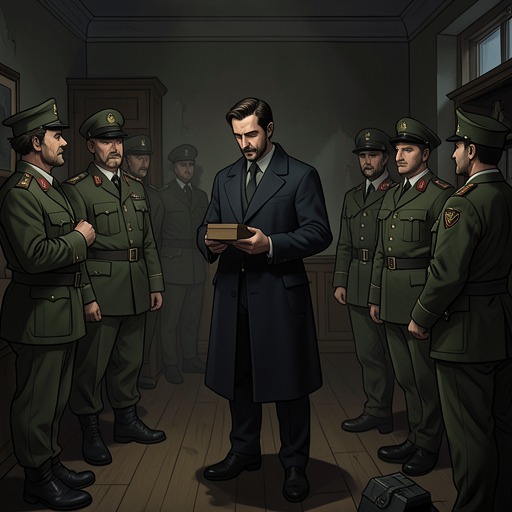
The Unnamed narrator finally sees Jay at Dalby’s house, where Jay is in the room with Dalby and K.K. The narrator recognizes him after the long succession of screenings and earlier sightings, and the shock is sharpened by the apparent intimacy of the scene: the elusive figure is talking with the head of the narrator’s department. It overturns the narrator’s assumption that Dalby and his side were approaching the same conclusion as Jay from opposite directions. Their connection is now visible, although its precise terms remain uncertain.
In a later conversation, Jay describes his business not as selling loyalty but as selling people, and characterizes his practice as arranging for talented men to change employment of their own free will. He rejects the Unnamed narrator’s comparison with Eichmann and offers Eichelhauer as the more apt name. The answer is revealing without making him a simple ideological servant: Jay frames his activity as recruitment and exchange, while his prior record suggests that payment, rather than a fixed political doctrine, has repeatedly shaped his choices. He also speaks of brainwashing as a weapon and argues for its possible use against people considered antisocial. He claims to have processed nearly 300 people and regards the practice as a major advance. The Unnamed narrator contests the assumption that a weapon is harmless merely because it does not cause conventional physical injury; their disagreement exposes the moral divide beneath Jay’s calm, administrative language.
When Ross and police arrive, Jay tells his housekeeper to show them up and to say that he is already in custody. The officers search him and take him to Carshalton. Before leaving, Jay has changed into a grey-green mohair suit and wears a nuclear-disarmament badge; seeing the Unnamed narrator notice it, he removes the badge and presses it into the narrator’s hand without explanation. His composed cooperation contrasts with the scale of the operation attributed to him. It does not, however, resolve why he gives himself up so readily. The narrator and Jean later consider whether Jay expected Dalby to rescue him despite the struggle between them, but the question remains open.
Arrest, Return to Work, and Significance
Jay’s arrest does not end his involvement in intelligence work. At a conference with Carswell, Painter, Ross, and the Unnamed narrator, it is agreed that Jay will be paid £160,000 to open a department working directly between Ross and the narrator. On the same Saturday, Dalby dies when his Jensen 541S leaves the Maidstone bypass at high speed. The timing gives Jay’s new arrangement a stark context: one central rival is dead, while Jay is converted from captured adversary into a monitored participant. The narrator also reports that Jay had been trying to sell him back to their side, but the evidence offers no simple account of what Jay expected to gain or how his negotiations with Dalby affected that effort.
The operation’s afterlife remains unsettled. Painter’s medical research team has found no way to reverse the effects of brainwashing. Some members of the original network remain under threat of prosecution under the Treason Act, while others continue sending reports in the belief that those reports are reaching a foreign power through Jay. The narrator therefore does not allow Jay to handle them, guarding against the possibility that he might resume control of the channel. Jay attends monthly meetings with Ross and the narrator to prepare Army Intelligence Memoranda Sheets and is described as efficient, but efficiency does not amount to trust.
Jay’s final relation to the narrator is expressed through a social invitation rather than a fresh confrontation. He asks the narrator and Jean to dinner, saying he will cook; the narrator would like to accept but decides against it, recalling that close friendship is unwise in this business. The decision echoes Jay’s own account of a world where people, loyalties, and information can be traded. Jay remains useful, sociable, and difficult to place, but the narrator never stops seeing the danger in letting him close. His role in the story rests on that unresolved tension: he is neither securely converted nor simply exposed and removed, but an intelligence professional whose survival depends on keeping every allegiance provisional.