KGB
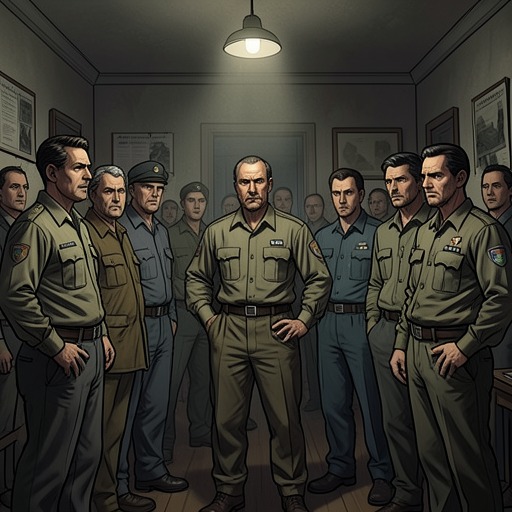
The IPCRESS FileThe KGB, expanded in the novel as the Committee on State Security, functions both as the name of the Soviet spy apparatus and as a suspicion that can reshape the Unnamed narrator’s position inside an already distrustful intelligence world. The story does not establish that the narrator works for the KGB; instead, it shows how an allegation, the possibility of Soviet intelligence access, and a final reference to SMERSH give the organization significance without making its operations directly visible.
Identity and Presentation
The novel identifies the KGB as the Soviet spy apparatus and gives its full name as the Committee on State Security. The Unnamed narrator refers to its six-storey building in Dzerzhinsky Street while reasoning about what a genuine Soviet agent would know: if he had been working for the KGB, he would have known who his contact was before arriving on the island. This reference makes the organization concrete as a point of comparison, but does not establish that the narrator has visited the building or had dealings with its personnel.
The KGB’s most explicit institutional connection appears in a note at the end of the narrative. The note identifies 19 Stanislavskaya Street in Moscow as a building occupied by SMERSH, described there as the KGB’s counter-intelligence unit. The text thus presents SMERSH as part of the KGB’s counter-intelligence structure, while offering no account of the unit’s activities in the main plot.
The Allegation Against the Unnamed Narrator
The KGB becomes an immediate threat to the Unnamed narrator when Jean reports that one department of The friends is convinced he works for the organization. That department has communicated its suspicion directly to the Central Intelligence Agency, and the accusation has angered people there. Jean says Dalby is uncertain whether the charge is true, but the Central Intelligence Agency is inclined to believe it because the narrator killed two of its Navy personnel long ago.
The accusation is therefore not presented as a confirmed intelligence finding. It is a judgment made within a network of agencies, where an old incident supplies grounds for suspicion and one institution’s view can influence another. The Unnamed narrator rejects the implication that Jean is his Soviet contact: he argues that a real KGB agent would know the identity of a contact before reaching the island, whereas he has no contact because he is not working for the KGB. His reasoning underlines the gap between being suspected and being shown to belong to the organization.
Intelligence Networks and Uncertain Evidence
The novel places the KGB within a wider world of concealed contacts, indirect messages, and information that travels across institutional and national boundaries. The Unnamed narrator describes spies as relying on several sets of friends and on tacit understandings rather than explicit arrangements. That account helps explain why suspicion can spread without a clear chain of proof, but the narrative does not identify this informal network as a KGB network.
A file examined by the narrator reports that Jay receives no regular payments from the Russian Government, while describing his income as very large, diverse, and irregular. This is evidence about Jay’s finances, not proof of either KGB employment or the absence of all Soviet connections. Elsewhere, Jay is the subject of a proposed purchase: Dalby instructs the narrator to obtain Raven from whoever holds him, authorizes an offer of £18,000 that may rise to £23,000, and requires payment after delivery into a Swiss bank, with Raven returned alive and unharmed. These dealings demonstrate the story’s intelligence market and its careful terms of exchange, but do not establish that Jay acts for the KGB.
The Closing Reference to Moscow
Near the end, a man tells the Unnamed narrator that he will be at number 19 if the narrator ever needs him. The narrator later drives back to London, while the old man who had jailed him at the house in Wood Green takes a plane to Prague. The accompanying note identifies number 19 as 19 Stanislavskaya Street, Moscow, and connects the building to SMERSH and the KGB. The scene frames the address as part of the narrator’s continuing network of possible protection or assistance, but it does not say that he accepts the offer, enters the building, or becomes an agent of the KGB.
The KGB’s narrative force lies in this unresolved distance between institution and allegation. It is named, defined, and linked to a specific counter-intelligence unit, yet the story withholds a direct account of its involvement in the narrator’s affairs. Its presence instead sharpens the novel’s central uncertainty: in a world of hidden contacts and competing judgments, an accusation can alter loyalties and danger before it has been proved.